Twenty-five years ago, I believed that anyone who didn’t like the Byrds
needed their head examined. I still believe that. It isn’t an issue anymore. The
Byrds are surely certain to endure without any ferocious special pleading from
me.” Thus began an essay included in the 4-CD Byrds box set issued by Columbia in 1990.
That the words were inscribed by Derek Taylor, a name known mostly to pop
historians for his driving role in the press offices of both the Beatles and the Byrds,
lends them added authority. Really, though, it doesn’t take those words to impart the
Byrds’ importance, with a capital “I.” Nor is it imperative that you run
out and snap up the remastered Byrds catalog, which Columbia/Legacy has been doling
out since last year.
|
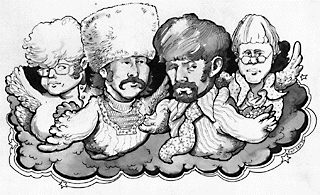
illustration by Nathan Jensen |
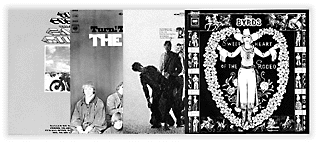
Rodeo, Dr. Byrds & Mr. Hyde, The Ballad of Easy Rider) are essential pieces
of the rock history puzzle, and Columbia has done an exemplary job of tweaking the
sonics and adding all the neat bonus cuts and groovy pix-n-fax reissue fans have
come to expect. But really, all that’s necessary to grok the Byrds’ importance is one
earful of a few notes: The Bach-inflected chime of Roger McGuinn’s 12-string
Rickenbacker guitar impersonating a cathedral belltower on the opening of “Mr.
Tambourine Man.”
This wasn’t a sound without precedent: McGuinn gained initial knowledge of
the Rickenbacker’s magical properties through the instrument’s cameo appearance
on the Beatles’ “A Hard Day’s Night.” By squashing the Rick’s signal into
a pair of tube compressors, McGuinn accidentally tapped into the breadth of that
guitar’s church-bell properties. The resultant sonic emissions were practically all
overtones, pure harmonic ring. It jacked straight into the adrenals, sounding for all
the world like one of the six ways God intended Man to play the electric guitar.
“It was a unique sound,” agrees Byrds bassist Chris Hillman
across a cellular connection as he drives back to his California home after a morning
surfing. “We weren’t emulating anybody, we didn’t know how! We weren’t
good enough. We tried to be the Beatles, but what came out was our own thing based around
Roger’s right hand — his finger-picking. And that’s the way it should be.”
McGuinn’s right hand aside, there was also the audacity of these five
rockers (McGuinn, Hillman, co-lead vocalist Gene Clark, rhythm guitarist/harmony
vocalist David Crosby, and drummer Michael Clarke), with their Moe Howard haircuts and
Cuban-heeled boots, jacking this noise into a Bob Dylan song. What’s more, it was
one of those war-and-peace Dylan epics the band had so little respect for as to chop
it down into a bite-sized chunk for AM teenybop consumption. Furthermore, this
was done in that six-month window prior to Dylan’s high-voltage desecration of the
Newport Folk Festival, wherein he found himself bored with his coffeehouse roots and
looking for a way back to his teenage rock & roll roots. The Beatles had whetted
these appetites within Dylan. It could be argued that the Byrds showed Dylan a
route to take.
Nothing was the same after “Mr. Tambourine Man.” Dylan plugged
in, the Beatles began jingle-jangling more, and pop songs started boasting
sophistication miles beyond “I Want To Hold Your Hand” — take, for instance,
“Satisfaction,” “Well-Respected Man,” “Sounds of Silence,” and
“Shapes of Things.” And thus began the Renaissance era of Sixties rock &
roll.
Still, warns McGuinn from his home in Orlando, Florida, “You have to
go back a little further than `Mr. Tambourine Man’ to get the essence of folk and
rock, the combinations and how they happen. It actually happened in New York, when I
was working with Bobby Darin at the Brill Building. My job was to write songs like the
ones that were on the radio, and Bobby stirred me into rock again, then the Beatles
came out and really influenced me. I started recognizing that the Beatles were using a
lot of folk music chord changes. I thought, `Well, what if I experiment with some
of these folk songs that I know.’ So, I actually put folk and rock together in
New York, before I came out to L.A. and the Byrds formed.”
“I was 19, 20 years old,” recalls Hillman, “and maybe not
as sophisticated as David and Roger at that time. I came from a small town and I’d been
playing bluegrass music, so it was a whole new world to come to Los Angeles and `play rock
& roll.’ None of us had that background, we didn’t start out in garage bands. We
literally had to learn how to plug into our amps and all that from scratch!”
“A lot of us were staying at a flophouse called the Padre
Hotel,” says McGuinn. “It was like $3 a night, over on Cahuenga Blvd. We’d have to
take the bus down to where we were rehearsing, which was over on Melrose. I remember
sitting at the bus stop and the rednecks would come by and go, `Hey, Ringo! Yer
barber die?’ We got a lot of verbal abuse from the citizens of Los Angeles at that point.
We’d get to the rehearsal, and we’d rehearse every day. At night, we’d go to World
Pacific Studios and work out with the tape machines. That was pretty much our
lifestyle. We worked out in the studio, and at the house Chris was staying at. The
police would come almost every night, because we would be making too much noise. It was
pretty wild!”
“It was a struggle,” adds Hillman. “We were trying to get
by as best we could. A lot of times, we were getting hired to play on surf demos by
this guy — Jimmy somebody, I can’t remember his name. But he would hire us to
play demos on bad surf songs. We would get $10 a piece, which in 1964 would feed you for
two days.”
Every one of these experiences, says Hillman, “would synthesize who
we were, what we were, what we did. Every night, we would go into World Pacific
Studios, and by trial, by error, we learned how to play. And like I said, we developed our
sound around Roger’s right hand.”
Though the ripples that hand sent through rock & roll were immediate,
the Byrds’ success was never entirely sweet in taste. McGuinn told Rolling
Stone‘s David Fricke in 1990 he first heard “Mr. Tambourine Man” coming
from a car radio passing him as he walked down the Sunset Strip. His immediate
reaction was, “`There’s something wrong here.’ I didn’t have any money, I was
living in this cheap little apartment, I didn’t have a car, and there goes this car
with our song on the radio.”
Although the Byrds would become a household name soon after the success of
“Mr. Tambourine Man,” they were never consistent in the hit singles
department. The band’s follow-up, another Dylan-penned jingle-jangle, “All I Really Want
to Do,” gets plenty of oldies radio play these days, but back then it was
outsold and outplayed by Cher’s competing version. It wouldn’t be until December 1965
that the Byrds would regain their commercial stride with Pete Seeger’s “Turn!
Turn! Turn!” Things looked promising in March of ’66 with the groundbreaking
“Eight Miles High,” which fused John Coltrane and Ravi Shankar’s sensibilities,
until the industry tipsheet The Gavin Report mistakenly warned that this
chronicle of the Byrds’ beleaguered ’65 British tour was about drug use. They didn’t
have another hit until well into 1967 with the cynical “So You Want to Be a Rock `n’
Roll Star,” but it would take another three years before the group followed
that with “Chestnut Mare,” by which point only McGuinn survived of the
original quintet.
The fact that the Byrds evolved at an amazing rate across the space of
three years — more drastically than similarly evolving contemporaries like the Beatles
and Stones — may have baffled a pop marketplace just getting used to jingling and
jangling. “I suppose we would have been more successful if we had kept the old
`Mr. Tambourine Man’ sound going a little bit longer,” McGuinn reflects. “But that
just wasn’t in the cards. We were making a conscious effort to pop out of one box
and into another. We didn’t wanna be in a box, so we’d invent a new form, then
they’d put a box around it. Then we’d move on to something else, and we kept doing
it until we ran out of places to go. Or people to do it with.
“There was something in the air. I think everybody was having that
kind of creative surge. The Beatles were fueling it, the Stones and the whole British
Invasion scene, then the bands in America were reacting to that. It was a game of
catch-up, and it was a very exciting time for music. Also, we were all friends and used
to send ideas back and forth. Or some of us might be inspired by certain licks
on albums and write new songs from them.”
Hillman notes one under-recognized weapon in the Byrds’ original arsenal:
Gene Clark, who composed some of the early band’s strongest non-Dylan material.
“I don’t think I appreciated Gene Clark as a songwriter until the last two
years,” says Hillman. “He was awesome! He was heads above us!
Roger wrote some great songs then, but Gene was coming up with lyrics that were way
beyond what he was. He wasn’t a well-read man in that sense, but he would come up with
these beautiful phrases. A very poetic man — very, very productive. He would write
two or three great songs a week.
“Last weekend, I played this little club in L.A. and I did `Feel a
Whole Lot Better.’ And I said to the audience, `You know what makes this song so
special? It’s the inclusion of the word “probably.”‘ Think about it: `I’ll
probably feel a whole lot better when you’re gone.’ Here he is, talking about
splitting up with this girl and all that, and here’s this interesting twist in the lyrics.
As opposed to, `Yeah, I’m going to feel a whole lot better,’ there’s this
little bit of doubt. That’s pretty sophisticated stuff for a 20-year-old kid to
write. `The World Turns All Around Her,’ `She Don’t Care About Time’…at the time, I
didn’t realize how deep those songs were!”
“Gene left in ’66,” McGuinn recollects. “He was scared of
airplanes, and didn’t want to fly anymore. He panicked on a plane, had to get off, and
that was it. Also, I think he had aspirations of being a solo artist, and he was
being set up by our management team, who wanted to single him out and make him an
Elvis-type figure. So, there was more to it than met the eye at the airport that
day.” McGuinn lets fly another dry chuckle. “There was an underlying, sinister
motive: `We can just take Gene, make him an Elvis, and we won’t have to deal with the
rest of these guys!'”
Despite the band hanging in there long enough to issue two strong albums
in ’67, Younger Than Yesterday and The Notorious Byrd Brothers, they
were slowly fragmenting behind the scenes. Crosby, for one, somehow got it into his head
he was as good a songwriter as he was a harmony singer, as ridiculous a notion as
the ponchos he wore onstage in the Byrds’ vintage period, or the trendy peace-n-luv
Frisco rhetoric he embraced more heartily than either McGuinn or Hillman. One can hear the
tension manifest itself in the 10 minutes of verbal warfare tacked onto the new
edition of Byrd Brothers: Clarke has difficulty negotiating the rhythms of
“Dolphins Smile,” and Crosby’s nagging-wife approach to coaching the drummer ain’t
helping. McGuinn chimes in with some well-placed barbs about Crosby’s rampant
egomania, and soon the three non-drumming Byrds are chiding Clarke as producer Gary Usher
attempts to redirect the proceedings. Crosby would be fired mid-album, while Clarke
would walk out one month later.
For many, the last truly remarkable Byrds’ album was 1968’s Sweetheart
of the Rodeo, in which the band’s trademark jingle-jangle was ditched for the
first high-profile blend of Nashvillian and long-haired sensibilities, mostly at
the behest of hired hand Gram Parsons. Although initially damned by both the country and
rock establishments (which didn’t intermingle then), the album was to become a
benchmark for non-cowboy country — from the Seventies California cocaine twang of the
Eagles and Linda Rondstadt to the latter-day alternative set. Hillman, surprisingly,
has reservations, most of them named Gram Parsons.
“I’d have to agree with Roger that Gram certainly used the Byrds as a
stepping stone,” says Hillman. “He was only with us a few months and he was
just a salaried sideman. People think Gram was a Byrd. No, he was on salary with
my cousin [drummer Kevin Kelley], because Roger and I were trying to keep this thing
afloat. Not to downplay him. Gram was great, but it’s like Roger said: `We didn’t
know he would turn into a monster in a sequined suit!’ Then I had to deal with him
for two years in the Flying Burrito Brothers, and he turned into a bigger monster in a sequined suit! We had to fire him — he got way outta hand. Gram was
seduced by the trappings, all the flashy things that kids want out of music, and he
wanted them before he’d earned them. He wanted the limousine, and the minute he met
Mick Jagger through us when we were in England, that was it. He wanted to be Mick
Jagger. It was all downhill from there.”
“Nashville is a very tough market to crack,” notes McGuinn,
“even if you were born in the South and done country music all your life. I
remember I had a manager once who managed Vern Gosdin, and he said, `Why don’t you move
to Nashville?’ I said, `Well, what’s in it for me? What’s the advantage in that?’ He said,
`Well, there’s a lot of good songwriters here, and if you stayed around town eight
or 10 years, maybe they’d accept you!'” No wonder the band’s appearance on the
fabled Grand Ole Opry was met with what David Fricke describes in his
Sweetheart reissue liner notes as “chilly, muted applause.” Hillman says the
only friendly face in the Rhyman Auditorium that evening was Skeeter Davis’. Years
later, when Hillman returned to the Opry with the Desert Rose Band, they were
reunited. Davis remembered: “They were just a little scared of you,” she told
Hillman.
Not long after the recording of Sweetheart, Parsons flew the Byrd
coop at the behest of Keith Richards on the eve of an abortive South African tour.
Hillman handed in his own notice after the trek, joining Parsons in the very
Sweetheart-ish Burritos. Clarifying his earlier statements, Hillman notes, “Gram and I
had a very close relationship, and as much as I respect him, he wasn’t always the
most ethical guy to work with. Unfortunately, I was also used as a stepping stone
for him. It doesn’t matter, I had some good times, I had some bad times with him,
and I wrote some great songs with him.”
McGuinn, for his part, would regroup the Byrds with guitar genius Clarence
White and bridge the Sixties and Seventies with a lineup that he feels “were a
strong live act, but we couldn’t always translate that onstage fire in the
studio.” Indeed, Byrds albums to follow Sweetheart were patchy affairs, with
scattered gems like “Chestnut Mare” and “This Wheel’s on Fire”
being standouts. The original quintet attempted a reconciliation on a 1973 album that no one
particularly wants to claim, and McGuinn, Clark, and Hillman even made a handful of albums
together in the late Seventies. Looking for all the world like the Cowardly Lion,
Crosby’s post-Byrds life has been well-documented, while both Clark and Clarke
remained active up to their respective deaths in the early Nineties, both of cirrhosis of the
liver. (A recent Gene Clark retrospective, This Byrd Has Flown, is available
on Monster Music.)
And what of our two interviewees? McGuinn has toured for several years,
doing a primarily acoustic show charting his progress from rockabilly through folk
rock to the present. Now that he’s documented it on his Live From Mars CD,
he jokes that it’s time to work up a new set. Also, concerned that traditional folk
music’s heritage is being lost in an era when folk artists are expected to generate
their own material, McGuinn curates a web-accessible digital archive called
“The Folk Den,” where anyone can download a newly-recorded folk standard complete
with chord diagrams and annotation. A new song is furnished each month. Hillman,
in the meantime, has spent the four years since retiring his Desert Rose Band
cutting albums like a bluegrass one with the Rice Brothers, as well as a hard,
Bakersfield-tinged country disc executed with ex-Dillard Herb Pedersen.
As for the Byrds’ legacy, it’s everywhere. It rings through virtually
anything by Tom Petty, and anyone from R.E.M. to the Dream Syndicate would be
unthinkable without the Byrds. Even artists as abrasive surfacewise as Bob Mould
doubtlessly light a candle for the Byrds each night. You can hear the jingle-jangle
straining to burst free from Mould’s usual bombast, and Hüsker Dü’s 1984 take
of “Eight Miles High” made the debt explicit. Jingle-jangle is a
standard component of the pop vocabulary, and it’s unthinkable without the Byrds. The
charts rarely acknowledged this while the band was in its hey-day, but history
has.
One final snapshot, courtesy of Chris Hillman:
“The best thing — and I want you to remember this — was that the
five of us sat down together at our Rock & Roll Hall of Fame induction [January
16, 1991]. We sat at the same table, we got along well, and we played together. And I
don’t know many groups that get up and play together after being inducted. I know
the horrible Credence Clearwater story where John Fogerty wouldn’t let Stu Cook and Doug
Clifford get on the stage with him. But I gotta say, at least we shared that one
moment that we earned.”
This article appears in June 27 • 1997 and June 27 • 1997 (Cover).