

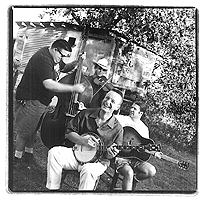
 L-R: Mark Rubin, Ralph White, Danny Barnes, and Bob Grant photograph by George Brainard |
the date: It’s Valentine’s Day. It’s almost too tempting not to take this opportunity to
picture the experiences of the lucky (albeit fictitious) winner of this august
journal’s “Win a Date with the Bad Livers” contest.
“Oh!” enthuses “the loud guy with the tattoos,” upright bassist/tuba player
Mark Rubin. “That means they get breakfast, lunch, and dinner at the UniCal
Union at highway 76 and I-10! That’s a heck of a deal!”
“We’d wake up real early,” intones his quieter partner, banjo daemon Danny
Barnes, “make a pot of coffee and jam.”
“We’d drive far off in the country,” Rubin continues, “meet a buncha nice old
people, and play music all day.”
“And if it’s Tuesday,” Barnes breaks in, picking up the thread, “we’d drive
back in time for the Texas Old-Time Fiddler’s Jam at Artz.”
It’s tempting to take that tack, even though we shouldn’t. For while we’ve
just now gathered a lot of information about the Livers, their driving
interests and motivations — their relentless, almost obsessive devotion and
immersion in pure music-making — this facetious journalistic device is
almost as confining as that ancient bugaboo of, “Oh, yeah! They’re those freaky
punk rock refugees who picked up acoustic instruments and play goofy,
high-speed Iggy Pop and Motorhead bluegrass covers.” And if anyone gets the
itch from reading this piece to purchase the Livers’ brand-new Hogs on the
Highway CD (their first for stalwart traditional music specialists Sugar
Hill Records), they’d find “bluegrass” just as confining and unnecessary a
slot.
“The band has sorta become a vehicle for the compositions we produce,” Barnes
muses over a cup of good, strong Kerbey Lane coffee. (Rubin opts for a cup of
coffee with a shot of espresso — what he calls “the Danny Barnes
`I-need-to-drive-all-night-to-get-to-the-next-gig’ special.”) “I think I have
41 compositions that I’ve published now, all of which have been recorded by the
Bad Livers. And we’ve created a vision — sort of a form, if you will.
“You know how, say, punk rock is a culmination of forms — plus some sort of
fly-by-the-seat-of-the-pants creativity thrown in? You can look at it and see
the Fifties part of it, the Sixties part of it, and then what was going on at
the time. You’d just throw all this stuff in a pot and create this thing. And
ultimately, the best examples of that tend to transcend even their form. For
instance, if you’re a real music fan, when you hear something that’s real, real
good, it doesn’t matter what the form is. You can appreciate it. Like me, I
don’t really know very much about classical music. But sometimes when I hear a
certain piece, it really moves me. I feel the same way about rhythm &
blues. Certain things just speak to you beyond their forms.
“We’ve created our own form. It’s a sound, and a culmination of sounds that
doesn’t really exist in any other band. And we’ve created this through a lot of
sweat and blood, hacking it out on the road. Really, the compositions are sorta
what we’ve decided we’re going into. They’re the vanishing point, where we can
see all this stuff going in to. And if you listen to the CD, we’ve created our
own form.
“There’s a lotta things that sit side-by-side in our universe that you just
don’t find on other people’s records. This is something that we have to
contribute to the betterment of the universe that no one else has, so we’re
pursuing this with everything that we have. Ultimately — hopefully — our
music will transcend even the form that we’ve created. I think we have, because
we’ve got a real cross-section of fans: For instance, we have the rock &
roll folks that really like our music, as well as a lot of really old people
that like our music. We have people from all these different walks of life that
really enjoy what we’re doing. So, I think we’re being successful at that.”
Rubin hammers home that the Livers have arrived at this form through “an
organic process,” chipping away at their music like a sculpture, eliminating
certain elements (the “goofy” punk rock covers), maybe adding others. And it’s
all been done simply through the process of touring, playing shows — just
doing it. And the evolutionary process has certainly been audible
through the course of the Bad Livers’ discography.
After their first single — a rollicking Bill Monroe-on-crystal-meth romp
through Iggy Pop’s “Lust For Life” — said hello to the world beyond the Monday
night rowdies gathered at the Saxon Pub, they released a Paul Leary-produced
gem called Delusions Of Banjer. It offered no evidence of the
Liver’s original bluegrass-via-punk repute, save for their interpretation of
the Butthole Surfers’ “The Adventures of Pee Pee the Sailor.” Two years later
came Horses In the Mines, even thicker with Barnes’ originals and
boasting a production job more authentically Library of Congress than Leary’s
hi-fi treatment on Banjer.
The new one, Hogs on the Highway sits somewhere comfortably between the
two previous full-lengths. The point of the band (and the album) is those
Edward D. Barnes compositions (or else those by “Trad., arr. Edward D. Barnes,”
whom Rubin calls his “favorite songwriter, next to Pub. Domain”). The
production is more crystalline and three-dimensional than ever, cut for the
most part at Barnes’ own Minner Bucket Studios and showcasing those originals
and the attendant hot picking to better-than-ever effect.
Yet both Barnes and Rubin emphasize that it took a long journey through the
spiritual night just to arrive at the point of Hogs. One of the main
reasons you haven’t held a fresh Liver platter in your hands until this moment
is because “We had to figure out what our goals were.” All the goals the band
had set for themselves had been met: They were able to tour internationally to
an assured audience; they could sell albums; and they were on the Touch &
Go label, which is the ultimate goal for many musicians in the indie-punk
world, thanks to a) the sheer number of quality acts Touch & Go has given
the world — Didjits, Butthole Surfers, Jesus Lizard, just to name a few — and
b) the humane, honest treatment the label provides, which has enabled it to
build such a strong artist roster.
The Livers have even had testimonials from a plethora of musical luminaries,
such as members of the Old 97s, who say the local trio are directly responsible
for hipping them to country music, traditional music, and the phantom power and
spiritual benefits inherent in playing without electricity. It’s apparently
become a standard post-show ritual for the Bad Livers to be approached by at
least one person and told that they were the inspiration for the testifier to
sell his original Misfits vinyl and all manner of other punk rock rarities, buy
a dobro with the profits, and pursue a more traditional (though slightly
warped) musical path.
Thus, to find new goals, change was necessary. And as anyone with sense can
attest, change often comes with some attendant pain and sacrificial bloodshed.
It was not the easiest thing in the world for the Bad Livers to make the switch
from Touch & Go to Sugar Hill, which had been courting the band for seven
years. “I’ve had [owner] Barry Poss’ business card since our first SXSW
showcase,” says Rubin.
“I wanna say something about Touch & Go and [T&G chief] Corey Rusk,”
says Barnes. “That’s one of the coolest guys. The label is run by the nicest
bunch of people, and it was all positive. We’re still in business on these old
records, and they’re still selling, and we get statements from them.”
“So, when you say we’ve left the label, that really isn’t true,” says Rubin.
“Our next record isn’t on that label, but we’re still very much a part of
them.”
“But the main point is,” emphasizes Barnes, “Sugar Hill has experience selling
banjo records. Touch & Go doesn’t. It’s like when Evan Johns put out that
record on Alternative Tentacles. It’s a great record, and that’s a great label.
But there’s only so much that they’re gonna be able to do with it. What really
gave us our legs was that Corey Rusk let us do whatever the hell we wanted to
do. So we were kind of allowed to develop on our own, and that’s a great thing.
But ultimately, what we’re playing is traditional music. No matter how you want
to look at it, it’s got banjos and fiddles and accordions and bajo
sextos and bass fiddles. It’s basically traditional music. So we went with
the best label in the world for acoustic music.”
“Talk to anybody at any label,” says Rubin. “When you talk about new acoustic
music and bluegrass music and progressive bluegrass music, there is not a
finer label working!” Also in Sugar Hill’s favor is the fact that the label
has, over time, signed some of the Lone Star state’s finer, edgier
singer-songwriters, including Terry Allen, James McMurtry, and the late Townes
Van Zandt.
“It’s like Mark says,” adds Barnes. “They’re the Touch & Go of
bluegrass.”
“They are!” enthuses Rubin. “Think of all the bands out there! Being on Touch
& Go would be the apex of their entire career! They would have put
out their own records, or been on a smaller independent, then it would be,” he
gasps for dramatic emphasis, “`We’re on Touch & Go!’ And that would
be the apex of their career! Only a major, beyond that. For us, we were there.
We were Grandfather Hip! We were like, `Well, we’re there already!’ And
everybody there are these huge, freaked-out fans. They sold our records for us,
not because of their great distribution system, but because they were so into
the Bad Livers. But our records are filed under `punk rock’ everywhere. So
we’re missing out on fans who are predisposed to acoustic music. The only way
we were able to get to those people was to go out and say hello to them in
person.”
“Another thing that’s important to note here,” says Barnes, “is that our
audience has gotten more educated. Like the people coming to see our shows six,
seven years ago, they were asking, `Where can I get these records?’ Now they’ve
got them. They’re now more educated about this music than they were
originally.”
Now, after working out an agreement with Sugar Hill over the course of six
months’ careful negotiations, the Bad Livers are happy. “It was an important
thing, because we wanted to be on a label that can sell banjo records,”
explains Barnes. “Part of growth is — let’s be honest here — that we want to
sell more records this time than we did last time. We did better last time than
we ever thought we could have possibly done. That’s great, but we’ve got new
dreams, now. It took several years, but we’ve got ’em.”
Unfortunately, the new dreams of Barnes and Rubin were not shared by the Bad
Livers’ third founding member, Ralph White III. Hogs is concurrently the
last Bad Livers album to feature White’s fiddle, button accordion, and
mbira, as well as the first to feature the mandolin and acoustic guitar
of his replacement, New Yorker (and former Austinite) Bob Grant. Ask Barnes or
Rubin why White left, and depending on the circumstances, you’ll get all sorts
of answers.
Belligerent drunks at gigs who approach Barnes with hostility over the issue
get the polite explanation that “he got tired of dealing with all the drunken
people talking to him after gigs when he’s trying to wrap up his cords.” (“One
lady told me, `Oh! I thought that would be the best part, dealing with the
public!'” grins Barnes.) Rubin likes to joke that the Livers cut into White’s
“kayakking time.” But the reality is, as Barnes tells it, “One day I woke up in
a hotel, and Ralph rolls up out of bed and he looks up at me, and he indicated
that he was about ready to go to the [nut] house. After 1,500-some-odd shows, I
can’t say that I blame him, because it’s really tough. It’s not easy trying to
deal with the business.”
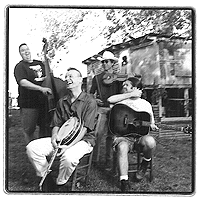 L-R: Mark Rubin, Ralph White, Danny Barnes, and Bob Grant photograph by George Brainard |
you got involved in music in the first place.”
“I think as time went on, Mark and I were becoming more and more encouraged
and willing to put more and more time into it, and more and more eager to see
what our rewards might possibly be,” continues Barnes. “Conversely, Ralph was
becoming less and less interested in touring and putting out records. The band
grew into a touring and recording entity. Ralph enjoyed the gigs, but he didn’t
enjoy the part in between the gigs. You only get to play about 45 minutes, then
you have about 23 hours of basic crap to deal with. I looked at him and
realized, `We’re gonna have to do something here. Will we be able to go on?’ I
mean, what do you do when Paul Weller no longer wants to be in the Jam? We
started it with him, and that’s what the band has been for 1,500 gigs, two CDs,
and a cassette. We were quite concerned and we were pretty much considering
throwing in the towel.”
They didn’t. Rubin and Barnes instead parted amicably with White, then put in
the call to Grant, who was a Bad Liver for a series of gigs in 1994 before they
realized that expenses precluded the Bad Livers morphing into a quartet. The
difference between Grant’s and White’s instrumental specialities means the
Livers’ instrumental flavoring has changed, with White’s predominant fiddle
contributions now supplanted by Grant’s flatpicking. (Grant’s ponytail also
chafes against the perfectly geometric 1959 George Jones crewcuts his bandmates
now favor, but neither Barnes not Rubin wished to incur the wrath of either
Grant or his girlfriend by enforcing a dress code.)
Still, as Barnes puts it, Grant “can just flat-out pick!” He has a
musical degree from The Berklee School of Music and an apparent Brian
Jones-style ability to pick up an alien instrument and figure it out in a short
amount of time. (They recently handed Grant a tenor banjo shortly before a gig,
and claim he wailed on it.) Barnes also surmises he should be able to mold
Grant into exactly the sort of player his originals need.
There, in a nutshell, is the state of the Bad Livers’ union, 1997. They have a
new home with an organization better adjusted to their unique phantom overtones
and caffeinated drive. They’ve lost a fiddle, but Barnes has gained a new
roommate on the road. (“I snore real bad,” smirks Rubin, “and I’m a real night
owl.”) White, meantime, can catch up on his kayakking, and possibly make the
album Rubin and Barnes believe White has in him. (He’s been working lately with
Los Pinkys’ Bradley Jaye Williams in the Gulf Coast Playboys and reportedly has
several excellent songs in him.)
The retooled Bad Livers, meantime, feel free to “go into the future” and
pursue the “spiritual quality” which they see as the defining element of their
unique hybrid. “All the old guys I learned to play from,” says Barnes, “never
played in a bar, never had a record deal, never went on tour. Yet they get more
joy, more spiritual dividends from playing than any band I’ve seen outside of
maybe Toots & the Maytals.”
“Ever notice,” adds Rubin, “that in reggae, they never use negatives? You will
never hear `no,’ or `down,’ or any other related words or concepts.”
And somewhere amongst the odd phantom overtones and pogo drive the Bad Livers
manage to pull from unamplified wooden boxes, you will also find a place where
seldom is heard a discouraging word. Where the soul of man will never die.
The Bad Livers celebrate the release of Hogs on the Highway on Saturday,
February 15 at Stubb’s and at a Waterloo Records’ In-store on Tuesday,
February 18.
This article appears in February 14 • 1997 and February 14 • 1997 (Cover).