

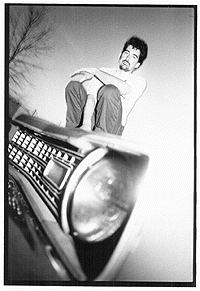
 photograph by Michelle Dapra |
the curves on the Kancamagus Highway, a tortuous stretch of blacktop that
connects your last gig in New Hampshire to your next one in Vermont. The Buick
Skylark you bought for $1 and got running for $150 is doing fine, except you
never know when the power steering’s going to conk out in the middle of the
next bend. Ka-whunk! There it goes, and you push hard left to keep inertia from
running you off the road.
For Slaid Cleaves, his music has been a lot like his cars. His career may
steer off the shoulder from time to time, but all he needs is a few spare parts
and a Hank Williams tape in the dash to get it rolling again.
This month he’s finally hitting high gear. He had to move from Maine to Austin
to get discovered by a Boston record label, but the destination was worth the
detour. A division of Rounder Records, Philo, is putting out his first national
release, No Angel Knows, a stripped-down slab of folk-rock that updates
Williams and Springsteen for the age of downsizing. It’s a breakthrough not
just for Cleaves, but for Austin’s folk community as well, which hasn’t broken
a new face onto the national scene since Jimmy Lafave and Betty Elders.
“The Rounder connection is definitely part of my pitch,” says his booking
agent, Seymour Guenther of Nancy Fly & Associates. “It means a lot to
certain buyers. And having the record on the radio will also mean something to
buyers.”
For Cleaves, it all translates to another summer of tooling around New England
in a rebuilt junker. He wouldn’t have it any other way. After all, auto repairs
and music both entered his life around the same time, and both came more or
less directly from his father.
“It was pure necessity,” says Cleaves of cars. “I was 16, just got my license
and had no job. My dad had this retired Duster he’d put out to pasture. He said
it was mine if I could get it up and running. I learned to do sheet metal. I
worked with bondo. It ran okay. I had that car from ’82 to ’88.”
The musical handoff was more roundabout. When Craig Cleaves was in graduate
school in 1965, he spent $140 on a Gibson guitar, then took several months to
work up the courage to tell his wife. Later on, after he’d settled into the
respectable life of a therapist in South Berwick, Maine, he’d go out weekends
to play what Slaid’s mother called “hillbilly music.”
The younger Cleaves never paid much attention to his father’s side project
until the summer, 17 years later, when he got addicted to Springsteen’s
Nebraska album. He’d read the Boss was inspired by Woody Guthrie and
Hank Williams, and it was then he remembered some old records packed away in
the attic. “I called it my treasure trove,” says Cleaves. “There was Johnny
Cash, and Buddy Holly, and old reel-to-reel tapes and singles and 78s. I taped
all my dad’s records and learned all the songs.”
He played keyboards through high school, but like his father, music was merely
a sideline to an academic career. His junior year abroad in Ireland changed all
that.
The moment of truth came in a one-room apartment in Cork, staring at the sink
and aching over the Irish girlfriend who’d dumped him on the plane ride over.
“I remembered I had this guitar with me,” he says. “I had seen all these street
musicians playing around Cork. They were not so great, but they still seemed to
make money. I set the goal of learning a song a day until I could go out and
play a couple of hours.”
He went out busking two days a week, and kept it up once he got back to the
states — especially once he realized his philosophy degree was worth nothing
more than a job in a photo lab. Once he graduated to bars, he was soon making
enough to quit his day job.
It was a good life for three years, ’til he started wanting to be more than a
household name in Portland. He never gave much thought to Boston’s booming folk
scene, a mere 100 miles south, because he never considered himself a
folksinger. What caught his ear was the roots-rock he heard coming out of
Austin. And no sooner had he hit Texas, than he won the prestigious Kerrville
New Folk award in 1992. It’s an honor he still considers a mixed blessing,
launching an identity crisis that lasted several years.
“It opened the folk door to me,” Cleaves says, “but it was never a door I was
interested in. I wasn’t ready to take advantage of it when I got it. The vast
majority of singers were aspiring to be like James Taylor. I always thought of
folk as Woody Guthrie and Hank Williams.”
Instead of building an audience on the folk circuit, he played around Austin
with a succession of sidemen and styles, experimenting first with
Kerrville-style balladry, then with Nashville new country. None of it brought
Cleaves any closer to national attention — or to making a living. He was
falling deeper in debt with each year in Austin, his wife Karen working long
stretches to support him. That was when he started selling his body to science.
Like other local musicians before him, Cleaves became a volunteer for new drug
testing at Pharmaco. Over five years, he’s had “everything from
electrocardiograms, vital signs, heparin lock insertions, sonograms, X-rays,
and physicals, to urine collections, fecal collections, blood sugar tests, lung
capacity tests, and biopsies.” And blood draws — as many as 20 in a day,
leaving little lumps all over his veins.
Those dead-end feelings color the new album’s closing track, “29.” Ostensibly
dedicated to fellow Maine musician Manny Versosa, who crashed his van just
after signing his big album deal, “29” is full of allusions to another
balladeer who died in his car at the same age.
“Twenty-nine was a tough year,” says Cleaves, now 32. “I hadn’t accomplished
what I wanted to. Hank Williams had written all those songs and lived an entire
career at that age. [Meanwhile], I got rejected from a Pharmaco study because
my blood pressure was too high.”
Sick of spinning his wheels, he decided that if nobody else would record him,
he’d do it himself. With a $60-a-month DAT machine from Rock-N-Roll Rentals, he
pulled friends into his living room, cut a demo, and started sending it to
record labels. Three months later, he ran into Ken Irwin of Rounder at South by
Southwest. Irwin, who had been following Cleaves on the recommendation of local
agent Cash Edwards, said he liked the demo and added, “We might be interested
in being a part of that.” Then he was out the door.
It took Cleaves a week to work up the guts to fax Irwin and ask just what he
meant. Over the phone, they struck a $10,000 budget, of which Cleaves had to
raise $3,000 from friends. “I had a half-hour of ecstatic jumping up and down,”
he says. “Then it was, `What do I do now?'”
The what next was to recruit guitarist-producer Gurf Morlix, a veteran of both
Lucinda Williams and Butch Hancock. He shared Cleaves’ ideas on how to produce
a distinctive-sounding record on bare-bones money.
“The whole idea was to showcase the songs,” says Morlix. “The demo was almost
there. We changed some of the arrangements, but we wanted to get the same kind
of a feel, to try and recreate the sound of a small room.”
The sparse production — a touch of dobro here, a bit of mandolin there and an
insistent, Johnny Cash drumbeat throughout — suits the songs. Many of the
songs co-written with Cleaves’ former high school bandmate Rod Picott are the
simplest and most direct, unabashedly modeled on Hank Williams. At the same
time, Cleaves pours contemporary stories into the classic forms. There’s Bill,
who works hard and plays by the rules and loses his wife’s love anyway. There’s
Jennie, who changes jobs as often as she does lovers. Each finds some dignity
in simply surviving, having already missed the bridge to the 21st century.
As for himself, Cleaves declares in the opening cut, “I’m not going down that
way.” He knows better than anyone, though, that all Rounder offers is a ticket
to ride. The label works the album to radio, but leaves the rest up to Cleaves
— and his booking agent. “The harder I work, the harder they’ll work,” he
says. “The hardest thing is, they have so many acts. If I’m not calling them
all the time, they’ll work on someone else.”
So it’s back on the road again, driving a rebuilt car from town to town. The
difference is, this time he’ll be playing bigger houses, mostly opening for
acts like Joe Ely, Jimmie Dale Gilmore, and Fred Eaglesmith. It’s not
glamorous, but it’s the chance he almost gave up hoping for.
“I feel so lucky,” says Cleaves. “The first few months after the deal I had
this survivor’s syndrome. I’m still amazed to think that Ken gave me this shot.
A year from now I might be in just the same place. Or it may be totally
different. It’s a threshhold moment.”
[Slaid Cleaves celebrates the release of No Angel Knows next Friday,
February 28 at a Waterloo Records In-store (5pm), and later that same night at
Waterloo Ice House 6th.]
This article appears in February 21 • 1997 and February 21 • 1997 (Cover).