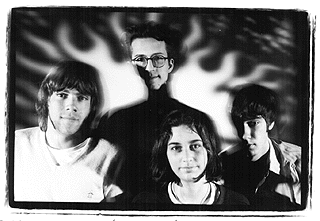
 photograph by Bruce Dye |
guys do not rock,” says Lisa Roschmann, laughing.
“Yeah, we were in Houston, opening for Luna,” says Andrew Kenny. “And we
played one song. It was probably a quiet one. And right as we stopped playing
— it was, of course, very hushed, because nobody knew who we were — right at
the front, two guys go `These guys do not rock.'”
“We all heard it,” says Mark Smith, cracking into a big smile. “I started
laughing. I thought that was the best thing someone could say about us.”
“Yeah, because we didn’t,” affirms Kenny. “We don’t.”
No, they certainly do not rock. One listen to The American Analog Set’s debut,
The Fun of Watching Fireworks, released last year on Trance
Syndicate/Emperor Jones confirms that loud and… well, not so loud — but
clear. Like a whisper in a hushed room. And if you’ve ever seen the local
quartet live, whether crammed into the corner at the Blue Flamingo, or under
the neon lava glow of the Electric Lounge sign, hushed is the atmosphere you’ll
find — where every beer bottle dropped into a garbage breaks the mood like a
telephone call during sex.
“I used to rock — really be able to bash away,” asserts Smith, the group’s
drummer. “That was until I met him.” He points accusingly across the living
room to his housemate Kenny (known to most as Ken). Kenny, clearly the leader
of the band, smiles sheepishly and shrugs.
“I was actually into much heavier stuff,” says bassist Lee Gillespie, just in
from the garage where the band is screen-printing by hand the cover to its next
single, “Magnificent Seventies.” “But then Ken — well, we actually turned each
other onto stuff. The stuff that Ken exposed me to broadened my horizons
considerably.”
And that was…?
“Uhh, magazines I’d never seen.” The three housemates burst out laughing
(Roschman is now in the garage making sure the paint doesn’t dry during our
interview; they’ve got 1,000 sleeves to press before the weekend’s out). “No,”
recants Gillespie, “just music I’d never been aware of. I’ve always really
liked music where there was a lot of attention paid to detail. My idea of
really amazing music is just a lot of melodies intertwining to make something
complex; making something that’s overwhelming with a lot of small, simple
parts.”
Again, all one has to do is listen to …Fireworks, or its follow-up,
From Our Living Room to Yours, due out on Trance in June. On both,
Kenny’s slow, seductive — simple — guitar melodies are pulled like
taffy over Smith’s Valium beat and Gillespie’s insistent throb while
Roschmann’s beacon keyboard playing — often a Farfisa — brings a sense of
weightlessness to the proceedings. In fact, it’s probably the band’s love
affair with the Farfisa — a primitive organ just up the evolutionary scale
from the dinosauric Mellotron — that gets the group all its “Space Rock”
press. (And there is a lot of press for the band, two scrapbooks worth,
including clippings from Spin, Billboard, Option,
Melody Maker, and NME.)
“That’s true,” says Roschmann about the Farfisa connection.
“Mmmm,” murmurs Kenny thoughtfully about the same.
“I could see that,” agrees Smith.
“I guess the Farfisa and the Vox Jaguar or Vox Continental have similar
sounds,” says Kenny. “Or a Moog. Whenever I hear a Moog, it’s like
automatically an arpeggiated note. I think of `Space Rock’ when I hear that.
That’s a good point. I never really thought of that.”
“I can definitely see that,” says Roschmann.
“We get lumped into the `Space Rock’ stuff all the time,” explains Kenny.
“It’s usually not, `This band is Space Rock.’ It’s more, `Coming from Texas,
the new Space Rock Scene…'”
“I can see it,” interjects Smith. “What do you call organ-based, mellow, kinda
spacey, atmospheric music? You have to make something up. Space Rock. That term
has been around forever. It’s just becoming more public domain. It starts with
Pink Floyd, and the 13th Floor Elevators, Red Krayola, Hawkwind — all that
stuff. I don’t really mind the term, but I mind the part where people thinks
it’s new. It’s been going on for years, especially in Texas.”
Which is exactly where these four, young twentysomethings are coming from,
spiritually, psychically, physically; Kenny and Gillespie are from Fort Worth
while Roschmann and Smith hail from Bedford, and all four ended up in Austin to
be near their bassist, who is still in school here. Their name, a not-so
imaginary revolution of lo-fi, living room musicians (where both their albums
were recorded), dreamed up at a Rangers game. Their label? As Texas as the
Butthole Surfers; the band was signed after sending a 30-minute sampler tape to
two dozen labels who’d put out albums by groups they like: 4AD for The Red
House Painters, Too Pure for Pram, Shimmy Disc for Damon & Naomi (the
Galaxie 500 influence is obvious), and Cranky for Jessamine and LaBradford to
name a few who lost out to Trance Syndicate. The American Analog Set, as Texas
as “spacey, atmospheric music.”
“I think we write good songs,” stresses Kenny. “If someone sits down and
listens to our records — or even the singles — there’s a lot of stuff in
there. We don’t hide stuff; there’s not back-mastered vocals, but there’s
detail in there.
“It works on both [foreground and background] levels,” says Gillespie. “Just
because they say `This is good to sit and do nothing to’ — chat with friends
— that’s fine. But if they’re really putting on the headphones and listening
for all the finer points, they’re there.”
“I think it’s nice when people say, `Yeah, I went to sleep to your record last
night,'” says Smith. “`It’s nice, soothing, relaxing.'” That’s a compliment to
me.”
Zzzzzzzzz.
The American Analog Set play the Trance Syndicate/Emporer Jones SXSW
Showcase at Emo’s, Saturday, March 15, 11pm.
This article appears in February 28 • 1997 and February 28 • 1997 (Cover).