

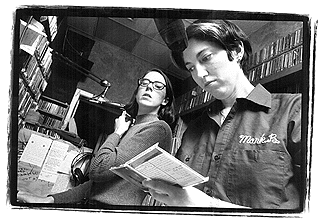
 Ina Hendricks and Jenn Garrison Thursday nights on KVRX photograph by John Anderson |
motions the affable station manager. “I want to show you the bathroom.” Inside
the small closet of a loo is evidence of fresh graffiti. “I just painted this
so they could start over for the new year, and they’ve already covered it,”
says station manager Jenn Garrison, seemingly pleased with this development.
“Now that’s self-expression!!”
Garrison is starting her second semester as station manager of KVRX, the
University of Texas student radio station and home to some of Austin’s finest
self-expression — on and off the wall. The non-commercial, 3,000-watt station,
which shares time on the 91.7FM frequency with sister station KOOP, is faced
with a rapidly mutating Austin radio market. Garrison is up for the challenge.
The recent cries of “Alternative Is Dead” may be silly and short-sighted, but
with regard to commercial radio, they’re spot-on. Changes at local radio
stations — Z-Rock has gone talk,
K-NACK may go urban, adult contemporary
or under altogether — and tweakings of formats at 101X and KLBJ seem to
confirm that the national alternative radio craze has collapsed onto itself.
Where does this leave fans of “alternative” music?
Carole Chandler, one of KVRX’s fundraising directors, sees the student
station’s potential for filling a niche in Austin’s radio market left by the
commercial station shake-up. “So-called alternative music has been so
mainstreamed. I think a lot of people are sick of that sort of thing and want
something different.”
This difference, she implies, is what KVRX has provided all along. From its
days as KTSB, a “gaspipe” (cable-only) radio station, to its eventual launch as
a legitimate frequency, KVRX has maintained a loyal listenership. Gleefully
oblivious to the plodding and deliberate twists of the local radio market, the
station has ignored the trends and done what it does best. And what that is, is
perhaps best encapsulated by the station’s Thursday 7-9pm slot.
Featuring the tag-team talents of Garrison and deejay Ina Hendricks, their
show seems to be in complete disarray as the two jocks skitter around the
narrow studio in search of a next song, frightfully aware of the current song’s
imminent ending. “You guys are just winging it, aren’t you?” I tease the two
deejays, who between them probably know more about music than entire air staffs
at most commercial radio stations. Hendricks responds with appropriate
indignation, “I spend an hour before the show pulling music to play and
that’s what’s going to get into the story — that we’re winging it?”
“I’m just gonna close my eyes and pick a CD!” Garrison boasts goofily, as she
covers her face with a hand that’s big but not big enough to hide a sly grin.
Stretching across a row of new CDs, Garrison picks another one and hands it to
Hendricks, who bursts out laughing.
“What?” Garrison asks, uncovering her eyes.
“This will go great with this song!” Hendricks announces triumphantly as they
cue up Heavy Vegetable to follow local wordsmiths Glosso Babel. The two-hour
show progresses, covering a multitude of genres represented by a baffling range
of artists: Vic Chesnutt, Spacemen 3, Tappa Zukie, Tricky, Carmen McRae, Austin
Klezmorim, Robert Mitchum, and Ed Hall. Somehow, Garrison and Hendricks make
the teetering bricolage work. Facilitating this is the safety net of their
combined musical knowledge, which fronts a combination of semi-professional
confidence and avant-dork charm.
And so it goes with most of KVRX’s 50 or so shows (another 30 cover the cable
time, when KOOP takes over the 91.7 broadcast frequency). Whether the shows
focus on a single genre or mix a myriad of disparate styles, the bottom line is
free-form radio — with some guidance and structure — but little in the way of
prescripted programming.
Garrison explains, “We don’t care how much a band plays around town. We don’t
care how many T-shirts they send us. We are going to play something because
it’s good music, not because some record company rep is pushing it, not because
it’s on the Billboard Top Ten.”
Fundraising director Chandler agrees. “Our mission is to expose listeners to
more than what they hear on commercial radio.” Garrison believes that it’s this
mission which creates KVRX’s niche in the Austin market. “I don’t see why we
can’t tap into K-NACK’s old audience and pick up some of their advertisers as
underwriters.”
KVRX’s strategy to take advantage of these turbulent times in Austin radio is
to rethink its entire approach to underwriting. “Previously, our pitch to
underwriters was: `We are non-profit. We are students. Give us charity,'”
whines Garrison mockingly. “We are a business,” she asserts. “We offer
something viable to the community. Our programming is something people aren’t
going to hear anywhere else.” Garrison goes on to explain that while KVRX is
funded in part by the university, they’re working toward not being so dependent
on UT funds and becoming more self-sustaining financially.
And Garrison is no stranger to the financial realities of radio — especially
commercial radio; she has part-time jobs at two of Austin’s most visible
commercial stations, KGSR and 101X. “I realized how important KVRX is since
working in commercial radio,” says the non-stop deejay. “Commercial radio is
80% about business and 20% about music. That 20% may be generous.”
The seemingly contradictory experiences of working in both commercial and
non-commercial radio have afforded Garrison a big-picture view of the
possibilities within Austin radioland. “I’ve been through marketing classes and
I don’t buy the stuff they say about non-commercial radio formats being
unsellable. I believe there’s a way to market what they consider unmarketable.
I think that [the current staff of KVRX] are on the breaking point of figuring
out how to do that.”
It remains to be seen, however, if “marketable” is even a term understood in
the language of non-commercial college radio. In the absence of that “80%”
profit motivation lies the true secret of KVRX’s formula. After all, Garrison’s
goal is to move the station toward self-sufficiency, not to have it become
another lint ball on the alternative-market coattail.
By bringing musical diversity to the community, says Chandler, formula and
goal become one, while at the same time providing an educational outlet for
students. KVRX’s sloppy charm is what lures and keeps most of its longtime
staff there. “I don’t think I’d want to be a part of something controlled by
the university,” opines Chandler. “Part of what’s so educational about this is
that a lot of responsibility falls directly on our shoulders. We must be
professional. If KVRX were controlled by UT, there would be less educational
value. You don’t learn anything if somebody’s just telling you, `Do
this!’“
Not that the “Do this!” school of management would fly in the do-it-yourself
playground of KVRX, anyway — which isn’t to imply that the DIY ethic is all
fun and games; some pretty serious business goes on during airtime. Take, for
example, the show Radio Germanistik, which airs Monday nights at 7pm.
The show’s host Kerstin Somerholter is a graduate student and instructor in the
Germanic studies department at UT. She had never been involved with radio
before last semester, when Garrison, one of her students, suggested a German
language and info show.
“She got me interested in doing this radio thing and trained me on the board,”
says Somerholter. The program continues this semester and Somerholter is
excited about the possibilities of other departments utilizing the unique
resources offered by the student station. Considering Central Texas’ German
heritage and the number of native German speakers in the area, the show fills a
niche not likely to be even touched upon by any other media outlet.
Richard Whymark, a UT student from England, produces KVRX’s five-minute news
segments. He’s one of the engineers behind the station’s recent CD project,
Cooking by Strobelight, KVRX Local Live Volume One. Whymark remarks that
the project was a fine learning tool for the many students involved. “We got to
experience seeing a project like this through. We got to twiddle knobs and
learn how sound moves around a room and all that nonsense!” Aside from its
educational value, the CD also highlights KVRX’s “Local Live” series which
features weekly performances by bands, who in turn earn well-deserved
exposure.
Asylum Street Spanker Christina Marrs participated in the KVRX CD project
through her other band, the Jubilettes. “We had a lot of fun doing that,” says
Marrs. “That was our first live recording, early in our career. Now that track
is around to haunt us.” She laughs. “My experience with the deejays is that
they are really eager to showcase new bands. More power to ’em!” Spoon’s Britt
Daniel was a KTSB/KVRX deejay between 1992 and 1995 and says the station has
played an important role in exposing local audiences to his band. “They were
the only station in town that consistently played our last album. There may
have been a bit of play on 101X and K-NACK, but KVRX played us regularly.”
“I listen to KVRX and KOOP exclusively,” asserts the artist known as SXIP, an
experimental virtuoso whose mastery of the flute and tampon are legendary in
Austin’s performance-odd circles. “I’ve been in almost every major city in the
U.S. Besides Boston, Austin has the best radio in KVRX/KOOP’s mix. There’s
nothing like it. Not just for what they choose to play, but for how they
participate in the community. They’re not just a bunch of college geeks with
their heads up their asses. They actually know and care about this
community.”
Given these assertions, one might think that SXIP and KVRX’s production
manager Mike Heidenreich were reading from the same script: “You go to any city
in America,” says Heidenreich, “and there will be a radio station like 101X,
maybe even owned by the same company and programmed by the same people. The
same bands are being played in Chicago that are being played in L.A. that are
being played in Dallas or Austin. I don’t think that all those communities are
the same. Community radio and college stations are more oriented toward their
own cities.”
Alternative, indeed.
It’s a song as old as time itself (or the Seventies, at least): Commercial
radio tries to mimic the innovation and successes of non-commercial radio by
programming hipper, newer, fresher product, thereby attempting to beat the
non-commercial stations at their own game. But commercial radio’s need to
program “product” is the inherent downfall of this scheme. It’s become almost a
generational ritual, this phenomenon, where art and musical innovations are
routinely trivialized by commercialization. Radio is a business that thinks it
will keel over unless it’s constantly reinventing itself; yet, its drive for
dollars leaves it impotent in the new ideas department.
Is alternative dead? No. That’s stupid. There will always be an alternative,
if one chooses not to ignore it. KVRX chooses not to ignore it, and
additionally, chooses to let it remain undefined. That’s the beauty of it. The
joyous chaos that is the amorphous mass of free-form radio doesn’t need to be
defined.
Back in the cluttered studio, Garrison and Hendricks spin the hits, or not.
And when a caller asks for something special, Garrison smiles and nods into the
telephone, “Yeah, we’ll play that. We can do that. We can do whatever we want.
We’re KVRX!!”
[A KVRX fundraiser, featuring El Flaco, Phantom Creeps, Terror at
10,000 Feet, the Hamicks, and Enduro, happens at Liberty Lunch this Friday,
January 24.]
This article appears in January 24 • 1997 and January 24 • 1997 (Cover).