

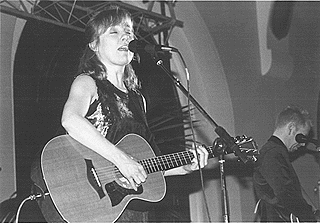
 Iris Dement at the Texas Union Ballroom February 25 |
La Zona Rosa, February 13
Max’s Nofziger’s “Flower Power Hour” — a Maxstravganza if you will. Three
hours of nothing but Max. Or so you might think. Actually the “Flower Power
Hour,” the half of it that I saw anyway, was severely lacking in the mayoral
candidate. So what goes down at this weekly shindig? Well, it was a handful of
Nofziger’s friends taking turns on the stage to play some covers (Kate Wolf,
Gram Parsons, Merle Haggard, Nanci Griffith, Gillian Welch) and some originals.
In a 90-minute slice of his own soir�e, Nofziger himself sang back-up on
exactly three songs and stood on stage during a fourth. Even so, he was a
reluctant and less than comfortable back-up singer — more like a mobile stage
decoration in a green plaid shirt with a “Max for Mayor” button on. No
complaints, though, because as a singer, Jose Carreras he ain’t. You see,
politics may make strange bedfellows, but it doesn’t make musicians. Nobody can
do both successfully in the same lifetime. Check out Capitol Hill. Congress
has, or had anyway, a handful of ex-athletes (Bill Bradley, Jack Kemp, J.C.
Watts, Steve Largent), a couple of former actors (Fred Grandy, Joe Don Baker,
and, although not a congressman, Ron Reagan himself), but no erstwhile rock
stars (ok, maybe, Lee Atwater). But don’t even try to defend the
proposition that Sonny Bono qualifies as a musician under any criteria. And the
President? He can’t sax above an eighth-grade level. It all sort of makes
Nofziger’s return to the political arena look like an inevitability, don’t it?
— Michael Bertin
THE CARDIGANS, PAPAS FRITAS
Liberty Lunch, February 15
Not since Abba has a Swedish pop group scored such an unlikely success as the
Cardigans, riding the crest of the Romeo + Juliet soundtrack with their
jauntily self-depreciating single, “Lovefool.” It’s fitting, then, that their
capacity crowd at the Lunch was a writhing mass of lovestruck joy and flibber
tigibbet coupling. After a thankfully short set by lo-fi Beantown chordwasters
Papas Fritas, the Cards opened with — stay with me on this — Black Sabbath’s
“Iron Man.” Not what you’d expect from leggy frontswoman Nina Persson, but then
nobody thought croonboy Pat Boone would be covering the Ozz and dressing like a
longtime Chaindriver either, so there you go. Much has been made of the
Cardigans’ sound; not quite retro, not quite rock, it falls, tumbles, and
occasionally oozes into the realm of neo-pop, upbeat bubblegum lovesongs. Their
Liberty Lunch show favored the more danceable tracks from the band’s CDs
Life and First Band on the Moon, much to the joy of the crowd —
there was even a tiny gaggle of post-pubescent moshers briefly stirring it up
during the pre-encore version of “Lovefool.” Shiny, happy popfools crowdsurfing
to Sweden’s smoothest import since Absolut? Frida Lyngstad and company should
be receiving some royalties soon, I think. — Marc Savlov
DRUMS & TUBA
Stubb’s, February 18
Whether they’re called categories, types or in the case of music — styles —
using genres as a cognitive device for understanding reality has both its good
and bad by-products. On the one hand, it helps us understand something new or
difficult to describe by comparing it to something we already know. On the
other hand, using genres as a tool for understanding can prevent us from
judging a novel event on its own merits. Thankfully, once in a while something
comes along that challenges our use of established categories. One good example
is the platypus. Another one is Drums & Tuba. This local group doesn’t fit
neatly into any established format, and that’s precisely one of the reasons I
liked them so much. They possess many of the elements I look for in a band:
sharp playing, willingness to take chances, and unique group interaction. The
characters in this experimentalesque trio are: person one, tuba and
simultaneous trumpet and pocket trumpet; person two, drums, cymbals, sticks,
drum shells, and (for lack of a better term) nerf sausages; and person three,
guitar voices and guitar sounds, occasionally through two guitars at once.
Adeptly demonstrating the flexibility and uniqueness of the instrument, the
guitarist provided the main rhythm movement on some tunes, while the
tubas/horns moved on the melody line(s), and the drums added accented
embellishments. Part blitzkrieg bop, Les Claypool, Bad Livers minus vocals, and
Medeski Martin & Wood, Drums & Tuba rocked and bopped — hard.
My only regret was that as an opening band they didn’t play longer. This
doesn’t mean that the Tuesday night crowd at Stubb’s wasn’t into their rare
stylings; in fact, I was rather surprised by the receptiveness of the crowd.
But I look forward to hearing them in a future headlining spot where they can
really open things up. Drums & Tuba’s music demands that you let yourself
go, that you get inside of what they’re playing, not listen passively. This
band is too good to reduce to an established format, style marker or genre. Do
yourself a favor and check out the D & T gestalt for yourself. — David
Lynch
WYNTON MARSALIS’
BLOOD ON THE FIELDS
Bass Concert Hall, February 19
Those shying away from last Wednesday’s production of Blood on the
Fields, Wynton Marsalis’ epic work on American slavery, might be
surprised to know what they missed. Marsalis, who has time and again come off a
solemn and sanctimonious prat, joked a bit with the audience, announcing
“Tonight, you are going to hear a piece entitled `Blood on the Fields,'”
followed shortly thereafter by, remarkably, “I’ve talked enough.” More
remarkable still was the nearly three hours of music that followed. No period
of American history brought more misery, polarization, and shame to this
country than the enslavement of African Americans, a practice that ended only
slightly more than a hundred years ago. This is rarely the stuff of an
evening’s entertainment, especially in the hands of a man whose precedent for
Stanley Crouch-ian analyzing has wrung the life out of many an effort. But
Marsalis has figured out a few things, among them how to tell a story. There
are no saints among Blood‘s captives; one is an African prince, Jesse,
who once owned his own slaves, while another, Leona, Jesse’s lover, is a
commoner, and their lives would have never intersected were it not for their
captivity. When Jesse escapes, Leona prays for his return. Only through the
realization that their struggle is everyone’s struggle, do they eventually find
the freedom they crave. Race is never once mentioned. The narrative, propelled
by three singers and the 14-piece Lincoln Center Jazz Orchestra, made Blood
on the Fields unforgettable. The musicians deftly maneuvered through
rhythmic dances, fiery brass counterpoint, and quiet gospel-tinged interludes.
Marsalis’ truncated vision of jazz beginning with Louis Armstrong and ending
with Duke Ellington is still intact. The fervor of Armstrong’s music and shared
hometown sensibility shone through the evening’s performance. Blood‘s
bluesy, stylistic jumble was much in the tradition of Ellington’s Black,
Brown and Beige or Sacred Concerts, and indeed, the spirits
of Williams/Nanton/Webster/Hodges and the rest of jazz’s greatest orchestra
soared through the proceedings. But there was more than just mimicry at work.
The LCJO’s droll, seen-it-all, spoken narration gave the work an unexpected
humor and warmth. The band had so many bright spots (drummer Herlin Riley,
trombonist/vocalist Wycliffe Gordon, saxes Victor Goines and Wess Anderson,
trumpeter Marcus Printup) that it was frustrating when they didn’t stretch out
more often. As for the vocalists, Jon Hendricks’ appearances were high camp and
seemed out of place. Miles Griffith did a fine job that still went all but
unnoticed due to the riveting performance of Cassandra Wilson. Her prodigious
talent and grace almost shook the thunder out from under this amazing
assemblage of musicians. Still, the night belonged to Marsalis, who conducted,
stomped his feet, sang, played, danced, and led a crack ensemble through a
masterful performance. In the end, Blood on the Fields was not a
story of slavery and oppression, but of dignity and freedom, finishing in a
celebratory New Orleans parade march. It’s unlikely Austin audiences will be
treated again to a show of this caliber anytime soon, but at age 35, it’s also
unlikely that this work will prove to be Marsalis’ life’s work. And judging by
the smile on his face, the newly at-ease Marsalis has finally figured that one
out, too. — Jeff McCord
BLUES FAMILY TREE PROJECT
Victory Grill, February 19-22
Culminating with a weekend of fireworks, the Blues Family Tree Project
week-long celebration was mainly about one thing, the blues. Friday’s show
started out with the young and talented guitar prodigy Jake Andrews playing out
in front of the Blues Specialists. Andrews had some good leads and displayed a
surprisingly solid vocal style, but he seemed somewhat humbled by his
surroundings. Understandably so, as T.D. Bell took the stage, and with riffs so
fast and smooth you could hardly see his hands move, showed why he and the
Blues Specialists are one of the most consistent blues acts in town. As if that
wasn’t enough, Blues Boy Hubbard appeared and stepped unceremoniously into a
guitar rhythm, signaling the horns for the melody that made “Cantaloop” a show
stopper, filling in the solo spaces with sharp jabs from his big fat Gibson.
Hubbard brought on the more showy R&B side of the evening’s installation by
doing a slew of standards including “Sweet Home Chicago” and “Soul Man” and
even ending with a James Brown tune. It takes a great blues man to make those
songs still compelling live, and with the exception of the overdone ending of
“Brand New Bag,” Hubbard pulled it off. And while the near-capacity crowd on
Friday would indicate otherwise, the highlight of the Blues Family Tree series
came Saturday night with a two-hour set by Long John Hunter. Most space was
filled at the Victory Grill for this show as well, but the audience was
decidedly more subdued. Long John did not disappoint, though, and he showed why
the guitar is the dominant voice of the blues. Fronting a five-piece band,
Hunter pulled together the differing styles of his keyboardist, drummer, and
sax player to full effect. The drummer banged out one of the most unique and
inspired solos I’ve seen, showing rapid-fire technical skill on the cymbals and
snare without losing the thread of the song he broke. But it was Hunter who
made it live, walking the room with antenna hook-up, shaking hands, making
jokes and fans for life. When a concert series like this one goes beyond the
lineup and turns into a true celebration of the blues, it makes you wonder
whether all this talk of the genre’s demise has been greatly exaggerated. —
Christopher Hess
This article appears in February 28 • 1997 and February 28 • 1997 (Cover).