




Fifteen.
It’s a tantalizing taste of life, rife with unrealized dreams, teen angst, stomped hearts. Parents don’t understand. Too young to drink, no car, nowhere to go if you have one, school sucks, life sucks.
Trampia Guzman joined a gang at 11. By 15, he was a father himself, pulling double duty as dad to his younger siblings in the necessary absence of their single working mother and a father behind bars. Feed them, bathe them, play with them, get them to bed. Help Mom as much as possible. When she came home exhausted and fell asleep, he’d sneak out and party all night with the gang.
The gang. Mi hermanos, mi familia. Where Trampia comes from – East Austin – joining a gang isn’t a choice. The choice is which gang. Without gang affiliation, your mother, brothers, and sisters are in danger. Thug life threw open doors to all the predictably bad paths: drugs, violence, crime – nothing unusual for a boy dancing atop a bed of $75,000 in drug money.
One afternoon, Trampia, 15, found a stranger knocking at his front door.
“I have a message from your father in prison,” said the man. “He says you’re running in circles you shouldn’t be and if you continue, you’ll find yourself where he is now. Because I owe your father, my job is to keep you out of it, mijo.
“I’ve been given the green light to treat you like you’re in prison.”
Leave the Streets Alone
Today, Trampia goes by a solo moniker, this fireplug of a man, head clean-shaven but for a black goatee and shades. The sunglasses suit the hip-hop image, ever present except when he whips them off to talk face-to-face, which is often. Trampia likes to look you in the eye.
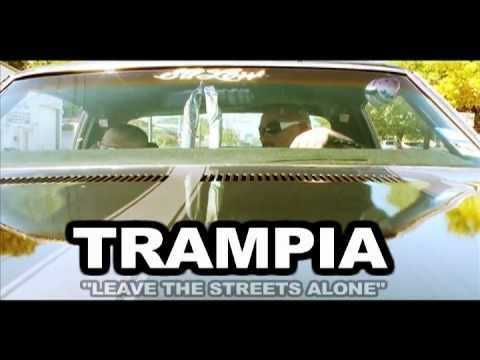
Decades removed from the hustle, Trampia now delivers cruisin’ “muzic,” Latin soul and hip-hop on wheels. His are car culture anthems, like the theme for Brown Impressions Lowrider Car Club, but nothing spoke to the community he grew up in and remains a resident of more than last year’s “Leave the Streets Alone.” With a powerful, locally shot video directed by Dirty Wormz’s Smackola, “Streets” re-enacted Trampia’s efforts to escape “being groomed as a third-generation heroin dealer.” The video had everything to do with the singer/MC being voted Best Hip-Hop act this year at the Austin Music Awards. Few AMA winners over the show’s three-decade history have been as genuinely excited to take home a plaque.
“There’s only a few ways to get out of a gang,” he says some six weeks after South by Southwest, reflecting on life before attending an Award ceremony where he met Bruce Springsteen. “Go to jail, die, or get jumped out. Jumped out is when you have to stand and get beaten up by 12 people for one minute, 60 seconds.”
Trampia relates this information like a tribe elder chanting oral history, sitting in the Chronicle‘s offices. His very name is a badge of reclaimed honor. Look up his grandfather, challenges his namesake, and you’ll find “the heroin king of 1985” with a record longer than his grandson’s tattooed arm. Trampia, his muscled hand grasping the air, means “late night nomad traveler.”
His wife, Leona, sits by his side, documenting him on camera, listening with occasional nods, a devoted constant in the life he sought so hard to change. Their son, nearly 12, is in school.
“I wasn’t going to jail and I wasn’t dying,” states Trampia leaning forward. “So I went to them and said I wanted out.”
Jump Me Out
“I started crying. I was scared.”
Trampia describes his reaction not only to the presence of an ominous messenger on his porch, but the channels by which the information traveled from prison, and the understanding that his absent father exercised authority over him.
“My job is to keep you out of it,” the man had said.
So Trampia did something akin to what you see in “Leave the Streets Alone.” He said he wanted out.
“My dad’s friend had to come to the meeting with me,” he remembers. “They had a whole meeting on it, with 60, 70 gang members present. They didn’t want to let me out at first. I was intelligent and resourceful – reserved – and they had a vision for me in the gang: what role I would play, where I was going, and what I was going to do. Organized crime.
“This man had to step in and say, ‘My authority overrules yours.’
“They didn’t see it that way. That’s when I saw what a gang truly was, not thinking they were my family and had my back. When it came down to it, they were harassing me, I was afraid to go outside. They were harassing my 5- and 6-year-old brothers, flattening my mom’s tires. She was a single mom. It was hard for her to replace tires, and I couldn’t tell her what it was about. My father’s friend said keep it on the down low.
“It took about three months of back-and-forth to prison. The gangs are run out of the prisons. They really are. After about 90 days and correspondence to and from the bigwigs in prison that oversaw the gang, they said, ‘Go ahead and cut him loose.’
“Without having to jump me out, the gang released me.”
Low Rider
Forty.
In some urban circles, reaching that age is an accomplishment. Mindful of his good fortune, Trampia rides it in nonstop style with the volume cranked.
His cruisin’ muzic draws from a broad landscape. Trampia’s first concert was Ratt and Twisted Sister at the City Coliseum in the mid-Eighties. Attracted to the traditional music of his uncle Sonny Trujillo in Los Texas Wranglers, he resisted being pushed into Tejano, finding meaning in blues while burning to sing hip-hop. A stint in the Muzic Cartel encouraged him to pursue playing car shows in California, concerts for the vatos in San Antonio, and all the local gigs he can book.
With its low bottom, metal edge, and the soulful harmonies that make Latin hip-hop so appealing, Trampia’s soundtrack existed in Eastside car culture decades before kustoms rolled down South Congress every spring.
“Car culture is not gang culture,” he makes clear.
He recalls packing up the family and driving to swap meets on weekends to buy rare parts and the genial community of a visit to the local garage. A glance at a young lady in his rearview mirror while cruising Chicano Park led to his wife and son. Life shifts on the axis of a vehicle – why not sing about it? Once he attended the Tuesday Hillside Concerts in East Austin. Now he headlines them.
“[Car culture] is family oriented,” he explains. “That’s why I’m so for it. Respect, loyalty, integrity, honor, passion for what you’re doing: These people work 9 to 5 to do this. They budget their money to make quality cars. There’s no room for dealing drugs. Some of the clubs have passed cars through generations.
“I was a closet rapper, worried about what people would think if I started singing. When I recorded ‘Leave the Streets Alone,’ the guys actually laughed at me and made fun of the song. It wasn’t mainstream enough. I had to explain it wasn’t for radio, it was for my son. And the song was true, from beginning to end.
“That was a touchy video for me. I wanted to make it right. We had some gang members show up at the shoot to make sure nothing was being said – they’re still watching.”
“That was my life, raw and uncut, and I didn’t want my son to walk in those footsteps.”
This article appears in May 25 • 2012.