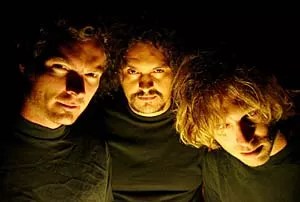
Milton Mapes
Appreciating the hardscrabble flatlands of West Texas requires a mind-set that finds promise in panoramic, wind-whipped desolation. Anyone can marvel at the Grand Canyon, but it takes a stout brand of introspection to squeeze transcendence out of Lubbock.
From Monahans to the Mojave, Milton Mapes utilizes lonely geography to convey the psychological landscape of an emotional vagabond on their just-released second album, Westernaire.
“There’s something different about the landscape, the weather, and the sky,” says Greg Vanderpool, who formed Milton Mapes with drummer/guitarist Roberto Sanchez in 1999. “I’ve always been fascinated with the geography of the Southwest. Those kind of things carry a certain feeling or mood that we’ve always tried to capture in the music.”
Songs like “Palo Duro” and “A Thousand Songs About California” evoke a sense of longing to escape from broken relationships, dead-end towns, and failed beliefs without succumbing to apathetic resignation. Milton Mapes’ warm, Neil Young-influenced mix of twang and fuzz offers the same sort of aural refuge small-town AM radio stations used to provide to solo travelers passing through on an all-night run. Even the album’s title sounds like the name of a neon-lit motor court somewhere in New Mexico.
“I’m not exactly sure where the word ‘Westernaire’ came from, but it just seems to describe the point of view from which a lot of the songs are written,” explains Vanderpool. “It’s kind of about not knowing what’s next, but taking comfort in the fact that you don’t know what’s around the corner. A lot of the songs come from that perspective of trying to figure out what’s beyond the horizon. What’s exciting in life sometimes is not having all the answers, but trusting that there’s something else out there that keeps you going.”
Vanderpool and Sanchez grew up next door to each other in Dallas and wound up playing together in the Plebeians. In 1999, they moved to Nashville and began Milton Mapes, naming the project for Vanderpool’s grandfather. The duo arrived in Austin in 2001, releasing their debut EP, The State Line, later that year. Recorded in Texas and Tennessee, the EP alternates between the elegiac sweetness of “Used to Be Enough” and the faraway den of distortion that haunts “Lubbock.”
“The State Line was kind of a patchwork of musicians and a lot of things going on at once,” says Vanderpool. “It was kind of chaotic, which was the idea.”
By contrast, Westernaire was recorded in one place with a less transient group of musicians, which allowed a more cohesive approach to the songs. Despite having also developed a formidable live presence, Vanderpool’s reserved stage manner correctly suggests he’s more comfortable writing than performing.
“I’ve never thought of us as entertainers,” he admits. “It’s more about creating a mood in the room and taking everyone else along with us.”
Together with the preponderance of Lone Star locales mentioned in their songs, Milton Mapes’ amalgam of roots rock and alt.country might seem to brand them a “Texas music” act, a notion at which Vanderpool bristles.
“I’d like to think of us as a Texas music band, but now that’s sort of just an industry term,” he says. “I mean, we have more in common with Pedro the Lion than we do with Pat Green.”
However Milton Mapes is classified, Westernaire has garnered plenty of fortuitous feedback since its January completion. After initially getting rejected for a SXSW showcase earlier this year, Vanderpool nonchalantly left copies of the album at the SXSW offices.
“A week later, they called us and said we got in,” he laughs.
On the strength of their showcase, Milton Mapes was invited to contribute “The Only Sound That Matters” to the latest Starbucks-distributed Hear Music compilation, which also features tracks from Gillian Welch and the Jayhawks. Then, the newly formed music arm of Aspyr Media took interest, releasing Westernaire and reissuing The State Line with bonus tracks.
As a booze-and-spirituality-fueled examination of why some people are inexorably drawn to music even as it draws them away from the so-called good life, “The Only Sound That Matters” is a poignant centerpiece for Westernaire‘s mind-set of not knowing what comes next.
“Hopefully,” Vanderpool offers, “there’ll be more redemption on the next album.” — Greg Beets
This article appears in Tom ‘Leatherface’ Delay.