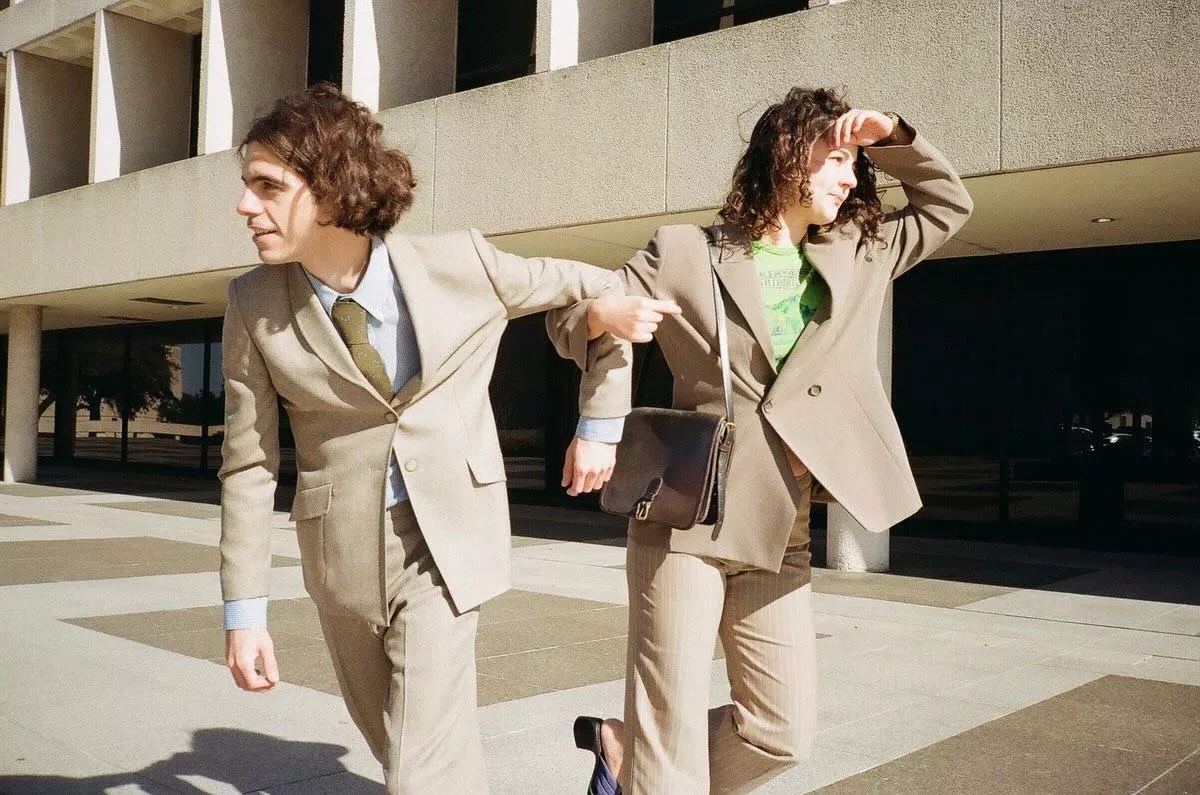
Rife with arcade-game-recalling synth sounds and hummable indie-pop melodies, Dorio’s third album is right at home in the world the pop duo have created around the project.
It’s also an adventure in expanding that world through trust and self-reflection: assembling a visual team, adding other multi-instrumentalists to the mix, refining collaborative cohesion, and drawing from Austin’s creative ethos.
Receiving Chronicle coverage is new to the duo too. Singer Rachel Rascoe wrote for the Chronicle for seven years and rode the rollercoaster desk of music editor for two of them. During that time, she joined partner Chad Doriocourt as a part of Dorio. Silver linings and newly found footing aligned for a delightful conversation with Rascoe and Doriocourt here.

Austin Chronicle: Super Love 3 feels like an album with a really strong visual world to me: the name has that retro video game callback, and then your music videos have a very distinct, consistent cinematographic style. I’m curious what role visual aesthetics play for y’all in your composition and production process.
Doriocourt: Visuals for this album were really easy because the last two albums we were trying to find what it was, and we’ve been perfecting that visual world where everything just made sense for this album. We’ve worked with the same video team [Good Relations Records] for the past two albums, and we already had similar tastes with them to begin with, but even more so after working with them for the second time in a row. I think we’re really finding people that can express the visual world we want to create.
Rascoe: They really like to shoot on film. I feel like that has informed our work together.
Doriocourt: Film is kind of a big thing for us. Our photographer, Katherine Squier, also shoots on film and we record a lot on tape. We’re not analog purists by any means, but it’s really fun just working in digital and analog.
Rascoe: It’s funny that we’ve gotten the video game comparison so much because I don’t know if that was fully in our consciousness until we put it out, but I’ve enjoyed it, because I think Chad has a tendency to really hone in on certain images. We were looking at Italian magazines from the Seventies a lot.
Doriocourt: Specifically this one, Ciao 2001.
Rascoe: The visuals is the main part where a team is coming together. For example, the pictures of us on the album are at Chad’s friend Dean’s house, who has this amazing apartment that’s full of Mod furniture.
Doriocourt: I met him when I first moved to Austin. I was working at a grocery store, Sprouts – shout out, Sprouts. He’s quite a bit older than me, but young at heart, and he introduced me to a lot of the music that inspires Dorio, like Stereolab and the High Llamas. They’re not a direct influence on this record, but they’ve helped us, visually and aesthetically, morph into what we are now. So it was cool to shoot the cover at Dean’s house, because I feel like Dean was really helpful.
Rascoe: He’s been a taste liaison for Chad. I once called him a scene elder in the Chronicle. He was riding around with Sterling Morrison and Daniel Johnston and all those people.
Doriocourt: Dean’s a legend. He always has a story that’s extremely wild. Speaking of Stereolab, he was like, “Yeah, I’m gonna email Tim” – of Stereolab, Tim Gane – “and we’ll go to the green room at Mohawk and hang out, we’ve been pals forever.” I’m like, “Sure, Dean, you always say crazy stuff like that.” And then, sure enough, we’re at Stereolab, and all of a sudden, we’re hanging out with Tim in the green room at Mohawk. It’s the one time we’ve ever seen a Dean story come to fruition. We’re saying, okay, maybe all of his wild stories are true. We gave him a little shout out on the back of the record.
AC: Speaking of building a team, the couple as a music duo is a classic concept and, I think, often a contentious one. You’ve said that this album has felt like reaching a new level of collaboration. What does that look like for y’all?
Rascoe: We got better at a more instinctual back and forth. When you’re in a relationship, the nice thing is that you don’t have to [do] as “constructive criticism” as you would with other people, but it can also be really hard. Chad does production and engineering for other bands and I was an editor and a journalist, so we both have that hot-or-cold quality where we hear something and are like, “immediately no,” or “immediately yes.” I think we were better able to tap into that as a helpful quality about both of us on this album, rather than hurting each other’s feelings. One of the biggest lessons I learned from doing arts criticism all those years is that criticism is an act of love and even giving your attention to something is showing that you deeply care about it and are actually thinking about how it could be better.
Doriocourt: Whenever I’m producing other bands that I’m not in a relationship with, per se, or not as comfortable with, I do have to tiptoe and be a bit more vague, read the room more, but I think we trust enough in our relationship that we can be open with each other.
AC: You’ve both spent a lot of time in the Austin music scene in your work as a producer and journalist. Are there social or sonic themes in Austin’s music scene that influence the record?
Doriocourt: Not really sonically. I don’t know if I relate to a lot of my Austin peers’ music musically.
Rascoe: Chad’s always coming from someone who is heavily invested in this pop perspective that doesn’t always feel like it’s all the rage here. Still, I do think that, from a broader perspective, we’re both from Texas – he’s from Bryan, I’m from San Antonio – and I always said, there’s nothing more Austin than having moved here from a smaller Texas town because you’re interested in music. I was coming at some of the content of this record with a sense – that I feel like a lot of people in Austin have – of disillusionment about if you should move, if you should be doing what you’re doing, and all those day-to-day questions. I think that aspect of the Texas music experience came into play more in songs like “Everyday Feels Like Tomorrow,” that light anxiety that still ends up sounding kind of fun on this record.

Doriocourt: I was working at a music venue here in town for like six years. We both left public facing positions in the music economy. I think I’m very inspired by musicians in Austin, and friends and community in Austin. To me, that’s more inspiring than the music scene. I think it’s easy to ride on Austin. I do it all the time. But every time I travel somewhere else, I’m like, Austin’s really great. I think in my mind, I’m graduating from not looking at Austin as a place to be inspired by just music, and more inspired by the city itself.
AC: Lyrically to me, like you mentioned, a lot of this album is those mid/late-20s anxieties and maybe Austin-endemic questions. Did you set out to make a cohesive album?
Doriocourt: I think any album that we make is gonna be cohesive in a way.
Rascoe: Chad started with a sonic vision of a sound that was more based around acoustic guitars.
Doriocourt: I think from recording other bands and then recording one and a half albums at our home studio, I am getting a bit more confident. Speaking for this record, I didn’t really care about outward perception. I mean, that’s obviously still in my consciousness, but I think I realized that no matter what happens, I’m probably always gonna feel the same: satisfied, and also a bit self-conscious. I took that into this record as a confidence of, I’m just gonna do what we want to do. That, along with skill building from recording at our studio for the past four or five years, created a product that was our true self showing.
AC: What else is in your future?
Doriocourt: We’ve got our tour and then we’re planning an East Coast tour very tentatively in the fall. We have a new band set-up, where it’s a bit smaller, but sounds more true to the sound in a way. It’s just a different sound from our previous live situation, but it’s a bit easier to travel with this setup. So Rachel and I, for the past year we’ve been perfecting just us two being able to play a show. Which is nice.
Doriocourt: I want to mention that on this album Rachel plays more instruments than she has in the previous album, specifically guitar, and that’s been a reason why we’ve been able to play live as a duo more, because Rachel has perfected her guitar skills. I think that helped the collaboration of this album. The last album, it was kind of just singing on a couple tracks and helping with all the lyrics, but this one I feel like was our truest collaboration and not just for us two, but also with other musicians too. [After] our first album, where it was just me, I realized that having other people around is really helpful.
Rascoe: I think we’re both just always working on music, not really knowing where it’s gonna end up. But I do think we also like to take phases of creativity. So after we go on the tour, I assume Chad will eventually crazily dive into making new music, and I’ve been trying to do a lot more creative writing and songwriting this year.
AC: Is there anything else we didn’t hit on that you think is crucial?
Doriocourt: Sonically, on this album, we used [an] IRL drummer, our friend CJ Eliasen. The past album was done on a drum machine, so it was really nice to have live drums on this one that were kind of manipulated in a way to make it sound like samples, even though they’re not samples. We were lucky enough to play with musicians that sound like samples and sound like machines because they’re so good. So that was a big trust that I was able to pass off to other musicians.
AC: It’s interesting to hear that this was a trust experiment for you, letting other people make some of the sounds.
Rascoe: I feel like that’s really an expression of Chad’s development as a producer and the way he wants stuff to sound in the studio. Whereas before he would extend his control by either playing or programming all the instruments, he’s really able to express it in the way that those people are recorded.
Doriocourt: Yeah, through working with better musicians that can take our ideas and make them, quote, unquote, “better,” or expand on it in a way that we couldn’t, and then sound control in the studio.
AC: Do you have any tricks or items to help you survive the tour?
Doriocourt: Good company and good payouts.
Dorio plays at End of an Ear on Thursday, July 10.
This interview has been edited and condensed for clarity.
This article appears in June 20 • 2025.