Data mining achieved full volume Monday night at Antone’s when a roomful of Gary Clark Jr. fans found themselves on the happy end of a Spotify Fans First Event. Fanatic ATX streamers of the native blues powerhouse received an Evite to the exclusive show, during which the guitarist previewed 11 of 16 songs from his third studio LP This Land, due Feb. 22.
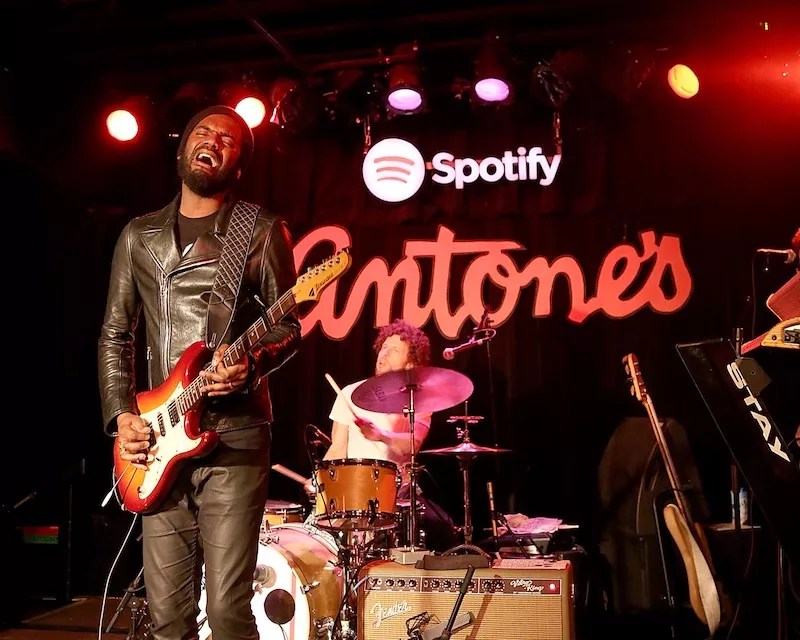
For exactly one hour, Clark and his four backers – second guitarist Eric “King” Zapata, Johnny Bradley on bass, drummer Johnny Radelat, and organ/keys maven Jon Deas – animated the upcoming album with all the hyperreal intensity of prescient DIY film deity John Sayles casting the bandleader in 2007 major motion picture Honeydripper. Third song last night, “Low Down Rolling Stone” twanged like a juke joint bump-and-grind straight out of that movie’s wood/shredding scenes. Clark made mention of ongoing band rehearsals doubtlessly for the group’s appearance on SNL this coming weekend, but the quintet proved tight and together from the first note.
Thick, chunky, gyrating blues set a pattern repeated all show: tangy organ coating a bruising, Beasties bomp, with Clark’s voice dripping throughout the whole. Dressed in a black leather and a black knit cap, the axe grinder chopped a deep Stax/Motown groove on second supplicant “When I’m Gone” as if he’d already departed on his next two years of road hogging This Land. “Low Down Rolling Stone” found Clark finally wringing a kinetic solo from his six-string.
A leap forward from his pair of non-live Warner Bros. platters, 2012’s Blak & Blu and The Story of Sonny Boy Slim in 2015, the upcoming disc balances the former’s urban cohesion with the latter’s bedrock roots dive. Its reverberations in a post-“This Is America” landscape are obvious, but the falsetto-infused Curtis Mayfield soul and backend’s rent party further Clark’s ascendance as a truly contemporary throwback to all-in-one Fifties R&B writers/producers/singers/players. That last hat flew off on gig midpoint “Feed the Babies,” which began skeletal until up through its bones ripped a screaming, guitar-face solo by Clark in full wail mode.
The one-drop reggae lilt of “Feeling Like a Million” featured a full-length neck scrape from the lead picker, and the succeeding “Gotta Get Into Something” burst as if Green Day and Detroit proto-punks Death split a single, complete with the exclamatory howl from the Rolling Stones’ “Brown Sugar.”
“I love this place,” said Clark afterward, shaking his head and smiling.
His comfort meant everyone else’s fulfillment.
“Gotta Get Up” prompted all five musicians to chant into their microphones until the room punctuated the chorus with its own outburst of energy. In contrast next, Clark dedicated the silken “Pearl Cadillac” to his mother and mopped his brow in conclusion to its palpable devotion. A shot of whiskey preceded This Land lead-off and firestarter namesake single, which in the face of all the black history that hustled and flowed before it came off somewhat muted. Ditto for sole encore “Guitar Man.”
Technicalities both, really, because the main event’s hardcore fanbase took home a reward of kings: 21st century Texicana ranging from T-Bone Walker and Joe Tex to Gary Clark Jr.
Antone’s set-list, 2-11-19
“What About Us” “When I’m Gone” “Low Down Rolling Stone” “I Walk Alone” “Feed the Babies” “Feeling Like A Million” “Gotta Get Into Something” “Gotta to Get Up” “Pearl Cadillac” “This Land” —————— “The Guitar Man”This article appears in February 8 • 2019.