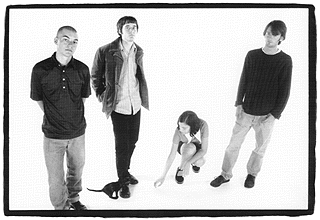
 |
most other young bands these days, Furry Things exude a virulent aversion to being affiliated
with any musical scene or movement. They are keenly aware of how quickly a
bandwagon travels from boon to bane, and they’re very careful to describe
themselves in a way that won’t give scoop-hunters the ammo to slap them with an
unsavory label.
“We’ve always been a band that likes to do all kinds of music,” asserts
guitarist/producer Ken Gibson. “We’re all about doing all kinds of music and
not sticking to one sound. That was always our idea from the beginning. This
band can never be just one sound. That’s what makes it interesting for
ourselves.”
What makes Furry Things different from umpteen other bands making the exact
same assertion is that they walk the walk. Witness the dichotomy between their
first album The Big Saturday Mission and the recently released EP
hedfones.
While the former was a pop-oriented collage of sound that conjured up
everything from Spector to Stereolab, hedfones hones in on the band’s
penchant for ambient noise on rhythm. The five tracks on hedfones are
eerie, wide-open soundscapes that tend to emphasize texture and utility over
melody and structure. “A lot of the EP came out of us playing together so much
and having different ideas for different grooves that we might lock into during
a live performance,” says drummer Charlie Woodburn.
An air of free-form experimentation was also a factor in the expansive nature
of hedfones. “Two of the songs came out of live jams during practice,
and one was just all of us going in one by one and throwing down a beat, a bass
line, guitar, and keyboards without knowing what it would come out like,” says
Gibson. “It was an experiment, but it turned out great.”
Although this direction has struck many Furry Things fans as something of a
departure, the band views hedfones as simply another step in their
collective musical continuum. “Everyone says it’s all so different, but it’s
only different because it’s all so concentrated toward one direction,” says
Gibson. “It’s more directed toward certain sounds, but there are still aspects
of that on the first album.”
As Furry Things evolve, their predilection toward dance music seems to become
more and more pronounced. On hedfones, “diskoteque” morphs Dance
Fever with Liquid Sky to chilling effect, and “buttercup” gradually
lulls you away with an endless dub groove. The band says more dance beats are
forthcoming on their next (still unnamed) full-length album, which they expect
to release by summer’s end.
“I think we were coming up with that old-style dance stuff subconsciously
because we were listening to old Blondie and stuff like that on tour,” says
keyboardist Chris Michaels. “And even before that, when we’d be jamming and
doing live improv, a lot of it would come out like dance music.”
Indeed, the very genesis of Furry Things can be traced to a rave where Gibson
met bassist Cathy Shive. The two began recording four-track tapes together
about two and a half years ago, with Michaels and Woodburn coming on board
shortly thereafter. “I used to rent four-track machines before I had one, and I
would just screw around night and day,” Gibson says. “You can get wonderful
sounds out of four-track, especially if you dub down. I have four-track stuff
you’d never guess was four-track.”
It was these four-track tapes that brought Furry Things to the attention of
Trance Syndicate. To this day, the band eschews traditional studio settings to
the greatest extent possible. By recording on Gibson’s four-track and
co-engineer Adam Wiltzie’s eight-track, the band saves money and avoids the
potential of creative conflict with house engineers. “I wouldn’t be able to get
a key and just walk into a studio by myself, but I can do that with Adam,” says
Gibson. “It’s important to be working with someone you like as a person. I’ve
worked with engineers who are like, `You can’t do this! It’s just noise!’ We
don’t want to work with people like that.”
Four-track prowess becomes even more crucial when your desire is to use
home-based technology to create colorful aural explosions of Brian Wilson
proportions. Although it’s not necessarily the first thing you hear, Furry
Things are all die-hard Beach Boys fans. “Still California” from The Big
Saturday Mission displays some veiled Beach Boys reference points, and
Gibson says the next album will have similar moments.
Perhaps the strongest testimony to the band’s Beach Boys fixation is the
scheme Shive and Gibson devised to see the Boys at San Antonio’s Sea World. “We
called Sea World and made up this big lie that we were with some magazine that
wanted to interview the Beach Boys,” recalls Gibson. “They gave us backstage
passes and free admission. We got backstage for about five minutes and we
started drinking margaritas and having a great time, but then we got kicked
out.”
“I think they kicked us out because we were laughing at John Stamos,” adds
Shive.
Furry Things will have even more opportunities to explore the California myth
when they move from Austin to Los Angeles this summer. “The ocean and the
weather is what’s drawing me to L.A.,” says Gibson. “It really has nothing to
do with music.”
“It’s not that we dislike Austin. We all like Austin, but we want to move on
to a bigger city. It feels like we’ve done everything there is to do, seen
everything there is to see, been everywhere we can go.”
Headlining the Trance showcase at SXSW is not at all a bad way to go out. In
spite of their residence in the live music capital of the world, Furry Things
have risen to headliner status without the aid of incessant gigging. In fact,
the band credits the exact opposite approach for their success. “A lot of the
big bands in Austin get a buzz and then burn out because they play every couple
of weeks,” notes Shive.
“We don’t play locally more than two or three times a year,” says Gibson. “Why
should anyone go see you now if they know you’ll be playing again in two weeks?
I’d rather have our gigs be an event, kind of like going to an amusement park.”
Furry Things headline the Trance Syndicate/Emporer Jones SXSW Showcase at
Emo’s, Saturday, March 15, 1am.
This article appears in February 28 • 1997 and February 28 • 1997 (Cover).