


Austin music proved a global bellwether at the onset of COVID-19 when the city canceled South by Southwest by declaring a local state of disaster. Loss of the capital’s most lucrative week, for the first time in the festival’s 34 years, made headlines around the country as it reverberated across artists, production workers, venues, Downtown businesses, and more.
The Moody Theater‘s last big gathering occurred March 11 at the Chronicle‘s Austin Music Awards, where Mayor Steve Adler, to a mixed audience reception, called the decision to shut down SXSW “something that had to happen.” Efforts to reschedule gigs held for only a few days before most music spaces announced shuttering and local orders closed all bars. Many remain boarded up.
Between the Rolling Stones at Circuit of the Americas on Memorial Day and Black Pumas‘ unprecedented four sold-out nights at Stubb’s just after Labor Day, spring and summer cancellations avalanched through the fall and winter. Amid devastating losses, Austin music rallied through drive-in concerts, livestreams, and fundraisers. Plus, local artists still delivered landmarks: Gary Clark Jr.‘s primetime performance of “This Land” on the Grammys telecast, Jackie Venson‘s November debut on Austin City Limits, and an inaugural Latin Grammy nod to Gina Chavez for La Que Manda.
Industry Impact
Following the fall of SXSW 2020, festival founders confirmed the organization’s insurance did not cover cancellation due to a pandemic. Days later, the company laid off about one-third of its staff in what a senior source characterized as “the only way to stop the bleeding.” SXSW plans for a virtual conference this March 16-20.
Following the January exit of co-founder Charlie Jones to start his own events company, local concert giant C3 Presents also endured major layoffs. In September, C3 workers called the reduction “widespread,” impacting “almost everyone except the directors.” December dealt a blow with closure of Texas’ largest independent concert promoters, Margin Walker Presents, whose co-founder Graham Williams told the Chronicle, “There’s definitely a live music scene in the future, it’s just further out than people realize.”

The Fight for Venue Funding
Despite billing as the “Live Music Capital of the World,” civic relief for music clubs stalled throughout 2020. In May, the Red River Cultural District and Music Venue Alliance Austin warned that surveyed Austin venues had, on average, 30 days of operational savings. Despite lengthy discussion by City Council, zero CARES Act funds for COVID-19 relief were reserved for venues.
During a summer of uncertainty and statewide ban on bar operations, some spaces reopened with food & beverage designation under loosened state rules. Local venue funding wouldn’t land on the agenda until September, pushed through by a series of rallies hosted by Austin Texas Musicians and the Amplified Sound Coalition. City Council eventually passed the SAVES resolution on Oct. 1, securing $5 million for clubs and approving guidelines for the Live Music Venue Preservation Fund on Dec. 3.
Efforts paid off when the Economic Development Department quickly opened up applications a week later, with the Long Center as administrative partner. Beyond city limits, over 20 Austin venues and promoters joined the National Independent Venue Association to support the Save Our Stages Act, which provides federal grants for operational costs at small venues. Recent inclusion of the plan in the long-awaited national stimulus package gave hope to indie venues nationwide.
Lease Termination
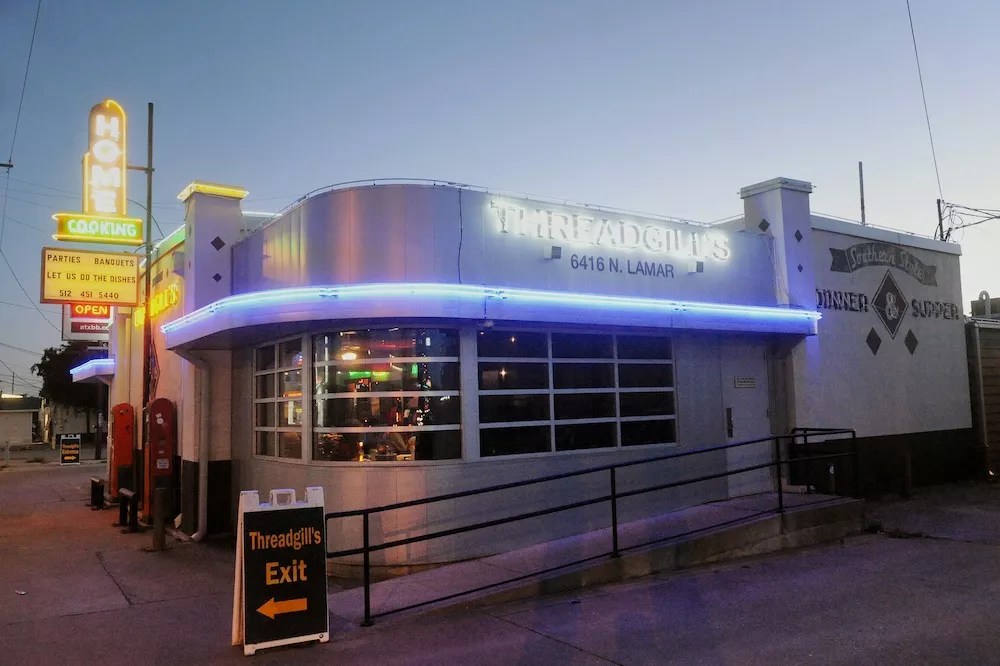
Venue relief funds arriving too little, too late forced many music hubs to terminate their leases. In order of closure announcement, 2020 claimed: Dozen Street, Threadgill’s, Buzz Mill Shady Lane, Shady Grove, Plush, the Townsend, Barracuda, Scratchouse, Unit 108 (formerly 523 Thompson), Skull Mechanix, One-2-One Bar, Dirty Dog Bar, B.D. Riley’s Irish Pub on Sixth Street, North Door, Buffalo Billiards, and Texas Mist.
Unprecedented Philanthropy
When Austin music workers found themselves out of a job, a local safety net of nonprofits stepped up. The RRCD quickly fundraised for Banding Together ATX, which distributed H-E-B gift cards to service and creative workers throughout the year, while the Health Alliance for Austin Musicians expanded offerings to assist with food, rent, and prescriptions. Both found support from June livestream A Night for Austin, which raised over $500,000 for nonprofits including Six Square.

Following warnings of funding gaps for health care, HAAM closed the year with upped support via Austin’s EDD and Travis County’s Central Health. On the same front, the SIMS Foundation stepped up to unprecedented demand in mental health and recovery services. Catering to health care workers and artists, Jonathan “Chaka” Mahone of Riders Against the Storm launched grants through the Diversity Awareness & Wellness in Action (DAWA) fund.
Alongside creative relief funds through Austin Creative Alliance and Sun Radio Foundation, local music patrons Black Fret pivoted to connect artists with well-paid corporate Zoom happy hours. Nonprofit Austin Texas Musicians asked artists to estimate their losses due to SXSW’s cancellation, pushing for the city’s first direct divvying of $1.5 million to musicians under the Austin Music Disaster Relief Fund. The June program provided local musicians $1,000 grants, overseen by the Grammys’ charitable MusiCares.

Black Lives Matter in Music
Nationwide protests over systemic racism prompted conversation about equity in Austin’s music industry. In June, guitar hero Jackie Venson dropped off a televised broadcast of Blues on the Green, citing few spots for artists of color in the event’s history. Blues on the Screen amended to a historic all-Black bill curated by Venson aired on Fox 7 Austin.
At UT, football players and members of the Longhorn Band pushed the university to reckon with the racist origins of spirit song “The Eyes of Texas.” In August, the band’s first-ever Black student org, LHBlacks, announced they would not play the song during football season. A recording blared on the loudspeakers instead.
In an unprecedented move, the Austin Music Commission voted to designate half of the long-discussed Live Music Fund to BIPOC (Black, Indigenous, and people of color) artists and organizations under a plan proposed by Commission Chair Mahone. The LMF, created last year, unlocked the first long-term fiscal support for the local music industry with a portion of hotel occupancy taxes. In the private sphere, Mahone’s Black Live Music Fund accepts donations to support Black entrepreneurs and musicians – including a Feb. 19 fundraiser at Empire Control Room.

In Memoriam
The last 12 months took too many legends of local music: East Austin pianist and Skylark Lounge resident Margaret Wright, outlaw country fixture Jerry Jeff Walker, songwriting sage Billy Joe Shaver, “Godfather of West Texas Music” Tommy Hancock, Willie Nelson drummer/accomplice Paul English, Tejano innovator Manuel “Cowboy” Donley, country troubadour James Hand, pioneering punk Hickoids/Next drummer Arthur Hays, Iron Age composer/guitarist Wade Allison, “Treat Her Right” rocker Roy Head, and “Whiskey River” author Johnny Bush. Recently, passionate Austin music photographer, poet, and all-around creative Nari Mann died Dec. 18 at age 40.
This article appears in January 1 • 2021.