

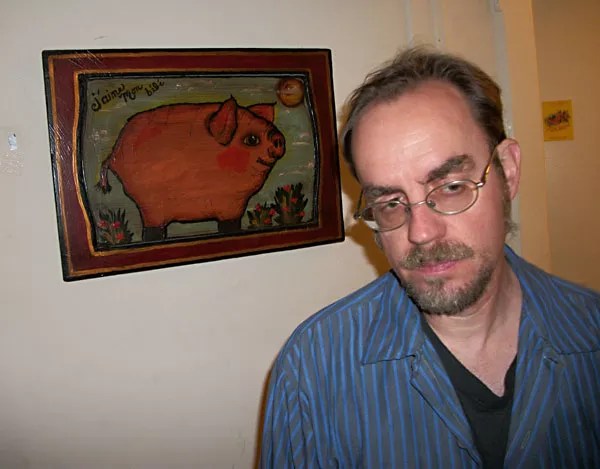
Wednesday, March 14, 11am, Austin Convention Center Room 11AB
In a world where bands teem like bacteria, how does anyone tap into the real goods? You look to digital musicologists. They’re behind a large portion of the music content on the Web. Suggestions you see on music sites (“If you like Van Halen, here are five other bands you may enjoy”) aren’t just computer-code magic. That’s actually the work of music writers.
“Music is something that is used socially,” says Chuck Eddy, celebrated music critic, new Austinite as of last year, and current musicologist for Rhapsody. “Humans have a much wider scope of knowledge than computers, and digital musicologists are providing a service. I find it kind of exciting that if I plug in albums, the next day someone clicks on something I put in there and discovers new music.”
The job entails a lot of different content creation, explains Eddy, “general metadata.” Metadata?
“Metadata is hard to define, but in this context, it includes band bios, album reviews, popular tracks, and similar artists. When I write, ‘This band is similar to these other 10 bands,’ the similarities might be artists they influence or related projects, some form of overlap,” says Eddy. “Again, the idea of a digital musicologist is that people benefit from having an actual human being guide them to music they might like. This isn’t some mathematical algorithm. You have to put bands in a context. Another part of metadata is placing artists in subgenres and even sub-subgenres. It takes human beings to do that.”
How does this affect the climate of music writing?
“The definition of what I do as a freelance music critic has expanded in so many directions,” muses Eddy. “Until a couple years ago, I was just a writer or an editor. Sometimes I miss writing 4,000-word reviews, but I have the short pieces down to an art form. It’s almost like writing a haiku. How much information and opinion can you pack into 600 characters? I like figuring things out – like where does country rap come from? Making connections is always what I’ve done.”
This article appears in March 2 • 2012.