

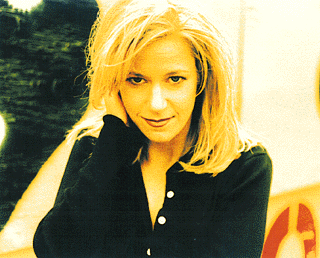
 photograph by Todd V. Wolfson |
good news is that you can still jump onto this bandwagon while it’s in its formative stages.
There is no bad news. Trish Murphy has only been in Austin for about six
months, but she’s been in Texas most of her life, and she’s been around music,
oh, since about birth.
“I kind of got a good lead as a kid because my dad was a musician down in
Houston, and in the Sixties he had this little pop band,” says Murphy. “So when
I was about 5, he’d write songs and make us [Trish, brother Darin, and sister
Gina] sing them with him. I remember he wrote this song about `Put all your
dreams in a white envelope and send them up to the Department of Hope’ and it
had this chorus about how they would take care of all your dreams. So he had
all the three-part harmonies lined out, and he told us what to sing. And it
became kind of a thing. We were the singing kids.”
Although Murphy grew up in Houston, her family moved around a bit with
stopovers in such thriving Metropoli as Baytown; Florence, South Carolina; and
Amarillo. Yet it wasn’t the kids’ frequent switching schools that made moving a
test, but rather finding a scene — creative minds with instruments — in some
of those places for the family to stay involved in making music. (For those
about to move to Dimebox, the Murphy family secret is to use community theater
as a gateway into artsy cliques).
So yes, it is location, location, location. Murphy’s music has a feel that is
exclusively southern, predominantly Texan, and decidedly small-town; listening
to Murphy you can hear the singer-songwriter in both style and content, yet her
voice also has tremendous range. She can transition from sweet and angelic to
haggard and beaten with purpose — as opposed to singers who perform vocal
gymnastics just to show that they can do it. For a parallel of the effective
variety, think Nanci Griffith on “It’s A Hard Life.” She begins with the
dulcet, “I am a back-seat driver from America,” but by the time she gets to
“Lord I can’t drive on the left side of the road,” she’s got this impassioned
rasp in her voice.
The big difference, stylistically anyway, between Murphy and the Griffiths or
even the John Prines and Guy Clarks of the world is that her songs have a
definitively pop component to them. You’re not likely to hear an Americana
artist say they used to love Elton John (which Murphy does), but unless you
make a conscious effort to avoid it, the things you grow up listening to are
going to end up in what you write. So, the mainstream part of her sound results
from Murphy’s listening to mainstream artists as well as singer-songwriters
when she was learning how to play.
“When I was like 11, I think, one day I just went in and asked my dad if he’d
teach me how to play,” she says. “So from age 11 to like age 14, I just played
guitar constantly. Come home from school. Play guitar. Sit around at night.
Practice. Listen to Eagles records. Practice. Listen to Heart records, anything
I could listen to. John Prine and Bob Dylan records — my dad gave me those
when I was first learning to play… but it’s almost like I’ve got too much of
that pop thing in my blood to just do singer-songwriter type stuff.”
After college in Dallas, Murphy turned down a production job with the Wall
Street Journal in Paris, and decided to turn her sights on a career in
music, eventually deciding to move out to Los Angeles. Fun and productive? No,
this is L.A. Murphy was surprised to see the metal scene still thriving, and
after a little less than a year she returned to Houston, putting together Trish
& Darin, a pop duo with her brother. The pair essentially created their own
circuit by going into places that didn’t have live music and asking if they
could play. After a while, she surmised that she’d “gone as far up the ladder
in Houston” as she could, and moved to Austin with a new batch of songs.
The songs, many of which appear on her debut Crooked Mile (due in
April), are only about a year old, surprising when you consider that the
33-year-old Murphy has essentially been a musician since age 11, but only
recently started writing her own material; she did co-write many of the
originals that Trish & Darin used to perform, but her brother carried the
load of the work.
“I knew it was going to be hard,” says Murphy. “And I think that’s why it
took me all that time of sort of weird preparation to find a voice and an
authenticity… I really wasn’t sure what was going to come out. I knew that I
wanted to do it, yeah, but it was almost like I couldn’t not do it [any
longer]. I was sort of driven at that point. So I just wrote and wrote and
wrote, and wrote some more.
“Unfortunately, songwriting is a very lonely and singular process,” she
continues. “But that’s where the authenticity factor comes in. If it’s
something that’s directly transcribed from my own experience, then the raw
feeling is there. It’s there. The only arbitrary part is how you want to word
it. And the way I do that is to condense it and make it as potent and as sweet
smelling as you can. I’ve put things into words that I’ve never really had to
put into words before, but it’s the one area of the entire creative and
performance process where I don’t rely on someone else’s input.”
As long as Murphy continues to produce and progress, then she shouldn’t have
to rely on the Department of Hope to take care of her dreams.n
Trish Murphy’s SXSW showcase is Friday, March 14, 9pm at the Ruta Maya Coffee
House.
This article appears in February 28 • 1997 and February 28 • 1997 (Cover).