

Despite being saddled with the moniker of “grocery snob” by my more
frugal friends, yes, I shop at Whole Foods, and until recently, that was where I
spent most of my grocery dollars. The reasons were multifold. There’s a store within
walking distance of my home. It offers organic produce. The meat and fish are of very
high quality. And it has unusually good baked goods and cheeses. There were
drawbacks — it took some time to develop an immunity to the self-indulgent loudspeaker
performances (at this point, I pay so little attention to the background noise in Whole
Foods that once I failed to notice an in-store performance by Austin Lyric Opera)
and it cost me — but I paid the extra money because it allowed me to shop and
escape in a reasonable amount of time, and I didn’t have to leave the neighborhood and
be trapped at a crummy superstore. Ultimately, it was convenience that tipped my wallet
toward Whole Foods, even though I knew I couldn’t get everything I wanted and that
what I did get was at boutique prices. In that way, it’s like shopping at a 7-11:
immediate gratification for a little more money. There’s also a Randalls in the
neighborhood, which I avoid until it’s recipe time and I need a reliable supplier of
marshmallow fluff or instant coffee. Randalls is remarkable mostly in its lack of
coherent organization. Recently, all cookies or crackers that fall under the umbrella of a
particular brand name, like Keebler, were placed together. This means that instead of being
next to the Nabisco saltines, the Keebler saltines are positioned next to the Keebler
chocolate chip cookies. Last weekend, I overheard an elderly woman lamenting:
“What have they done to my store? I don’t even recognize my store any more.”
In an age when grocery shopping is becoming something you can do over the
Internet, when ready-made dinners are a standard item, when superstores have some of
the most engaging architecture on the landscape, and when you can purchase organically
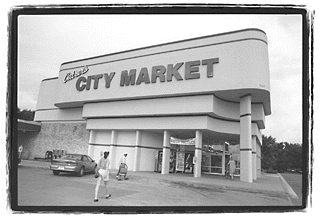
grown everything, Cutrer’s City Market appears on the horizon to bring you back to
planet earth. In contrast to shopping through space or in the hermetically sealed
biosphere of a superstore, Cutrer’s offers a more traditional approach — a
medium-sized grocery store intended to fit the needs of the surrounding community with
competitively priced items. It’s so different from the rest of our space-age grocery scene that it
seems almost novel.
Joe Cutrer, a lanky, blue-eyed, seasoned, sober grocer, learned his trade
locally, starting at the HEB across from Becker Junior High when he was 12,
“before the labor laws were stringent. I pestered them enough until they gave me a job. I
worked for them all the way until I graduated; I’d work after school. Wasn’t much
for school. I did graduate from high school, but I’m more or less self-educated in
business. After I graduated, I went to work for Safeway stores. I worked for them for
14 or 15 years, then I went to work for Rylander’s, who was an independant here in
Austin, and them Tom Thumb bought them, and I stayed with them until 1995. Actually,
Randalls had bought them two years prior to that, and I left Randalls at that point to
purchase these stores. I’ve done just about everything in the grocery business from
packing groceries to stocking all night to buying these stores.”
All five of Cutrer’s City Market stores — 1120 South Lamar, 611 West Ben
White Boulevard, 6319 Cameron Road, 200 Buttercup Creek Boulevard in Cedar Park,
and 1148 Airport Boulevard — occupy the structures of former Foodland stores. In
1995, Cutrer became General Manager of Foodland with the understanding that he would work
with the owner to remodel the stores, then buy them when they were ready. It took
a little more than a year. Cutrer purchased the stores from Foodland on October 17th,
1996, and the names were changed to Cutrer’s City Market on November 1st. The
transition was a smooth enough one that the stores never even closed. And although the
profit margin in the grocery business is small (a penny on the dollar is a
reasonable amount to expect from a profitable store), Cutrer believes that 1997 will be a
profitable year.
Cutrer’s stores are remarkable, filling an almost outdated, but
indispensible, niche. “There’s been a lot of market study on how to niche our stores
into the market, and obviously HEB, Randalls, and Albertson’s are much larger in the
size of the total company, and in the physical size of their stores. They offer
more variety… but there are a lot of people who don’t like to shop the large stores,
because it takes a lot of time, and some of them don’t like to walk the aisles;
different reasons. [The largest City Market, the one on South Lamar, is 22,000 sq. ft.] We
attract a lot of those people. We also find that because of where our stores are
located, they’re really neighborhood-oriented stores. What our strategy at this point in time
is is to become a really good neighborhood store. We know we can’t offer
everything, but if we can offer most of the basic items at a competitive price, and a good
produce and good meat selection, we feel like we can draw enough business out of
these neighborhoods to do pretty well,” says Cutrer.
Another facet of Cutrer’s marketing strategy involves catering to the
neighborhoods themselves. As small stores, they have allocated a greater percentage of
floor space than most other companies to products catering to the Hispanic population,
the fastest growing population in the United States. Mexican brands of chocolate, beans,
sauces, sodas, rolls, and other items take up a large portion of an aisle at the
Lamar store. “We try to give the merchandising in the store to the neighborhood, to
the people that shop that store, and we continually try to find out what they expect. We
have fairly large Hispanic sections in all of our stores except Cedar Park
(because there aren’t a lot of Hispanics living there).”
|
|
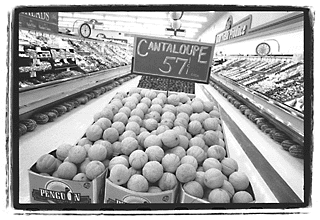
Cutrer’s is able to compete with HEB, the “low price leader in town,”
through a Houston supplier called Grocer’s Supply, which distributes products to
independents throughout Houston and South Texas. It’s able to consolidate buying since it
services so many stores, allowing independents such as Cutrer’s to be able to offer
products at a very low cost. In addition to ads in the newspaper, Cutrer uses a
bulletin board outside each store to advertise a “loss leader,” a product at a
peculiarly low price to draw people in. It works. I’ve been drawn in by 5lbs. of
potatoes for 49 cents, 12 cans of Coke for $1.97, and, most recently, 10lbs. of chicken
leg quarters at 39 cents a pound. Once you’re inside, signs advertising “Temporary
Price Reduction” flash seductively at every level. This isn’t old food, it’s a
“deal” offered to a grocer that Cutrer chooses to pass along to the consumer. The
result is that everything at Cutrer’s is practically free, and with little hassle.
They don’t have the best selection of fresh bread, organic produce, or a deli, but
I’m not going to be able to make just one stop per week, anyway. The most you can
hope for is a convenient grocery route: in my case, stopping in Cutrer’s for the
essential pantry stockers, and Whole Foods for any fish or organic produce I might
want, and the bakery in my neighborhood for fresh bread.
Superstores, such as the recently remodeled and enlarged giant HEB at
South Congress and Oltorf, are designed to save customers time and money. You can buy
everything — bread, hula hoops, birthday cakes, produce, hoses, meat, auto parts, beer,
etc. — and do everything — cash checks, pay bills, renew your driver’s
registration, pick up prescriptions, rent videos — but it seems to be a compromise. You
have to make only one stop, but it generally turns out to be a very frustrating one:
The fresh bread is nothing special, the produce fluctuates, the lines are long,
and the parking lot is a war zone.
In all aspects of life, you choose your battles. Grocery shopping is no
different. If you’re dedicated to eating a diet high in nutrients and low in pesticides,
your options are somewhat limited. Making organic fruits and vegetables a priority
can mean subjecting yourself to inflated prices, histrionic clerks, and a sorry
selection of potato chips. Decisions must be made: Is it worth the extra cash to eat
right? To support a local business? Is shopping at Wheatsville, Sun Harvest, or
Central Market worth a drive when Whole Foods is right next door? The list of
variables goes on and on.
In the past, I’ve pigeonholed myself into shopping somewhere that I can’t
necessarily afford because shopping where I want is infeasible for other reasons: HEB’s
Central Market’s prices, selection, and overall aesthetic make it my all-time
favorite, but its distance from home and the sheer magnitude of the floor plan take it out
of the running for me, except on special occasions. Each of the local supermarket
giants has produced its prototype of a bigger, shinier store for more convenient and
faster shopping, but I find it more aggravating to shop there. But the small parking
lot, store size, convenience, proximity to home, and prices of Cutrer’s City
Market bring in shoppers like me, who might normally be found at one of the larger
markets. And although Joe Cutrer is interested in expanding from just five stores, he
says, “We’re not interested in getting into the big stores out there; we’re going to stay
with neighborhood concepts and keep a store that will fit the neighborhood.”
This article appears in July 4 • 1997 and July 4 • 1997 (Cover).