

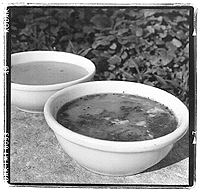
 photograph by John Anderson |
cooler climes, where the onset of fall and winter means the changing of colors, the donning of
sweaters, and the lighting of chimney fires, another seasonal rite of passage
exists — the transition from light, summery meals to dishes blanketed in warm
sauces. Fall and winter mark the return of sinful splashes of cream, luscious
layers of cheese, and hearty vegetable pur�es. Gone are the gazpacho and
cool green salads, forgotten the grilled fish and marinades of soy or citrus
fruits. What exits most kitchens during the chilling winter months has a
mission beyond mere nourishment: Cold weather food soothes the soul and warms
the body.
Regardless of where you spend your winter, whether in mild Austin or frigid
Philadelphia, one comfort food remains inextricably linked to the falling
mercury. Soup. Sure, we boast a number of warm weather favorites here in Texas.
But what better punctuates a brisk winter walk or invites you to curl up and
hibernate when it’s inhospitable outdoors than a steaming bowl of soup?
Pottery vessels revealing traces of boiled liquid enhanced with cultivated
grains provide proof that soup, or a close relative such as porridge, fed
prehistoric peoples as long ago as 7,000-8,000 B.C. One Biblical reference to
soup, the Old Testament story of Esau selling his birthright to his younger
brother Jacob in exchange for a pottage of red lentils, illustrates that the
piping hot preparation was valued for its comforting properties long before
chicken soup was adopted as a universal cure-all. Historians tell us that early
Native Americans enjoyed fortifying broths made from hickory nuts and served
hearty chestnut gruels. And in ancient Greece, street vendors hawked thick
bean, pea, and lentil soups as between-meal snacks, while their counterparts in
China perfumed steaming broths with flowers, herbs, fruits, meats, and fish.
As long as it has been around, it is no wonder that soup’s variations seem
endless. One favorite of Greek antiquity was “black broth,” a curious
concoction of blood, pork, vinegar, salt, and seasonings. Apicius, Rome’s
first-century gastronome, shared recipes for grain-and-legume-based soups in
his landmark cookbook, but also recorded a rather forward-looking recipe for a
pur�e of lettuce and onions. A 15th-century Venetian cookbook, De
Honesta Vouptate, details a recipe for hemp pottage (with an added warning
that over-consumption could spark nausea). Generally, however, soup is
associated with restorative qualities.
A Yiddish proverb says that worries go down better with soup than without, and
as far back as the 12th century, Hebrew scholar, physician, and rabbi Moses
Maimonides prescribed chicken soup as a cure for “black humor.” In France,
Alsatians claim their Weinsuppe, a delicate chicken and egg drop preparation,
is a remedy for arthritis. A favored post-natal gift to new mothers in
Scandinavia is fruit soup, believed to provide the extra strength needed for
nursing. And closer to home, menudo earns top marks as the ideal antidote for a
hangover.
Those simply seeking to warm their hearths with winter soup will find that cookbooks detail countless
different preparations, beginning with basic stocks and culminating in chunky
stews. Great French chef Auguste Escoffier, in his definitive, early
20th-century cookbook of French cuisine, held humble stock in such high esteem
that he deemed it “everything in cooking.” Indeed, stocks — themselves
numerous in kind — act as the building blocks for most other soups and while
they can be purchased canned and ready-to-use, it is difficult to reproduce the
rich, full flavor of the real, homemade thing. Stock isn’t difficult to
prepare. It’s about as easy as tossing some bones — leftover or fresh from
your butcher — into a pot over low heat with a few standard vegetables and
seasonings, covering the mess with water, and then basically, waiting.
Escoffier’s book, like classic American cooking guides such as the Joy of
Cooking, goes on to divide soups into categories, the most common among
them stocks, consomm�s, pur�es, velout�s, creams, bisques,
chowders, gumbos, and stews. While a local sampling of restaurant menus reveals that soup’s defining categories have long since
acceptably blurred, purists adhere to the following guide:
Stock: The liquid in which the bones or meat of beef, pork, fowl, or fish have
been cooked along with vegetables (typically carrots, onions, and celery) and
herbs (typically thyme, bay leaf, black peppercorn, cloves and occasionally
garlic), in order to extract the flavor (albumin) which is found within the
bones. Vegetable stock is typically derived from onions, celery, carrots,
leeks, and herbs and spices as detailed above.
Consomm�: Stock that has been clarified and enhanced with the addition
of lean meat, egg whites, and vegetables. Consomm� came into being when
King Louis XIV of France requested that his chef prepare a soup so clear that
he could see his reflection in it.
Pur�e: A thick soup traditionally made of starchy and/or mealy
vegetables such as beans and/or potatoes and blended until smooth.
Pur�es made from vegetables or herbs with a low starch content are often
thickened by the addition of rice, potatoes, or bread cubes.
Velout�: A pur�ed soup thickened by a white sauce made of roux
(melted fat and flour) and stock-based white sauce. Velout�s are then
bound with eggs and cream, and finished with butter.
Cream: Cream soups vary from velout�s in that they are thickened by a
bechamel sauce, not by eggs.
Bisque: While bisque has become the common term for a thick, slightly
gelatinous soup, purists define bisque as a pur�e of shellfish that may
be thickened by grains, a roux and fish stock, or bread cubes.
Chowder: A traditional American favorite made from fish or clams, salt pork,
potatoes and usually onions, carrots, celery, and garlic. New Englanders claim
authentic chowder is made with milk or cream while Manhattan chowder features a
base of tomatoes.
Gumbo: The defining soup of the South, gumbo gets its name from an African
word for okra. Gumbo is a stew thickened by a roux, as well as okra and/or
fil� — powdered sassafrass leaves.
Stew: A hearty preparation in which chunks of meat, seafood, and/or vegetables
have been cooked down in stock, milk, or cream.
Not up for putting the soup pot on at home? (Beethoven did say that “only the pure in heart can make a good
soup.”) Head to any of Austin’s favorite soup spots and indulge.
Chez Zee: Everyone knows to stop in to Chez Zee for dessert, but it’s worth
popping into the festive cafe for a quick bowl of their signature Corn and
Aztec Shrimp Bisque, packed plum full of popcorn shrimp and fresh kernel
corn.
5406 Balcones Dr., 454-2666
Cook’s Night Out Deli & Catering: Pick up a pint of the homemade
chicken-and-sausage gumbo or another soup of the day and serve it in the
comfort of your own home.
1221 West Lynn, 477-3945
Eastside Cafe: The soups at Eastside are nearly as famous as the garden. Pollo
tortilla is always on the menu, along with a vegetarian soup and a special soup
du jour. Home cooks will find inspiration in Eastside’s Soup Yourself cookbook, available in the restaurant’s gift shop.
2113 Manor Rd., 476-5858
Fresh Choice: One of the rare spots in town to cop a bowl of homemade New
England Clam Chowder. The restaurant’s soups — 2 soup du jour selections (one
always low-fat or non-fat) and the other menu standard, a low-fat Fettuccine
Chicken Noodle — are made fresh daily on the premises.
9761 Great Hills Tr., 795-9200
Hudson’s Grill: This casual spot’s soups took top honors in the Reader’s
Poll.
8440 Burnet, 458-5117; 13376 Research, 219-1902
Hyde Park Bar & Grill: Lentil soup has been a late-night favorite at this
neighborhood haunt for years. Hyde Park also offers a homemade soup of the
day.
4206 Duval, 458-3168
Kerbey Lane Cafe: Soup’s on at any time of the day or night, and the selection
is forever changing. Vegetarian preparations win rave reviews.
12602 Research, 258-7757; 2700 S. Lamar, 445-4451; 3704 Kerbey Ln.,
451-1436
La Madeleine: The creamy tomato-basil soup has made many an addict, and the
French Onion claims its fair share of fans as well. (Note: Tomato-basil soup is
now available in jars at the bakery.)
3418 N. Lamar, 302-1458
Little Mexico Mexican Food: Menudo is on the menu at the South Austin
institution every single day.
2304 S. First, 462-2188
Mother’s Cafe and Garden: The choices are constantly changing, but if you hit
the tomato/artichoke bisque day, you’re sure to be pleased. Mother’s always
features a dairy and non-dairy soup.
4215 Duval, 451-3994
Fortune Pho 75: Pho’s pho — aromatic broths afloat with noodles and herbs —
provide an inexpensive (and filling) taste of the exotic.
5501 N. Lamar, 458-1792
Red River Cafe: The cafe’s soup maker, Charlie, turns out home-style favorites
such as potato or broccoli and cheese daily and prepares a stick-to-your-ribs
black bean soup on weekends.
2912 Medical Arts St, 472-0385
This article appears in January 3 • 1997 and January 3 • 1997 (Cover).