


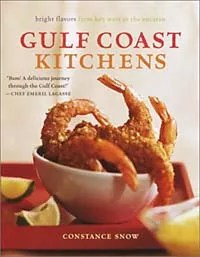
Summer is the time of salads and Summer is the time of salads and barbecues, cool cocktails and citrusy bites. It’s when we begin to crave bold flavors, spicy morsels, and tangy treats. A new cookbook from Constance Snow, writer for The Times-Picayune in New Orleans, captures these cravings and presents them in recipes of concise wording with easy-to-follow directions. In Gulf Coast Kitchens: Bright Flavors From Key West to the Yucatán (Clarkson N. Potter, $32.50), she has compiled hundreds of recipes that define the traditions and tastes of America’s third coast. Snow’s Gulf Coast is diverse and multifaceted. She has collected recipes from roadside dives, five-star restaurants, local cooks, and even her own personal repertoire.
Don’t be fooled: This isn’t one of those comfort-food cookbooks that pretends to capture some imaginary “essential” Gulf Coast through antiquated, stale recipes. Snow happily places fusion fare alongside the old standards. For instance, contemporary chef Mike Christensen’s award-winning oysters in Champagne Sabayon With Wilted Spinach shares the pages with a more traditional Creole filé gumbo. Snow’s inclusive attitude toward her subject extends also to the cultural influences she associates with Gulf Coast cooking. Sure, the standards are there — African, French, Spanish, and Mexican. Snow has included recipes for black-eyed-pea fritters, Acadian chicken and dumplings, jambalaya, and tortilla soup. But she correctly recognizes such contemporary cultural influences as Greek, Vietnamese, and Cuban. These ethnic groups have placed a major stamp on the Gulf Coast culinary landscape during the past half-century, though too often people fail to acknowledge it.
Her recipe for Florida spiny lobster with moje de ajo is as refreshingly delightful as it is simple to make. Another for Vietnamese sweet-and-sour soup, sweetened with pineapple, has real appeal for those blazing summer days on the coast. In fact, there are so many great recipes in this book that it will take most cooks many years to exhaust them. A brunch-time recipe from the historic Island Hotel in the Florida Keys for Shrimp and Cheddar Cheese Grits Topped With Bacon Gravy has got to be one of the more sultry dishes I’ve ever eaten. Meanwhile, a mouth-watering crabmeat cocktail with Mexican crema, mango, and avocado aptly captures the sunny sparkling waters and lazy beach-time atmosphere of the Gulf Coast. In between these charms, Snow seasons the pages with nuggets of advice for the everyday cook: how to shuck oysters, trim an artichoke, and the art of picking quality seafood. Gulf Coast Kitchens is simply a necessary text for every summer beach house and every cook who loves to eat. — Rachel Feit
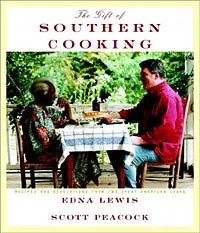
With the 2003 advent of The Gift of Southern Cooking: Recipes and Revelations From Two Great Southern Cooks (Knopf, $29.95) seven years in the making, there’s been much curious press coverage about this odd couple of Southern cuisine. Edna Lewis is an elderly African-American chef and cookbook author from Virginia, a grandchild of slaves who became revered as the bohemian and formidable chef at Cafe Nicholson and Gage & Tollner in New York. Scott Peacock is a young white man from Alabama, formerly a chef at the Georgia governor’s mansion and currently acclaimed at Watershed restaurant in Atlanta. First professional colleagues, then collaborators and energetic proponents of classic Southern cooking, their friendship has developed into a mutually devoted familial relationship, with Peacock taking the increasingly frail 87-year-old Lewis to live with him, assuming the role of her protector and caretaker.
Out of this gentle and powerful relationship has emerged a quietly joyful, beautifully produced book of Southern recipes that encompasses traditions from both of the authors’ backgrounds, as well as from their research into the breadth and depth of the foods of the American South. The recipes are peppered with useful cooking techniques and contextual foodways, and the volume is generously larded with gorgeous photos.
The voice in the writing is that of Peacock, but the stories, recipes, and philosophy reflect the history and palates of both authors; the collaborative result is a book full of grace, informed creativity, and above all, flavor. Particularly now, just as the bounty of summer crops are coming on, this Southern sensibility and these simple but sophisticated recipes really resonate for me. My farmers’ market supper tonight of tomato aspic, fluffy corn fritters, and creamed scallions constituted a happy prelude to a lot more cooking from this lovely book. — MM Pack
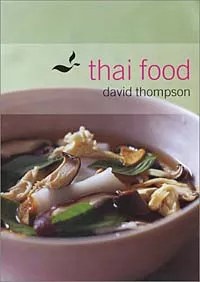
David Thompson‘s magnum opus Thai Food (Ten Speed Press, $40), which was 10 years in the making, is without question the most comprehensive and complete cookbook written in the English language on the cuisines of Thailand. Thompson got waylaid accidentally in Bangkok during a holiday, became enthralled with the people and food, and within the year had moved there permanently.
He soon became the apprentice to a master of ancient royal cuisine and began to chronicle her recipes. He also researched the old memorial books (a practice in Thailand and Laos whereby recipes, among other things, are recorded to celebrate the accomplishments of the deceased) for the recipes they held, judiciously testing them to establish accurate measurements where none existed before. His hard work is to our benefit.
The book begins with an exhaustive 100-page overview of Thai history, culture and society, and regional variations, which put the foods of Siam into proper perspective. Next follows 85 pages explaining thoroughly the importance of rice and its production, the intricacies of the Thai kitchen and basic cooking methods, and a complete glossary of all ingredients.
The recipes cover every aspect of Thai cooking, both ancient and modern, from the most-basic popular dishes found on the typical Thai menu to the most complex of the royal dishes, while covering every single region of the country. A good example of the esoteric extreme is the recipe for Prawn and White Turmeric Salad. I have eaten this elusive dish in Chiang Mai at the Diamond Mountain Restaurant. White turmeric is found only in the far north of Thailand and has a superb taste reminiscent of subtle young ginger with a suggestion of sweet turmeric. I never expected to find a recipe for this incredible dish in any cookbook, much less one written in English, yet here it is, complete with suggestions for substitution.
You’ll find every recipe clearly written and easily followed, with extensive headnotes and comments. The book is lavishly illustrated with superb photos and clearly indexed. Never before has such a complete collection of Thai recipes and background information been assembled in such a concise manner. Thompson’s passion for Thai food shines through brightly, making for a superlative cookbook on the cuisines of Siam. If there is room for only one Thai cookbook in your collection, this is the one! — Mick Vann
Like many people I know, I travel, in large part, to eat. Everywhere I go, I seek local specialties in out-of-the-way, hole-in-the-wall eateries, markets, and neighborhoods, occasionally splurging on exquisite dinners in fine dining establishments. Food discoveries almost always involve interesting experiences with people and culture, and this is important when traveling. Food, being a common thread among all human beings, can deepen our understanding of cultures vastly different from ours, and make our travels even richer, building bridges between people and creating memories that will last a lifetime.
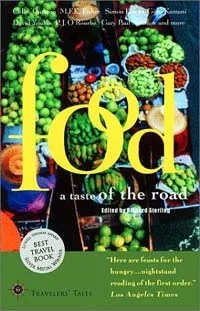
This collection of stories, Food: A Taste of the Road (Richard Sterling, ed., Travelers’ Tales Inc., $18.95, paper) will take you, through the personal experience of the writers, on a world tour of experiences as they make connections with people and places through food, revealing humanity through cuisine.
The stories are diverse and run the gamut of emotions, touching subjects like love, war, food taboo, language barriers, and social injustice. Some are intense and poignant, like “All Guns, No Butter,” by P.J. O’Rourke, which recounts his experience as a reporter in Somalia in late 1992. Others are lighthearted and funny, such as “Spanish Guts,” where Brett Allen King witnesses his friends’ participation in a feeding frenzy of “variety meat” while they discuss sex at a Madrid tapas bar. In “Tomatoes,” author Richard Goodman discovers a practical joke in his garden in Southern France. “Night of Oranges” is a touching story, written during the time of the revolution by an 18-year-old Romanian exchange student. Some of the stories might trigger personal memories of travels past. Julia Duffy Ward‘s “One Woman’s Spice Route” and Danny Carnahan‘s “Kenyan Barbeque” brought back memories of my own travels and experiences abroad.
This is a good, satisfying book for easy summer reading that will entertain and inform. It may be just the thing to appease the “travel bug,” at least for a short while, before it bites back with a vengeance. — Claudia Alarcón
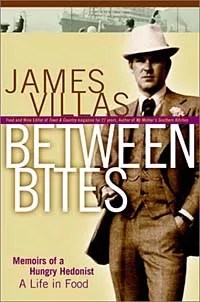
James Villas, former longtime food editor for Town & Country magazine and food writer for Esquire, does not tell all. A memoir differs from an autobiography in that the writer has complete license regarding what not to include. Between Bites: Memoirs of a Hungry Hedonist (Wiley & Sons, $24.95) is a compendium of loosely chronological chapters, each focusing on a different topic and usually built around beautifully written profiles of the food-world friends Villas admires and respects — chefs, food writers, educated gourmands, and great restaurateurs of the old school.
As is often the case with the best chroniclers of life observed, Villas writes humorously and lovingly, if sometimes mercilessly, about the amorous, alcoholic, gluttonous, and neurotic foibles of his fellows, while dwelling very little upon himself. Nonetheless, his personality, interests, and quirks clearly shine through his thoughtful observations and accomplished prose. Villas began his professional life as a professor of French language and literature; this literary grounding serves his writing very well.
A handful of themes emerge, from which Villas does not shy away. One is his unabashed passion for the good life, his très riche 40 years of eating, drinking, travel, and conversation in the company of such notables as Craig Claiborne, M.F.K. Fisher, James Beard, Paul Bocuse, and Paula Wolfert. While he has no quarrel with eccentric or bawdy behavior and indeed revels in dishing those tales, he is certainly intolerant of ill-breeding or bad manners; woe betide anyone who exhibits such in his presence.
And finally, Villas is vehemently and eloquently a purist and has no use for food celebrity or culinary invention for its own sake. He despairs of what American gastronomy has become by the end of the 20th century. “My stance hasn’t exactly made me popular in the arch food world, but I no longer care, and at least my gustatory passion is once again intact.” — MM.P.
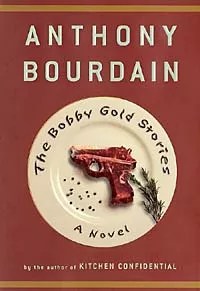
In Anthony Bourdain‘s latest novel, The Bobby Gold Stories (Bloomsbury, $19.95), we follow the exploits of that loveable scruff Bobby Gold, an enforcer and security manager for a small-time loan-shark mob thug with a popular nightclub. Bourdain again shines brilliantly in his prose, injecting the reader directly into the tribal world of the sleazy side of late-night Manhattan. Bourdain’s descriptive and hilarious narrative will have you feasting on the sleazy slices of life that lead Bobby Gold toward his unforeseen end. Gold’s true nature is revealed early on when we witness his tuneup of a fishmonger who’s late on his gambling-loan payments. The scene Bourdain sets assures us he knows the inside of a seafood market, describing the fish scales and guts to perfection. Gold could have just beaten the old man and left, but he first offers him Demerol to kill the pain and lets him pick the arm to be broken. The fast action centers on the club and its kitchen and the after-hour haunts of its employees and overflows with scenes that illustrate the abusive but good-natured banter between the knuckleheads working there. We meet Nikki, the “sauté bitch” queen of the cooking line who becomes his lover, but only after she approves his musical tastes: “I need to see your record collection. … I see any fucking Billy Joel in there and this ain’t gonna happen.” Bourdain has again proven his steely grasp of the underbelly of the food scene of New York and filled Gold’s world with rich characters that are instantly recognizable to anyone who has ever walked on the wild side. The pace accelerates throughout to a crashing crescendo, giving us a highly enjoyable read that you can’t set down until you reach the surprising end. For foodies and mystery fans, a must read! — M.V.
Anthony Bourdain will be at BookPeople tonight, Thursday, June 5, at 7pm.
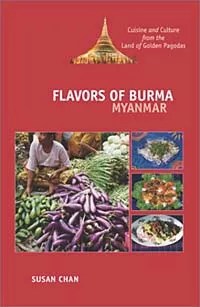
You have more fingers on one hand than there are cookbooks in English that cover the cuisine of Burma. Susan Chan‘s Flavors of Burma-Myanmar: Cuisine and Culture From the Land of Golden Pagodas (Hippocrene, $22.50) is the first among these that delves into the cultural aspects shaping the cuisine, while giving the reader a comprehensive collection of well-written recipes aimed at the Western kitchen. Burma has always seemed mysterious and exotic as a country, and there are few Burmese restaurants in America where one might sample the food. With the release of this title, Chan has erased the mystery and brought the wonderful foods of Burma into the spotlight.
Burmese cuisine is a richly spiced amalgam of tastes, heavily influenced by its neighbors (Thailand, China, Bangladesh-India), yet the flavors are unique and original. Chan eruditely explores the history and culture, offers an intriguing travelogue around the country, fully explains the kitchen and its ingredients, and then launches into a full-scale array of recipes, which have been used by her family for generations.
The recipes are easy to follow, the ingredients easily available here in Austin, and the tastes unlike anything you have ever eaten. You’ll find dishes such as Curried Split Pea and Prawn Soup, Fish Cake Salad, and Chicken With Spicy Curry Leaf Gravy. Imagine ending your meal with Glutinous Rice Cake With Coconut and Butter and the classic Fermented Tea Leaf Salad.
Chan opens up the world to the amazing tastes found in her native country in a way that makes them seem really simple, while enforcing the exotic nature of this beautiful cuisine. Flavors of Burma is definitely a title that belongs in any international cookbook collection. — M.V.

Literary food writing is once again alive and well. When publishers realized foodies were buying cookbooks for bedtime reading as much as for actual cooking, it must have occurred to them that culinary nonfiction seasoned with a few recipes would be much cheaper to produce. The culinary memoir market has exploded with each new writer being touted as the literary heir to the legendary M.F.K. Fisher. While only Colette Rossant comes close to Mrs. Fisher’s writing prowess in my opinion, these four books released in the past six months made very enjoyable reading. — Virginia B. Wood
Missouri-born novelist Jeremy Jackson is on a mission. He wants cornbread declared the official bread of the United States, and he makes a strong case for it in this witty little love story. Cornbread in all its permutations is the object of Jackson’s affections, and he offers history, family anecdotes, and 40 inviting recipes to make his case for cornbread canonization. The Cornbread Book: A Love Story With Recipes (HarperCollins, $14.95, paper) is a delightful, easy read with recipes that are likely to send cornbread lovers racing to the kitchen. Dishes such as Velvet Spoonbread (a rustic American soufflé), Buttermilk Cornbread (always made without sugar at my house), Zaletti (crumbly Italian polenta cookies), Indian Pudding (a classic early-American dish), and the unique Popcorn White Loaf (a wonderful, nutty yeast bread made with popcorn flour) make this slim volume a necessary addition to any corn lover’s recipe collection… In much the same way chef Anthony Bourdain exposed the seamy underbelly of restaurant kitchens in Kitchen Confidential, young Connecticut restaurateur Courtney Febbroriello uses her personal story to reveal the day-to-day operations at the front of the house of a chef-owned restaurant in Wife of the Chef: The True Story of a Restaurant and a Romance (Clarkson N. Potter, $24). While her style is not nearly as raunchy as Bourdain’s, Febbroriello’s tale is every bit as true and engaging in its own way. The author and her chef husband, Chris Prosperi, are the owners of Metro Bis and Metro Express in Simsbury, Conn. In Wife of the Chef, Febbroriello chronicles their romance, purchase, and operation of their first joint venture. The author makes it clear that she’s not some foodie who swoons over every new culinary innovation; in fact, she’s a self-described picky eater who rarely enjoys her husband’s eclectic creations. However, she’s particularly adept at providing insights into what it’s like to be the often-invisible wife of a star chef, as well as the organizational backbone of a small family business. Just as Kitchen Confidential should be required reading for every culinary student, any couple contemplating the equally challenging joint ventures of matrimony and restaurant ownership should read Febbroriello’s book… The New York Times food columnist Amanda Hesser has been the darling of the New York culinary writing world since the publication of her award-winning The Cook and the Gardener in 1999. In Cooking for Mr. Latte: A Food Lover’s Courtship, With Recipes (Norton, $23.95), Hesser has turned the diary of her romance and eventual marriage to Tad Friend into a charming memoir. The diary also works as a personal recipe collection, complete with dishes adapted from family heirlooms or magazine articles and books published by her friends, as well as the occasional dish inspired by her romance. The story begins with their inauspicious blind date, where Tad made a totally unsatisfactory restaurant suggestion and ordered a latte after dinner, earning his nickname and demonstrating to Amanda his need for major reform. The tale ends a year later with their joyous wedding at Tad’s parent’s summer home on Long Island. As much as I enjoyed the inside dish on New York’s food writing circle, I found myself somewhat annoyed by Hesser’s many earnest culinary snobberies. I kept hoping she’d get over herself and that an obvious great catch like Mr. Latte had the patience to overlook or learn to abide her prejudices. Judging by the last chapter, they obviously worked it out without my advice… Award-winning journalist and Daily News columnist Colette Rossant has expertly fashioned a uniquely appealing coming-of-age story from her personal experiences in Return to Paris: A Memoir (Atria, $22). Rossant engages all our senses in descriptions of a childhood among her father’s Sephardic Jewish family in warm, sunny Cairo and then creates sharp contrast when she’s uprooted by a vagabond mother to live with her French-Catholic grandmother in cold, dreary post-WWII Paris. The constant in these vastly different households turns out to be the kitchens, staffed with loving, generous cooks who feed the lonely young girl’s soul and pique her culinary curiosity. Later, there’s a stepfather who proves to be both culinary soul mate and mentor to Colette, teaching her to recognize and appreciate haute cuisine as she accompanies him in search of chefs to staff his many hotel properties. He will also be her one ally when she scandalizes her proper French family by marrying an American. Rossant’s prose brings ordinary experiences to vibrant life, moving with grace from descriptions of great meals to inviting recipes. As her story begins with a return to Paris, it ends with one, as well. Rossant and her American husband vacation in Paris, returning to the cafe Jour et La Nuit where their romance began and they planned their future together. It makes a fitting end to her story and the happy beginning of a 47-year marriage.
This article appears in June 6 • 2003.