


Today’s five-person panel of engineers, analysts, and designers working on the Mars 2030 virtual reality experience has some good news and some bad news. First, the bad news: You’re not going to Mars. Not really. Now the good news: Some top minds are working on the next best thing.
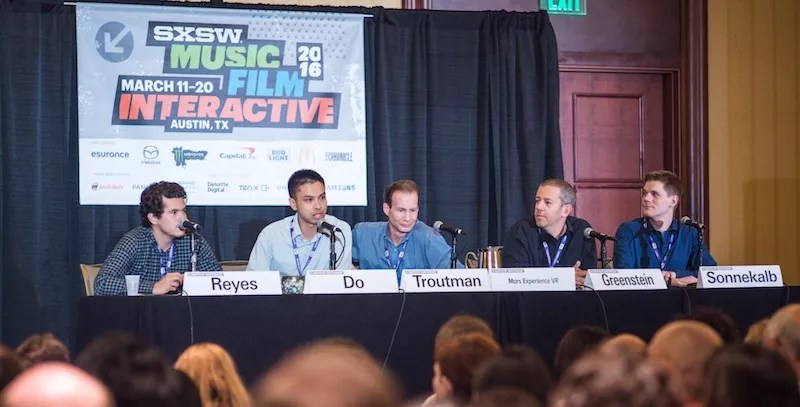
“Only one out of a billion people will be able to go to Mars in our lifetime, maybe two out of a billion,” said panelist Patrick Troutman, a senior systems engineer and NASA Human Mission Planner. “We all deserve more than that. We should be able to go along for the ride. Virtual reality is a way we can,” he said. NASA is collaborating with MIT’s Space Systems Laboratory and FusionVR to produce a virtual reality experience they’ll make available via a variety of platforms at no cost. It uses real data from NASA’s Mars orbitals (along with data from other international sources) to map the surface of Mars, and reproduce it in a realistic fashion that will enable users to walk and drive on the surface of the Red Planet.
Of course, pulling that off is no small task. The amount of data is overwhelming, and the photos they’re using all contain distorted images, since they’re scans of a round planet. Co-panelist and technical designer, Justin Sonnekalb, touched on a fewer of the odder challenges he faces, like issues with coloring. “No one has actually stood on Mars,” said Sonnekalb. “No one can tell us exactly what it actually looks like. And the kicker is that 85% of all the images you’ve seen of Mars are not expected to be the colors you’d see if you actually stood there,” he said. Instead, they’re colored to improve contrast for scientific study and for guiding the rovers. “The end result is that only about 15% of the images you find out there are actually balanced to look like they would if you were standing on Mars.” Part of his job is to color match the other 85% to those, and sometimes it’s counterintuitive. For example, at noon on Mars he described the actual sky as “butterscotch” in color, while at sunset the sky turns blue. “It’s quite different than Earth,” he said. “In fact, it’s basically the opposite.”
The team plans to release the collaboration for the Oculus Rift, Google Cardboard, and Samsung VR Gear, as well as for iPhone and Android. Down the road, it could help train astronauts for the actual trip to Mars. Another reason NASA’s interested in the project.
Mars Experience VR
Wednesday, March 16, Austin Convention CenterThis article appears in March 11 • 2016.