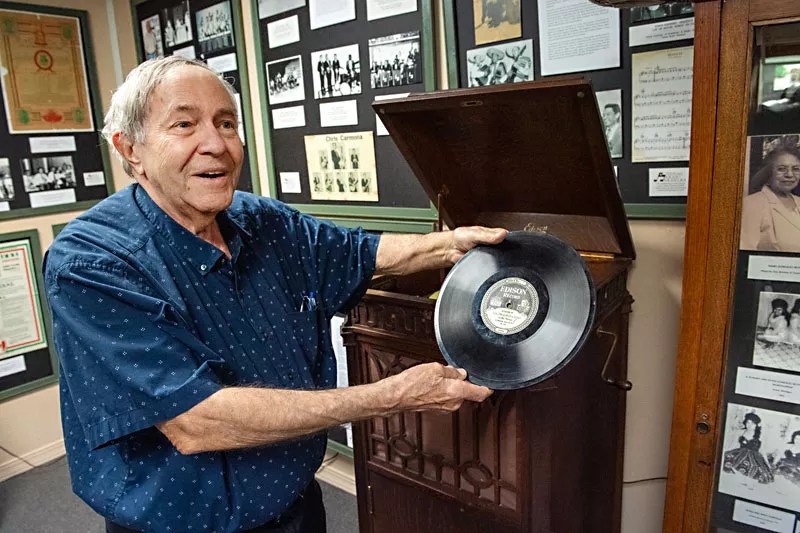
Guiding a tour of the Texas Music Museum one Thursday, President Clay Shorkey pontificates on the Lone Star musicians who most influenced their genres. “Willie Nelson, Stevie Ray Vaughan,” he trails off, name-dropping the state’s biggest exports. “There’s so many [other] people, but they’re all either Black or Mexican. And we don’t have statues of [them], so we pretty much found all these people.”
Since 1984, Shorkey has traveled across the state conducting primary research on Texas musicians – primarily, musicians of color. He’s interviewed Native American tribes and come to befriend Austin trailblazers in Tejano and blues; many of the hand-painted frames in the museum, located in the East Austin Economic Development Corporation’s Marvin C. Griffin Building at 1009 E. 11th, contain pictures that the archivist and retired UT-Austin professor took himself.
When Shorkey and volunteers Jay Stanley and Sylvia Morales give tours of the Texas Music Museum, they play their subjects’ music as it was originally recorded, on 45s, 78s, and even cylinders on a plethora of 20th-century phonographs. It’s an impressive addition to the gallery’s collection of news clippings, sheet music, and first-person interviews, but according to the co-founder, the 2,000-square-foot building showcases only a fraction of his archives.
“We have 90% more than what we can show in this little building,” Shorkey says. Community Engagement Manager Morales, who organizes presentations of the museum’s offerings at local Title I schools and senior centers, estimates another 25 exhibits – spanning genres like rock, gospel, Tejano conjunto and orquesta, country, jazz, and hip-hop – are stowed away at an Austin Police Department storage facility, which the museum must vacate by next summer.
“We’ve got more than 100 interviews that we’ve done all over Texas, and I’d like to have some money to have someone to be able to transcribe, digitize, [and make] all those materials usable.” – Clay Shorkey
In recent months, the Texas Music Museum has appealed to the city for support in locating a bigger gallery space. In July, the team proposed a three-phase plan to the Music Commission, envisioning relocation from its current building to a spot with 13,000 square feet of working space, as well as another 1,000 feet in storage. The presentation requested $333,300 to fund the move and to revamp the museum’s staff from part-time volunteers to a salaried executive director, education manager, two part-time docents, and four interns. The commission formed a working group to assist the museum in refining a proposal for City Council, which the team plans to present this month.
Besides expanding its team, city support would allow the Texas Music Museum to properly preserve its archives, currently stuffed in the building’s cluttered front office. “We’re gonna try to get some funding so we can pay somebody [to work] on all the [photo] negatives,” Shorkey explains. “We’ve got more than 100 interviews that we’ve done all over Texas, and I’d like to have some money to have someone to be able to transcribe, digitize, [and make] all those materials usable. We have a massive collection of recordings, but it’s not systematically organized.” Recently, the 81-year-old has used his Social Security money to pay an intern to place documents into acid-free folders.
Local arts grants also support the Texas Music Museum. A 2023 check from the Creative Space Assistance Program allowed the team to restore their air-conditioning unit after a summer of sweaty tours. More recently, $50,000 from the Elevate program went toward volunteer pay.
In addition to giving tours and presentations with Morales, Stanley highlights museum subjects on the Texas Music Museum Instagram page and curates events based on the artists. He’s previously hosted tributes to recently departed figures W.C. Clark and Dr. James Polk, while on Aug. 2, he and a team of musicians from UT-Austin and Huston-Tillotson University will perform the music of groundbreaking African American musicians from East Austin, like Damita Jo Deblanc, Dr. Hepcat, Teddy Wilson, and Pee Wee Crayton. Like all of the museum’s tours and events, the performance is free to the public.
The Aug. 2 event follows a previous East Austin tribute Stanley hosted last month, which Morales said inspired a large turnout. “A lot of people from the community came out … they added onto it because they knew a lot of the people that he was presenting about,” she says.
This community crowdsourcing has become a Texas Music Museum standard. “We get to know people and build positive, good relationships [with other museums and community members],” Shorkey says of his research process. “A lot of these folks ended up being like family. That’s why you’ll see, wherever we could, we got baby pictures or high school pictures, because we were trying to focus on not only the musicians, but the people.”
Giving a tour of his extended “family,” Shorkey speaks with reverence about the unsung locals who contributed just as much to Texas culture as those household names.
“There’s a lot of stories about not just winning a Grammy or something, you know?”
The Texas Music Museum presents “A Tribute to East Austin African American Musicians” on Friday, Aug. 2.
This article appears in August 2 • 2024.