

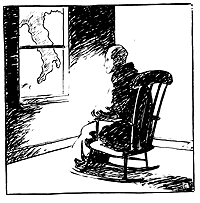
 illustration by A.J. Garces |
my grand-
father Vincenzo Ventura found the time or inclination for Shakespeare, I don’t
know. Born in Sicily in 1883, he arrived in New York around 1905. He worked
with his hands all his life, until his final illness in 1970. Soon after he
came to this country, he was arrested for running down a street in East Harlem
shooting a pistol — it had something to do with someone making eyes at my
grandmother. The family is unclear about whether he went to prison for this
incident, but I have learned that when my family is unclear it’s usually
because they have something to hide.
To put it mildly, Vincenzo was difficult. My father, now nearly 81, told me
recently: “I remember when he hit me, and when he came at me with a knife. I
remember when I was about eight and I’d gotten a beating by some kid at school,
and I came home crying. My father put a steak knife in my hand and he said,
`Here, take this to school with you tomorrow.’ I cried more, and I said, `But
he’ll bleed.’ My father made fun of me for that for the rest of his
life.”
After a long silence Papa added: “I hated my father because he didn’t pay
enough attention to me — because he didn’t make me feel like a man. When
people asked me, as a boy, `What do you want to be when you grow up?’, I would
answer, `Not like my father.’ I’m an old man now, and I realize that I never
really saw him the way he was.”
What had started this conversation was Kenneth Branagh’s new film of
Hamlet. It reminded my father of the one time he feels that he saw into
his father’s heart.
It was on an Easter during one of those endless Sicilian meals, where plate
after plate is set on the table and people eat and drink wine for many hours.
My father was about six, which means that Grandpa Vincenzo was about 39.
Suddenly, Grandpa stood up (he was probably tipsy) and began reciting from
Hamlet. Vincenzo’s voice boomed. His gestures were exaggerated, in that
Victorian style of acting that seems so comical to us now. For moments, the
other relatives were stunned, and my six-year-old father was enthralled. The
words cascaded out (in Italian) — the “Get thee to a nunnery” speech,
delivered to Ophelia while Polonius (her father) and the King (Hamlet’s
stepfather) hide and listen:
“I am very proud, revengeful, ambitious, with more offences at my beck than I
have thoughts to put them in, imagination to give them shape, or time to act
them in. What should such fellows as I do crawling between earth and heaven? We
are arrant knaves all. Believe none of us. Go thy ways to a nunnery. Where’s
your father?”
For moments, my father was proud and amazed — and then all the relatives
began laughing. To give them their due, a drunken Vincenzo doing a poor
Sicilian imitation of John Barrymore was probably pretty ridiculous. But my
father remembers that their laughter was not good-natured. It was merciless
mockery. For one of the only times in his life, Vincenzo wilted and became
sheepish and ashamed.
“I knew even then,” my father remembers, “that it was Shakespeare. Papa talked
to me when I was little about Shakespeare.” When I asked how a barely educated
laborer could talk about Shakespeare, my father said that Grandpa played in
amateur theatricals in Italian Harlem. Had Grandpa played Hamlet? My father
wasn’t sure, but thought it likely — why else would he know the speeches by
heart? He may at least have auditioned for the role. But perhaps I’m not giving
Vincenzo his due. Charismatic all his life (he was fathering children in his
70s with a woman 40 years younger), with strong features and blazing eyes even
when I knew him, he would have been stunning in his early 20s — physically, a
good choice for Hamlet, especially among the kind of pickings an amateur group
usually has. And Grandpa was not the kind to settle for bit parts. So who
knows?
The speech ended, “Where’s your father?” It was as though my father was being
asked that question by his father. And when my father became old, he would (by
telling the story) pose that question in turn to his son. Kenneth Branagh
stages Hamlet in a magnificent hall of mirrors — an apt choice. For
when Shakespeare appears in our lives he often places us in just such a hall of
mirrors. So my father and I are both confronted by my grandfather — confronted
with the question, “Where’s your father?”
Seventy-five years later, that boy, Michael Luciano Ventura, could not forget
it, and had to tell me — his son, Michael Vincent Ventura. See: Even our names
are halls of mirrors. (And isn’t that true of so many families?) My father,
self-educated but well-read, can’t be unaware that in telling me this story he
is thrusting upon me the question: “Where’s your father?” When Papa says, “I
never really saw my father the way he was,” he is cautioning me, warning me
that I may not be seeing him the way he is.
Papa’s memories of the brutal Vincenzo did not lose their edge just because
Shakespeare influenced a few moments on an afternoon long ago. But because of
those moments, Vincenzo was lit differently in my father’s consciousness — a
subtler, more shadowy light, revealing complexities that had not yet been
guessed at. Vincenzo’s brutality cannot be excused, and I don’t feel brutality
can ever be excused. (If we begin by excusing anyone’s brutality, we must end
by excusing the brutality of history. I’m not willing to do that.) But with
this story Papa gives me another vision of my grandfather: a vision of a man
who saw himself, and even tried to express himself, as a kind of Hamlet, caught
between demands he did not choose but did accede to.
But acceding is, itself, a choice. And Grandpa lashed out from the
confinements of his choice. This does not make the lashings any more
forgivable. But wasn’t he saying that even in a man like him there is a Hamlet?
That he too was tortured and torn? And that something in him was greater than
what he had made of his life?
Grandpa was playing to an audience of one: his son. Or two: his son, and
(through the telling of the story) his grandson. For the only real audience is
those who get it. Those who laughed are only doing what the world usually does:
reflexively cutting off a heartfelt expression wherever it can be found. Not
because they disagree: not even because heartfelt moments often partake of the
ridiculous, but because anything heartfelt, even for a moment, is a threat to
the benumbed state in which we live out our compromises.
Shakespeare’s greatness is that when he appears in our lives, everything is
thrown into question. This is especially true of Hamlet, a play
constructed of questions. “To be or not to be” is only one of them. Underlying
the entire play is the question, “Where’s your father?” — not only for Hamlet,
but for Laertes, Ophelia, and Fortinbras. And there are all those other
questions: Has there really been a murder? Can a ghost be trusted? Is the new
king a usurper? Is the errant queen a sinner? Even if the king and queen are
guilty, is revenge ever justified? Will Hamlet go against his nature and be a
murderer? For it’s clearly against his nature, or he wouldn’t hesitate so long.
Is Polonius a clever conspirator, hiding intentionally behind his rhetoric, or
is he a fool? (It can be effectively played both ways.) Is Polonius’ line “To
thine own self be true” merely rhetoric, or is it what the play demands? Is the
innocent Ophelia even innocent? Hamlet says, “Nymph, in thy orisons/Be all my
sins remembered.” “Orison” means “prayer”; but Shakespeare, the greatest
wordsmith of all, would know that the word which “orison” calls most readily to
mind is “orifice.” And as for questions, remember that the very first speech in
Hamlet is simply: “Who’s there?”
Grandpa, who’s there? Papa, who’s there? Mirror, who’s there?
Every generation creates its own bullshit about art. The current bullshit is
called “deconstruction.” But the incident I’ve told is art stripped of crap. A
man whom we know little about, wrote a play a few hundred years ago. And a much
lesser man, one Vincenzo Ventura, recited from that play at a picnic more than
70 years ago. And a far-too-cerebral actor named Branagh made a film of that
play last year. And that film inspired an old man to relate a memory to his
son, a memory that made them look anew at each other, at themselves, and at the
long-dead Vincenzo, in the hall of mirrors that is life.
A few minutes of heartfelt conversation, on a telephone, between a father and
a son — art can make that happen. In fact, art makes such things happen all
the time. And that is all the meaning or purpose it needs.
Shakespeare’s greatness may be measured by how his creations can suddenly
appear anywhere, even at a picnic of peasants who can’t speak English. This
greatness is more than mere language. For all its extravagant and marvelous
poetry, the greatest line in Hamlet is not “To be or not to be,” or “To
thine own self be true.” Repetition has flattened those lines into
clich�s. The greatest line is hardly noticed, but it is the core of this
play and of all art. It both transcends and overwhelms any transient theory,
and nothing can make it a clich�. Yet it can be said by anyone, at
anytime. Therefore Shakespeare (that monster of wisdom) gives this line to a
bit player. It opens the play, sets the tone, and poses the question that
everyone, no matter how humble or exalted, must ask — a question we never stop
asking: “Who’s there?”
This article appears in January 31 • 1997 and January 31 • 1997 (Cover).