

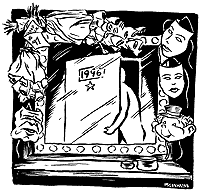
 illustration by Jason Stout |
Sir-or-Madam 1996: Like every year, you began as half promise, half threat. We wanted to
believe the promise, but these days a sense of threat is always in the air,
unforgettable and unavoidable. Quickly, you took on a personality, the way
storms or crowds seem to take on personalities. You showed us your face — or
rather, your faces, for I see you as sometimes male, sometimes female. As a
woman you pretend to be young and svelte, but it’s a pointless lie. Your
facelifts show, and you seem to see life as one big exercise machine. You’re
complacent and cruel by turns, and your eyes are selfish and seductive, like
one of those noir femme fatales who’s outlived her beauty. Like them,
betrayal is your pleasure.
Your male mask looks like Clinton or Gingrich. Puffy, phony, greedy. Pudgy,
dough-boy body. Pricey suits. Vacant eyes that only come alive when you’re
certain of your power. You’ll even sacrifice hungry kids to keep that power.
And your breath smells sour. And that was the air we breathed, and every whiff
felt tainted with a corruption that seemed to be not so much in our leaders as
in our time. In you.
But these are your faces, not ours. You are the date we write on our checks,
you are part of the price we pay. I don’t mean we’re helpless victims; even the
best of us are sometimes your accomplices. But we are also different from our
time, different from you. Every one of us has a secret that we keep from you —
something we try to protect from you. In fact, for many, our whole lives have
become an effort to protect ourselves from you, from our era. I suppose I’m
saying that, in our own way, each of us is trying to save our souls, that means
that even the most compromising can’t quite throw in with you, not all the way.
We play along, some more and some less, but we try to keep something in
reserve; because you’re not to be trusted, and there’s not one of us who
doesn’t know it.
As for us — our efforts change us, but somehow they don’t change the
character of the time. Your character, I mean, Sir-or-Madam 1996. We
find that baffling and painful. Well, the tougher among us have gotten used to
being baffled. To be frank, I don’t know whether that’s good. The very thing
that protects us (our endurance, our toughness, call it what you will) also
slowly wears away our faith. And that’s your strength, isn’t it, Sir-or-Madam
1996? Your malevolence feeds upon this irony: that the very hardness that helps
us common folks survive also makes us more cynical.
And yet… faith is a surprisingly resilient quality. Even people who profess
not to have it are often only trying to protect what’s left of it. You never
know when we’ll turn around and say, “Enough!” We only appear to have lost our
courage. What we’ve really lost is our sense of direction. Sometimes I think
human beings are made of courage, so much so that we take it for granted. The
courage it takes for the average person to get through the average day without
cracking up — that’s the same courage that, turned in a different direction,
makes for revolutions. It’s happened before, it may happen again, but it didn’t
happen this year.
Commentators like myself are expected to do year-end wrap-ups, and I suppose
that’s what this is. But I confess, Sir-or-Madam 1996, I haven’t been a very
attentive observer to most of what you’ve dished out. The books I read were
from other eras, the movies I watched were by people long dead, and the music I
live by doesn’t interest Billboard. Your new novels, poems, and songs —
I haven’t anything bad to say about them. They simply seemed meant for somebody
else. I felt I was in the midst of a million messages that had other people’s
names on them.
I don’t blame you for that. There’s no particular reason that you should speak
to me. I only wonder how many others feel that this circus hasn’t really
anything to do with them, and yet it surrounds them everywhere, all the time.
It’s hard to feel loyal to a world that presents us with an environment that
has nothing to do with us.
As for your movies — I have a theory about them. When citizens still had
fantasies of living heroically, they wanted movies about heroes acted by people
in whose heroism they could believe. Now most people are exploding inside, so
they watch movies about explosions. There’s still the occasional Lone
Star, or Trainspotting, or Breaking the Waves, films that
have something to do with the relationship between passion and fate — that
unresolved relationship that makes heroism necessary, even if it takes the
perverse form (as in Trainspotting) of escaping you through a drug.
Most escape through TV, or role-play on the Internet. In other words, they
indulge in facelessness. Fate-lessness. Time spent (seemingly) without
consequences. But to try to avoid consequences is itself a consequence of no
mean size. Heroin, TV, surfing the Net — I don’t see much difference.
(Heroin’s real high isn’t the drug, it’s the moment when the drug wears
off and the addict is forced into reality again, into having to score. Which is
more than can be said for TV or the Net.) But speaking of TV, here’s a nod to
Homicide: Life on the Streets, consistently the most vivid writing and
acting on any screen. Andre Braugher — explosions happen in his eyes. If he
were white, he’d be as famous as Al Pacino. But we still require that our black
stars have cherubic smiles, like Denzel Washington.
The truth is, Sir-or-Madam 1996, for all your seeming omnipresence, the most
alive people I know didn’t pay much attention to you. They seemed not to think
that you were worth their time. They cultivated another sense of time that had
nothing to do with the date on the calendar, or the headlines, or the latest
song, movie, technology, election, what-all. In a quiet way, without overt
rebellion, they directed their lives away from you. “Beauty,” “truth,” and
“love” have become suspect words — that’s the way you like it, Sir-or-Madam
1996, and those who flinch at those words have bought your act more than they
know. Nevertheless, some still see their lives in relation to such words. They
struggle, have money problems, get ill, deal daily with responsibilities that
are almost too much to bear, and they doubt — but they don’t buy what you’re
selling. (What you’re selling is the idea that your version of the world is all
there is.)
I’ll tell you a little story about some of them.
In a small town west of Austin, it was Mimi’s birthday. Her man Garland had to
be away on business, so Lora and Spider cooked Mimi a dinner. I happened to be
passing through. Lora’s food was fine, and so was Spider’s tequila. We danced
to the recording of a Texas gal singing “La Vie En Rose.” We spoke of
many things, laughed and almost cried, and as we talked we called out for
songs, recordings that augmented and complemented our talk. One singer and one
song in particular. We listened to it, to her, over and over. She is famous,
and I don’t want to use her fame for effect; I’ll just call her “Ida,” because
nobody’s named Ida anymore.
Ida sings with great delicacy and understanding. Every word is clear, gentle
but piercing. When she sings a song, it stays sung. She hasn’t recorded in a
few years because, though famous, she hasn’t sold well lately. One song in
particular we played over and over. Beauty, truth, love — that song shined
with them, as Ida saw and felt them. By the third or fourth time we played it,
we were crying and laughing, all four of us. And Spider said, “I wish we could
call that woman up and tell her just how much this means to us right
now!” Ida and I had once crossed paths (don’t read anything more into that;
we just crossed paths); so I happened to have her number in my book. I called,
long distance, got her machine, left a happy drunken message — with Spider,
Lora, and Mimi concurring in the background — about just how much her music
meant to us, and how it embodied our feelings that night.
The next afternoon I checked my machine in L.A. There was Ida. She said that
when our message came, she was lying on her floor weeping, so maddened with the
recording industry, with its banality and greed, that she was thinking she’d
have to give up any public life of singing. Our message to her, at that
particular moment, gave her strength again.
Think of all the elements that went into that burst of hope. I had to be
passing through that small town… it had to be Mimi’s birthday… we four had
to be sharing beauty, truth, love, and tequila… we had to play Ida’s song…
Spider, in his always-generous enthusiasm, had to get the idea to call Ida… I
had to have her number with me… all those improbable things had to come
together, in order for Ida to get that call just when she needed it. All this
converging, in an unpredictable way, to send some light into one woman’s dark
night of the soul. A woman I knew only slightly, and the others didn’t know at
all.
This won’t be reflected in any statistics, won’t be on any “10 Best” lists,
won’t be in any history books. When folks think of you, Sir-or-Madam 1996, it
won’t be what they remember. It was a moment in time, but not your time — not,
at least, the way you’ve defined it. But there it was. There we were. And
nothing is more important. Not the most glaring headline, or what Microsoft may
or may not be inventing.
Just a little beauty, truth, and love. Working a modest miracle, in a quiet
way.
Happy New Year.
This article appears in January 3 • 1997 and January 3 • 1997 (Cover).