

 illustration by A.J. Garces |
west on a
Tennessee two-lane, listening to Shelby Foote speak of Gettysburg. His Old
South accent gives the bloodiest battle fought on this continent a
daguerreotype, sepia-toned look in my mind’s eye: I see a battleground where
the living seem not quite living, the dead not quite dead. An odd suspension of
disbelief grips me — for hours of tapes I’ve forgotten who won, it seems the
battle (and all of history) could go either way. Until Pickett’s charge. 1863.
Not for 50 years would my people come to this country, yet Gettysburg feels
like my fight too. Which is as vivid a proof as I’ve ever had that I am an American — that the history not of my genes, but of my consciousness, goes
back to this land’s earliest days. The blood, not of my ancestors but of what’s
shaped my heart, is in this ground.
In this frame of mind — after driving hours through a grey rain, past farms
and tiny towns and countless skeletal winter trees — I enter Memphis. Take the
freeway south. Exit at Elvis Presley Boulevard.
You’d think Paul Simon’s “Graceland” would be singing in my head, but no.
It’s
too bouncy for this street. Elvis’ boulevard is bleak, run-down. Still, a vague
melody seems to be playing in the rain. A guitar, an untutored voice. Not
Elvis, yet not far from him. Some Civil War kid, scared of dying. The faces on
the street, mostly black, seem grim with fatigue — change has been too little,
taken too long, and cost too much. There are cheap-looking projects on all
sides of Graceland. It’s as though a kind of curse is rising like a mist out of
the ground.
So I’m surprised at my thrill as I pull into the Graceland complex. Even in
this chilly rain, with just a smattering of tourists; even in this shameless
atmosphere of commercial necrophilia; even so, there really is that odd elation
Paul Simon captured: “I’ve reason to believe we all will be received in
Graceland… There’s some part of me wants to see Graceland.” Driving into the
lot, you pass a four-engine Convair, Presley’s private plane. His daughter’s
name, “Lisa Marie,” is painted beside the cockpit. I recall tabloid headlines,
Lisa Marie saying Michael Jackson is a dud in bed (big surprise, right?). But
such thoughts can’t bring me down to earth. A surreality has taken over.
You buy your tickets in a building that feels like an airport. A typical
sign:
“Elvis Presley Mastercard — Apply Here.” I have an active imagination, but
sometimes it hits a brick wall. I can’t imagine how any human being can
physically torture another; and I can’t imagine what difference it could
possibly make to have Elvis’ face on your credit card. Yet the 20th century is
held tensely, excruciatingly, between those two poles of behavior — and both
are beyond me.
So much for my credentials as a commentator.
You rent a Walkman so that Priscilla Presley can give you a disembodied but
nevertheless guided tour of the mansion and grounds. Her voice is tinny and
cheerful, stripped of any emotion more difficult to deal with than wistfulness.
Except for a solemnity about his mother’s death, Priscilla presents us with an
Elvis who was never in pain. So why are we tourists so somber, so reverent, so
unlike Priscilla? I suspect why: Graceland admits no pain, so it is all left
for us to remember, feel, and bear. Under the pretense of commemorating Elvis,
the place is actually trying to erase him. But it can’t. Most of us look
bewildered and sad, but not bored. Enthralled. Elvis has not left the
building.
We board a little bus to take us through Graceland’s gate. Elvis’ voice
surprises me on the Walkman: “Won’t you come in.” The words pass too quickly to
be sure whether it’s really Elvis or an imitator. The bus deposits us at the
mansion’s door. A terribly acned, fleshy, young woman greets us, all smiles.
Her acne is obviously chronic — she must have 30 pimples on her face. I admire
her, wondering what inner somersaults she had to accomplish in order to take
the unavoidably public job of a greeter. That’s a kind of courage not many
have. Thus far, she alone at Graceland seems worthy of Elvis.
She tells us, “The upstairs still remains private.” Of course it does. Elvis
died in a bathroom upstairs, and he didn’t die well. A heart attack while
you’re trying to shit is not a pretty death. We already know the image. Let its
setting remain private.
What we see is naked enough. Glaring color schemes… chintzy decorative
“art”… a television in every room (sometimes as many as three). I imagine all
his TVs on at once, on different channels, and Elvis walking from room to room
not looking at any of them, needing their cacophony to drown out what’s
happening in his head. (Many on this tour must play their TVs constantly too,
during chores or eating or even talking; this may be what they have most in
common with Elvis.) The phrase “bad taste” is not adequate. It is impossible to
imagine anyone inhabiting the all-white living room, white sofa, white chairs,
white rug, white grand piano, white TV chassis — a sense of suffocation and of
something purposeful and sinister, as though it’s all been fashioned from the
hide and bone of Melville’s white whale.
That is the worst room, but the others are hardly better. Only the kitchen is
actually homey, though very large. You can believe Priscilla when she says this
was “where everybody congregated during the day.” Of course. It’s the only
human area in the house. Elvis (unintentionally) reveals himself in this
mansion: reveals he didn’t feel he was a human being. The artificiality of the
decor has to reflect how artificial he felt, a freak only comfortable (by all
accounts) on the stage and in this kitchen. A man who can’t sleep, usually too
drugged to fuck, whose bed is such a torture for him that he installed a huge
TV in the ceiling above his pillows. This is the house of a man who has given
up on the possibility of intimacy.
The place is a monument to his abdication of intimacy, except for the kitchen
— which is to say, except for his mouth, the organ of his voice and of eating.
His mouth was apparently the only part of his body that still felt alive,
toward the end. That’s what the house says, and it jibes with his progression
from the fluid movements of his youth to the mechanical, self-parodying motions
of what, for Elvis, was his old age. Look at footage of his last concerts: his
body is sluggish, his gestures are forced, his eyes are vacant; only his supple
lips still register the subtle swift energies that once radiated with such
force from his whole being.
Then finally out the mansion’s back door, past a yard and (if memory serves)
a
stable, to his father Aaron’s office. A TV plays over and over, a brief
interview with Elvis when he got out of the army in 1960. After the schlock of
the mansion, the stark beauty of the 25-year-old Elvis is a shock. Has our
century offered a more beautiful face as a public icon? Here is that
captivating mix of an arrogance that is absolute and innate, filtered through a
shyness so unavoidable it makes him laugh at himself. The low, insinuating
voice. His evident disbelief that anyone would be really interested in
what he has to say.
He’s speaking of the army, but he could be talking about everything he
surrendered to: “Play it straight and do your best. ‘Cause you can’t fight ’em.
If you’re gonna try to be an individual or try to be different, you’re gonna go
through two years [his army hitch] of — misery.”
He paused before he chose the last word. He meant it.
So much for the great rebel, who, more than any other single figure, was
responsible for initiating the cultural tidal wave that we call rock &
roll. Is it so surprising, with such a Founding Father, that the music would
end in the corporate-controlled repetition that blares from radios now?
I walk down a path to the “Meditation Garden.” A sign asks me not to speak
and
not to smoke.
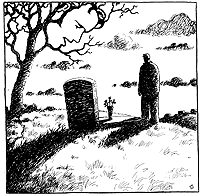
I wasn’t prepared for a graveyard. I guess I knew Elvis and his family are
buried here; still, I wasn’t prepared. A small stone for Jessie, his twin, who
died at birth. Then four enormous slabs: his mother Grace, his father Vernon,
his grandmother Minnie, and Elvis. These slabs are covered top to bottom with
what can charitably be called inscriptions — line after line of inflated
treacle.
It doesn’t matter. Especially in the rain.
The beauty of his voice and face. (It isn’t fair we recall the bloated Elvis
so vividly; that was true only in his last year.) The fantastic dancing of his
youth, the robotic movements of his last years. The reels of lousy movies, and
the few good ones. His spiritual progression from Tupelo to Vegas. His ability
to sing a gritty blues or a pop confection with equal conviction, originality,
artistry. His sense, from beginning to end, of being baffled by the very
reaction he sought so relentlessly. His generosity, his garishness, his
shyness, his shallowness, his profound impact. His inability to bear his own
company. His growing status as a secular saint, constantly returning from the
dead. (He would be 62 now. Do you really want to see Elvis at 62?) A
shining slab in the rain, rambling earnest inscriptions, as though he needed
justifying.
His true epitaphs are the graffiti on the walls that surround Graceland.
“Without Elvis You’re Nothing! He Owes Nobody!” “Your Hard-Headed Woman
Is Here.” “Graceland Is Our Field of Dreams.” Look down on them all you want,
but leave it to the fans to know.
This article appears in February 14 • 1997 and February 14 • 1997 (Cover).