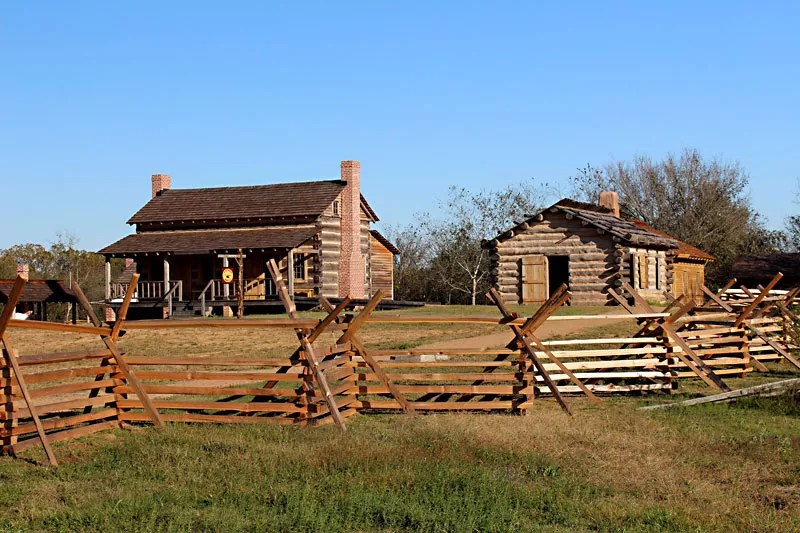
San Felipe de Austin has arisen from the ashes 185 years after it was destroyed during the “Runaway Scrape” retreat ahead of Mexican Gen. Santa Anna‘s advancing army. Well, a few buildings have been reconstructed of what was once the colonial capital of Texas.
In 2018, the Texas Historical Commission introduced a state-of-the-art museum northwest of Houston off I-10 to explain the site’s historic role. Last November a replica portion of the town was added. The six buildings of the “Villa de Austin” exhibit include a school, hotel, bakery, courthouse, and newspaper office.
According to Bryan McAuley, manager of the historic site, the new exhibit east of the museum re-creates a block of buildings that were on the west side of today’s FM 1458.
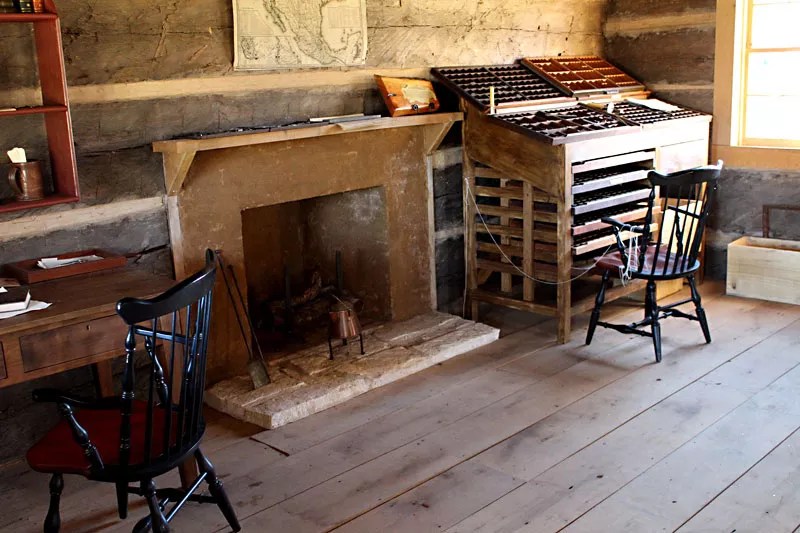
Stephen F. Austin established San Felipe in 1823 as the capital of his colony. By the time of its destruction in 1836 it had a population of 500 to 600, making it the second-largest town in frontier Texas after San Antonio.
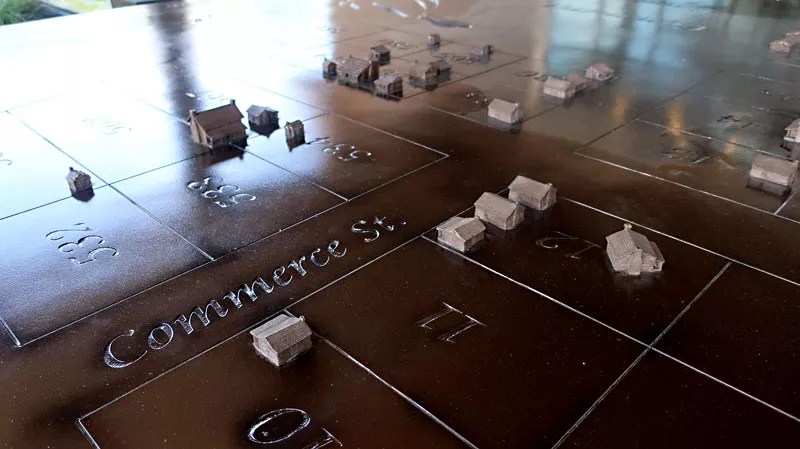
The town plat covered nearly 1,000 acres south from the Brazos River. Only about 100 acres were developed. “The lots were big and the buildings were small,” McAuley says.
From a bronze diorama on the back porch of the museum, visitors get a bird’s-eye view of the colonial capital. “Villa de Austin” shows how the town might have looked.
San Felipe de Austin State Historic Site is open Wednesday through Sunday from 9am to 5pm. “Villa de Austin” is open for self-guided experiences, with costumed interpreters to be added on future Saturdays. A trail on the north side of the museum winds through what were once the streets of San Felipe.
1,579th in a series. Follow “Day Trips & Beyond,” a travel blog, at austinchronicle.com/daily/travel.
This article appears in December 10 • 2021.