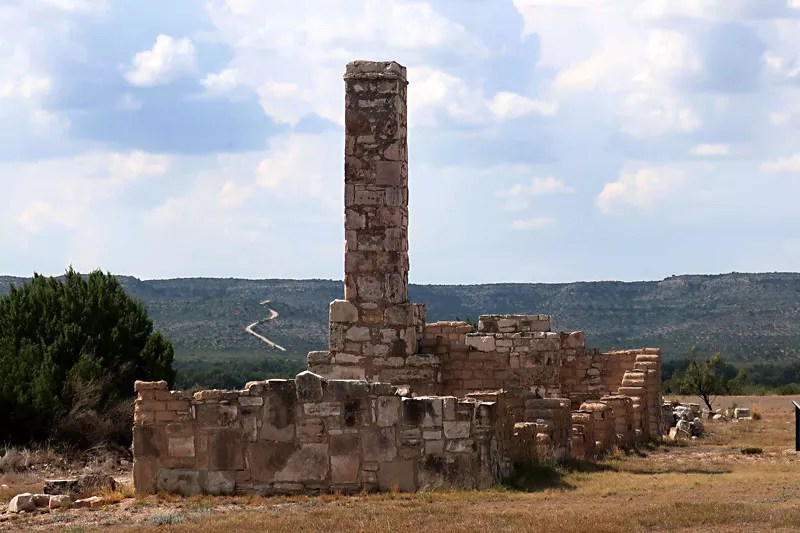
Fort Lancaster, in arid West Texas, played an important role in the western expansion of the U.S. beginning in 1855. The remains of stone walls and a museum at the historic site tell the story of a remote frontier Army outpost just a few miles off modern-day Interstate 10 near Sheffield.
Situated in a valley surrounded by mesas and hills, the fort controlled the Pecos River crossing of the San Antonio-El Paso Road. The limestone rock and adobe brick buildings housed around 150 soldiers and civilians at the fort’s peak. The early soldiers were more likely to help travelers with broken wagons and a shortage of water than protect them from hostile attacks. But of the almost two dozen frontier forts in Texas, Lancaster was the only one attacked by Native Americans.

Contrary to Hollywood depictions, Native American warriors generally gave the forts a wide berth. An exception came on the evening of Dec. 26, 1867, when a group of 400 Kickapoo and outlaw whites went after the Army’s horse and mule herd. In the fight that ensued, 40 Buffalo Soldiers held off the attackers with only three casualties.
During nearly 20 years of operation, the isolated fort was an important way station for gold seekers bound for California, stagecoaches, wagon trails of migrants, mail pouches, and even the experiment of using camels in the American West.

Fort Lancaster State Historic Site is 34 miles west of Ozona on TX-290. Visitors are welcome to walk among ruins covering 82 acres. There’s a small admission fee to the park, which is open daily from 9am-5pm. For more info, go to www.thc.texas.gov/historic-sites/fort-lancaster-state-historic-site.
This article appears in November 16 • 2018.