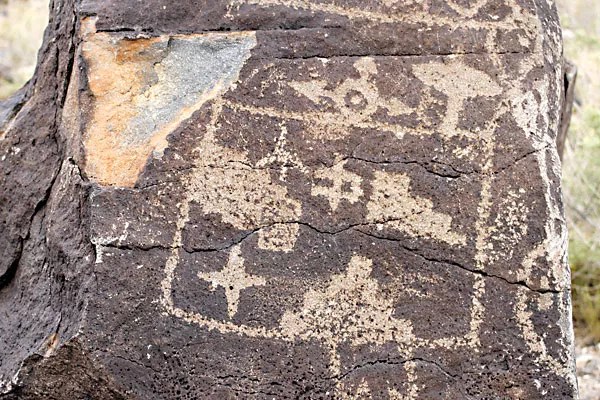
The Petroglyph National Monument on the western edge of Albuquerque, New Mexico, preserves an ancient, secret history scratched into the volcanic basalt rock.
Encroached on by housing developments on two sides, the national monument looks like a pile of black rocks surrounded by the brown desert. Along the paths, you’ll discover an outdoor gallery of thousand-year-old art among the hills and boulders. Set aside as a national treasure in 1990, the 7,236-acre park is a joint project of the National Park Service and the city.
Long before the Spanish first arrived in Albuquerque in 1540, this site was held sacred to the Pueblo people. The dormant volcanos in the park were at the center of a triangle formed by the mountains to the east and six volcanic cones to the west that were considered portals to the next world.
Some of the images chiseled into the surface of the stones are easy to identify as animals, humans, or natural elements. Other examples of the rock art are indecipherable symbols. The modern descendants of the ancient Puebloans recognize some of the designs, while others have been lost to history. The rugged trails through the park allow close examination of a large portion of the 25,000 petroglyphs within the monument’s boundary.
Petroglyph National Monument is three miles off of I-40 in western Albuquerque, N.M. For more information, go to www.nps.gov/petr/index.htm.
1,096th in a series. Collect them all. Day Trips, Vol. 2, a book of “Day Trips,” is available for $8.95, plus $3.05 for shipping, handling, and tax. Mail to: Day Trips, PO Box 33284, Austin, TX 78704.
This article appears in August 3 • 2012.