

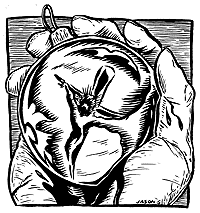
 illustration by Jason Stout |
to be the earliest gospel, The Gospel of Thomas. In it, Jesus says: “Let him
who seeks, continue seeking until he finds. When he finds, he will become
troubled. When he becomes troubled, he will become astonished.”
Surely there is no more troubling, astonishing figure in history. Ignoring the
tracts of believers, sticking to the few facts we know, we can say that Buddha
taught personal enlightenment, Moses sought to save his tribe, and Mohammed
wanted a world lit by his revelation. A common person can understand those
desires. Jesus is far more enigmatic, for he seems to have sought what no one
in their right mind wants: redemption through the Cross. We pretend to admire
that, yet if you seek it for yourself you’re considered unstable, to say the
least. (It’s worth remembering that many in Jesus’ time, including his family,
thought him unstable, too.) Still, twice a year, at Christmas and Easter, the
world seems to gravitate toward this strange figure.
I dislike the Christmas season not for the vulgarity of its commerce, nor
for the inescapable Muzak that’s replaced caroling, but because my mother did
her work well and made me incapable of seeing this holiday as anything other
than a contemplation of this haunting, troubling, astonishing man. Here he is
again, following me around, asking me to explain myself to him and to decipher
him for myself. I never manage to do either. But the struggle to do both, an
inner conflict I seem helpless to prevent, ends with an almost physical sense
of Jesus, as I perceive him, sinking deeper into my soul with ever greater
weight. I used to know a priest who would have called this process “faith.”
It’s been my privilege to know three genuine Christians. One was my mother.
Ever poor, she would often give what she had to whoever crossed her path in a
state needier than her own. I rarely saw her hesitate, nor show any regret for
being the poorer for her gift. Thus I was raised to believe that the test of a
Christian is simple, as stated plainly by Jesus in the Gospel of Matthew,
Chapter 25, Verses 35-40. They are exacting, difficult words:
“I was an hungered, and ye gave me meat. I was thirsty, and ye gave me drink.
I was a stranger, and ye took me in. Naked, and ye clothed me. I was sick, and
ye visited me. I was in prison, and ye came unto me.” The people he was
speaking to were mystified, didn’t remember any such thing, and asked how could
it be? “Verily I say unto you, inasmuch as ye have done it unto one of the
least of these my brethren, ye have done it unto me.”
There it is, and nothing will change it. All the Sunday services and all the
greedy prayers can’t make you a Christian without it. That is why after you
become troubled you will become astonished.
That is the voice of the Jesus I love. (Whether I live up to it — thus far, I
can’t — is another matter.) But he had many voices, among them a voice I fear.
I don’t mean the voice that rants about damnation. We don’t need Jesus for
that, we do damnation brilliantly for ourselves. Ask the survivors of
Auschwitz, or just count to twenty — 15 children will have died of hunger
while you’re counting.
No, the Jesus I fear said, in Matthew 5:27-29: “Ye have heard that it was
said… Thou shalt not commit adultery. But I say unto you, that whosoever
looketh on a woman to lust after her hath committed adultery with her already
in his heart. And if thy right eye offend thee, pluck it out… And if thy
right hand offend thee, cut it off….”
That is the Jesus of most Sunday Christians, and what is he really saying?
He’s making the human psyche itself a sin. He’s saying that there is no
line between thought and act, fantasy and behavior, imagination and morals.
Which is an attempt to deny the very existence of the psyche. For our psyches,
our imaginations, constantly thrust forth images — some shocking, some not. We
can choose among our imaginings, but we can’t choose not to have an
imagination. We can make choices about our behavior, but we have no control
about what images rise from our souls. To make our imaginations a sin is to
create a conflict within us that, as history amply proves, is irreconcilable
and unbearable.
How many millions have been tortured, murdered, excluded, censored, enslaved,
and humiliated, in the name of official Christianity’s war upon the imagination
— Christianity’s inability to tolerate the existence (much less the freedom)
of the imagination, nor tolerate anything other than its own image of itself?
Following Jesus’ own standards, we must lay Christendom’s horrors at his
pierced feet. For it was Jesus himself who gave us the right to judge him, and
taught us how, when he said, “Ye shall know the tree by its fruit.”
And yet, and yet… when they gathered to stone the adulteress, she who had
sinned not only in imagination but in the flesh, it was this same Jesus saying:
“He who is without sin among you, let him first cast a stone at her.”
That is a forgotten Jesus: the Jesus willing to break any law, of the church
or of the state, if it interfered with his overwhelming tenderness. He even
broke his own laws: The woman had sinned, in thought and in act, but he would
not see her stoned. This is very, very different from Moses and Mohammed. The
law, as they perceived it from God, was more important to them than the heart.
But as we read the gospels, again and again the heart is more important to
Jesus than the law.
(I mean no dishonor to Moses and Mohammed. Each was capable of great mercy
but, to my knowledge, they never transgressed their own laws. Each was trying
to found a society, and when you’re doing that, your focus must be on the law.
Jesus was trying to challenge a society, and when you’re doing that your focus
must be on the heart.)
It is easy to cling to Jesus, the challenger, who railed against the scribes
and Pharisees. But then he goes and challenges himself as well, as he was
always unafraid of doing, and he becomes the Jesus we fear most, the voice that
said without equivocation: “Love one another.”
Buddha told us to be compassionate and unattached. Jesus wasn’t interested in
unattachment. His counsel was the most passionate attachment possible: “Love
one another.”
Well, we all know how dicey love is. It’s enough to drive you mad, and it has.
But we can’t forget that voice: “Love one another.” It makes liars and sinners
of us all. We live mostly by, “Fear one another.” And, as the Christmas season
makes plain, “Profit from one another.” Many spend the Sunday Sabbath watching
games that say, “Be victorious over one another.” But we’re haunted by “Love
one another.” To claim that we all, concretely, should live like that, much
less that public policy should be based on that — well, as you know, to claim
such things is to be thought a fool. Certainly no business is run that way, and
business is what we’re all about these days. Yet those three words, spoken to a
small gathering two millennia ago, were so powerful that even now we’re
haunted.
What eyes that man must have had, to give his words such indelible
authority.
So this season there are all those infants in all those cradles under all
those trees and in all those parks. I don’t like babies, truth be told. They
are concentrated globules of unadulterated need. That, as far as I can see, is
all an infant does: It needs. Thus every Christmas we celebrate
God as hunger in its purest form. We try to appease that hunger with
trivialities presented to each other as sentimental gifts. Fully a third of the
nation’s GNP depends on this appeasement. Is it that, collectively, we can’t
approach God without too much awe or hypocrisy to bear, unless we imagine God
as a helpless, hungry child? But then, we’ve just cut off funds for a million
helpless hungry children, so even our least threatening collective image of God
has become nightmarish.
But the cradled Jesus implies nightmare, for something in us knows that we are
only praising the infant because one day he’ll be tortured. I don’t think of
the nails so much, nor the incredible strain on the muscles when your full
weight is supported by nails in your hands. I think of something you never see
in the paintings: the flies that must have buzzed around his face, his eyes.
Fat, inescapable, nibbling flies. The feeling of flies crawling over your face,
as in footage of starving children in Africa — that is part of how Jesus was
tortured. I have never doubted that our knowledge of the infant’s fate is part
of the unconscious reason that so many get so anxious at Christmas.
In the Gospel of Thomas, Jesus says: “Split a piece of wood, and I am there.
Lift up the stone, and you will find me there.” He was right about that. He
seems inescapable. His “Love one another” echoes down the ages. Every single
promise he made is either unfulfilled or unverifiable, yet still that echo
haunts us when we look at each other.
Of course we are dear to each other, for even a stranger’s action can effect
us deeply, make or break our day. We can’t seem to live with that fact — but
isn’t it a tacit admission of how much we actually do, whether we like it or
not, love one another?
In the spirit of that question, let me say: Merry Christmas.
This article appears in December 20 • 1996 and December 20 • 1996 (Cover).