

There is a certain quality that’s a hot commodity in the comedy world
right now, a quality more easily described than named. Over the years it’s been called
“hip” or “cool,” but neither of these terms adequately sums up the
combination of ironic detachment, laser-sharp wit, and cultural relevance currently in
demand. For lack of a better word, I’ll just call this quality “IT.”
In the current entertainment climate, characterized by an explosive
proliferation of cable programming and intense competition between media companies, IT is
sought after like gold in California circa 1849. Entertainment execs criss-cross the
country, delving into smaller markets in an almost desperate search for fresh, new
faces that will stand out from the sea of bland, homogenous programming that floods the
airwaves.
Such a search brought MTV executives James Jones and Lisa Berger to Austin
some three and a half years ago. MTV is an interesting case study in looking at
the changing face of media. When the network began in the early Eighties, it
revolutionized television in two major ways. First, it provided programming 24 hours a day, seven days
a week. Not even the major networks had ever dared such a thing. Second, it created a
synthesis between two media, music and TV. The birth of the music video launched an
acceleration of the whole media process. Bands that might have otherwise languished in
anonymity found that a catchy video could turn them into instant stars, and an
entertainment-craving public devoured the new art form like voracious wolves.
Yet, like all revolutions, the new MTV order eventually spawned a
backlash. The exponential explosion of programming meant that the attention span of the TV
viewer was shrinking like a slug in a salt shaker. Which meant the shelf life of
media products got shorter and shorter. Like Dr. Frankenstein trying to control the monster
he created, the folks running MTV were driven to pursue an endless quest for
entertainment to feed the media beast. The world of comedy offered a natural complement to
music television, so MTV began branching out in that direction. The quest for entertainers is
often a strange one, for the creative seekers often don’t know just what they’re
looking for, but they know IT when they see IT.
The Austin mystique drew Jones, producer for The Ben Stiller Show, MAD
TV, and Reality Bites, and Lisa Berger, MTV vice-president and director of
development, to our city, where a burgeoning comedy scene provides a hotbed of hip young
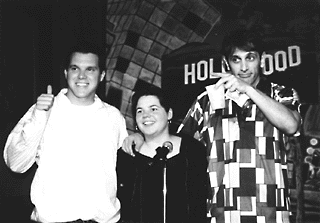
comics. Here the MTV scouts crossed paths with Chip, Laura House, and Howard Kremer,
three local talents who have IT in spades. In the words of Laura House, Chip was
“born to be on MTV.” The winner of 1996’s “Funniest Person in Austin
Contest,” Chip devotes much of his act to poking fun at the flashy but shallow MTV
culture; his sarcastic renditions of pop songs have made him a Velveeta Room hero. And
his monologues bounce wildly from topic to topic, almost like a remote flipping
from channel to channel and finding a different angle on Chip at every click.
Howard Kremer shares a natural appeal to the MTV crowd. This graduate of
New York’s American Academy of Dramatic Arts has the kind of chiseled looks that get
noticed by TV scouts, and his perpetual mischievous smirk and wide, slightly
psychotic eyes tend to keep an audience on the edge of its seats, wondering what he’ll do
next. Kremer has standard, tried-and-true bits which are virtually guaranteed
laugh-getters — such as his shuffled pile of crazy fan letters that he writes to famous
celebrities — but rather than sticking to the safe stuff, honing the same material over
and over, Kremer takes dangerous detours and follows obscure tangents to see
where he’ll end up. He loves nothing more than to bring a room to a deafening,
uncomfortable silence with some rambling tale before winning them back with his “big
gun” material. It’s this willingness to gamble and the inventive, improvisational
flair that set Kremer apart from the crowd.
Laura House is the kind of girl whose high school popularity was partly
based on fear; you had better be nice to her or she’d let loose her verbal nunchuks
and beat you to a pulp. A former middle school teacher, House is very in tune
with the youth culture and she has a certain dark, cynical edge that is a splendid
complement to Chip’s playfulness and Kremer’s wacky antics.
The trio were “discovered” at a showcase for MTV at the Laff
Stop (now Capitol City Comedy Club). All three comics had to pull strings just to get
into the showcase, which was designed for professional comics. “I was not
supposed to be in the showcase because I had not been paid to do comedy,” says
House. “I had to weasel my way into the showcase — God bless Margie
Coyle!,” she says, referring to the longtime Laff Stop staffer. “God bless her,
she broke down.” Chip’s situation was similar. “I’d never worked the Laff
Stop,” he says, “but a couple of the comics helped to weasel me into the
showcase.”
Kremer really had to do some fancy shuffling. “I’d been doing comedy
for almost three years. At the time we got word about this MTV showcase, I was on
a college tour opening for J.R. Brow and we were up in Minnesota. Actually, I had
committed to the tour and the day before we left I heard about the MTV thing — but we
left anyway because I had committed to it. But as the days went by, closing in on
the showcase, I thought, `Man, I’m gonna really regret it if I don’t do this,’ so
I left the tour, hopped on a bus, and took it from Minnesota to Austin. It was Super
Bowl Sunday in ’94 — a 24-hour bus ride. I remember riding through Dallas at
night and hearing all the horns honking because the Cowboys had just won the Super Bowl
— we just kept driving. I got dropped off in Austin, and the next day I’m doing
this showcase at the old Laff Stop.”
The day after the showcase, Chip, House, and Kremer, along with another
local comic, Johnny Hardwick, were contacted by Jones. (Hardwick has since become a
writer for and performer in Fox’s popular King of the Hill show.
“Where’s the Chronicle story on that?” Chip demands. I’ll get to it, Chip,
I’ll get to it!)
House remembers, “I was teaching at Bailey Middle School — go Bears!
— so I do the showcase, the next day I’m grading papers, and then that night
I’m eating dinner with the vice-president of MTV.”
Though dinner with MTV execs was thrilling stuff, it was merely the
beginning of a long roller coaster ride with the network that still isn’t over. Jones
and Berger weren’t sure what they wanted. House says, “They didn’t really cast us.
They told us they liked us, wanted to work with us, and they wanted ideas.”
Adds Kremer, “They didn’t want a sitcom from the beginning. They had, like,
veejay segments in mind where we’d come on between videos and goof around. But when
we sat down to write it, it kept getting longer and longer, so we wrote a half-hour
show and they liked it.”
That, however, was not what they first wrote three years ago.
“No,” Kremer notes. “We wrote these little
scenes….”
“Vignettes,” House explains, “with a `g.’ We had these
video postcards. We were videotaping ourselves and sending them to MTV as the premise of the
show. We had a bunch of different ideas….”
“Not all of them were reality based,” Kremer adds. “We
struggled with whether we wanted it to be real or bizarre and surreal, like hovercraft
and weird shit happening.”
“The streets paved with gold,” House says.
“So you opted for reality?” I ask.
“They opted for us,” Kremer says.
“Not that we were pushing for surreality,” Chip throws in.
“Is that a word?”
“So you were willing to do whatever it took to get them to say
yes?” I suggest.
House answers, “No, I wouldn’t say that at all. They basically liked
us and wanted to do a show with us and they were looking for the best way to bring
out our personas.”
“So you kept trying different things until something hit.”
“Yeah,” House says, “more like ’til it felt
right.”
When the trio came up with the script for the half-hour sitcom, it seemed
their dream was close to coming true. But the murky machinations of studio
programming often deal out harsh fates. For reasons that are still unclear, MTV vetoed
the show and the project looked dead in the water. Unsure of their future, Chip says,
the three “kind of went our separate ways. Which was really our separate
ways down to the Velveeta Room.”
Kremer really did strike out on his own, however, heading west to Los
Angeles. “When I moved to Austin, I had a thing about not getting stuck here, so
I basically had a commitment to myself to leave if the show didn’t work out. I didn’t
really have any connections out there, but it was about seeing if I had the balls to
go out there because you can get comfortable here just sitting on your ass and
not making anything happen.”
“So what did you do out there?” I ask him.
“Nothing!”
“Well, that took balls to go out there and do nothing.”
“Big balls,” House adds.
“No, I did some showcases, did some comedy,” Kremer says
impatiently, “but that’s got nothing to do with the show.”
Yes, the show; it languished for two years, but MTV had retained an option
giving it the rights to the show if it chose to produce it. Laura explains how
miracles happen: “Last summer, two years later, they resurrected the show. The
people that had said no — can we say that? Yeah? — they left!”
The end result of this laborious process was the “go ahead,”
which came last December, to shoot the pilot for a series to be titled Austin
Stories. The three comics star in the show playing characters they developed
themselves. House describes her part in the pilot: “My storyline is that [my friends] find
out I’ve had this long-term boyfriend who lives out of the country, so there’s
some question as to whether or not he exists. Then I have another love interest here, so I
try to break up with my boyfriend who lives in Prague and I end up breaking up
with my friend — even though we weren’t technically dating. I sort of play out this
neurotic, fear-of-intimacy storyline.”
Chip’s character, he says, “sneaks into movies using an elaborate
scheme passed down from generation to generation. Except I get caught and have to go
to work at the movie theatre. Mine’s the most `sitcommy’ of it all.”
Kremer’s character has to deal with his car getting impounded. “I
don’t have the money to get it out,” he says, “so I sneak into the impound
yard and start stripping parts off the car to sell in order to pay to get the car out
— it’s a race against time — but by the time I get enough money to get the car out,
there won’t be any car left.”
Although each of the comics has his or her own separate story, all three
still have to work together to shape the show, and that’s something new for them.
Kremer, growing serious for a moment, says, “It’s a strange situation for
stand-up comics, who usually work alone, to be grouped together. So that’s where a lot of the
chemistry comes from — unique, different characters — I mean, we’re not like the Kids
in the Hall or anything, coming from the same sensibility — we come from very
different areas and they threw us together and that’s where a lot of the conflict and
dynamics come from.”
“It takes some getting used to, working with other people,” Chip
says. “One difference is that in stand-up, you’re solely responsible — if you
suck, it’s your fault. But on the show, there are other people and they can make
you look good even if you’re not at your best. It’s cool that way.”
House counters, “Yeah, but in stand-up if you suck, it’s your fault
but only five people were there to see it. But if you’re writing your own character on
a show, it’s on film forever, on MTV every night — forever! For the rest of
your life!”
The strength of the pilot gave MTV the confidence to sign House, Chip, and
Kremer to produce 13 episodes. The three now split their time between Austin and
Hollywood, where they work in the MTV studios.
“How much do you guys write a day?” I ask.
“A pound,” House responds. “Every day we crank out a pound
of funny.”
“Sometimes,” Kremer adds, “I put my thumb on the scale so
we don’t have to do as much.”
Chip says, “We write all day every day.”
“They lock you in the room with a typewriter and a bottle of
bourbon?” I ask.
Kremer says, “Yeah, with a bunch of hard-smoking, snotty MTV
interns.”
“It’s basically a sweatshop,” House says.
“Yeah,” Chip says, “then from 5 to 6 we have to make MTV
T-shirts!”
“One arm’s chained, the other one’s typing,” House says.
Jokes notwithstanding, these three are serious when it comes to their
careers, and their stars have been rising even before their show has aired. This
spring, House performed in the U.S. Comedy Arts Festival in Aspen, Colorado, and this
summer, Kremer will perform at the big Montreal Comedy Festival. All three appreciate where
they are given the career they’ve chosen. Kremer says, “It’s weird when you
choose to go into the arts. There’s no guarantee that it’s going to pay off. You
never know that, hey, these are my struggling years and in two years they’ll be over and
I’ll be famous. You have to keep plugging along. It’s really nice when that turns
into something. It’s very gratifying and it’s also very lucky. You have to keep
plugging away. There’s nothing else you can do. I mean, when you find out how little
you’re really good at, you have to stick with it.”
“My message to the children,” House says, “is to believe in
yourself and quit your job, follow your dream. Because two months later MTV will call
you — I like to get specific with my advice — and they’ll apologize and give
you your own show.”
The first episode of Austin Stories is supposed to air some time
this summer but, as the three comics know, there’s often a large gap between
“supposed to” and “reality.” But whenever it comes out, we’re sure it’s going to
be a hoot.
J.C. Shakespeare is an actor and a stand-up comic who contributes regularly
to the Chronicle
This article appears in May 30 • 1997 and May 30 • 1997 (Cover).