

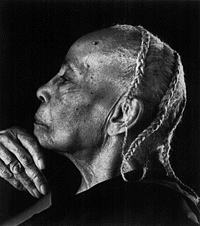
 Septima Poinsette Clark, photographed by Brian Lanker |
the value of words slathered like paint on an artist’s canvas: poetic words that live
somewhere between literature and painting; words written about photographs,
spoken by the elegant women in those photographs; words spoken by artists who
perhaps don’t trust images to speak for themselves. The Austin Museum of Art
(AMOA), downtown at 823 Congress and at Laguna Gloria, brings us these words
and more — four different exhibitions including photography, sculpture,
painting, drawing, and text.
AMOA at Laguna Gloria presents drawings by artist Jean-Michel Basquiat
accompanied by Kevin Young’s poetry, which is presented as art. The 28-year-old
Basquiat died in 1988 after a whirlwind career. He ascended from lowly graffiti
artist to high art icon, rubbed elbows with the likes of Andy Warhol and Julian
Schnabel, and changed art dealers like the rest of us change underwear. His
career burned brightly, his life burned itself out. Kevin Young, the poet, was
finishing high school in Topeka, Kansas, in 1988. He later graduated from
Harvard, got an MFA from Brown, and made a name for himself with his poetry.
Young was described in The New Yorker magazine as one of the vanguard
African-American poets that could well “turn out to be as important to American
letters as the Harlem Renaissance.” After seeing Basquiat’s work, Young was so
moved that he wrote poetry which addresses it. This exhibition allows us to
eavesdrop on a conversation between a dead artist and his accomplished admirer,
allows us to speculate on their similarities and differences. The two never
actually met.
“Fire will attract more attention than any other cry for help.” The words
belong to Basquiat, not Young. They are scrawled — all caps — in oilstick on
paper along with the artist’s signature crown, a couple of other scribbles, and
the following: WHEN THE FOAM BREAKS EVERY SOFA BREAK GLASS TO SOUND SIRENS. A
label on the wall reads Untitled (When Foam Breaks), 1981 and
“Jean-Michel Basquiat.” Is this poetry or art?
On the floor in the upstairs gallery is a huge piece of cardboard, laid out
like a bum on the grass, with these words written in oilstick:
The trees told nobody
what, that day, we did —
we died. Laid down
with our cans
of deviled
ham & closed
our eyes — two
valises full
of Van Camp’s
Pork & Beans —
the city an idea
shining far behind —
& we were not afraid…
The poem is called “Brothers Sausage” and in the gallery an exhibition label
reads, Brothers Sausage, 1983 and “Kevin Young.” Art or poetry?
“Two Cents,” the name of the exhibition, which was curated by Amy Cappellazzo,
director of the Wolfson Galleries, Miami-Dade Community College, sets up an
interesting dialogue, a play on words, a playing with words that muddles the
definition of art and poetry. Kevin Young came to the museum during the
installation of the show and wrote his poetry on the wall of the front gallery.
Other poems are scrawled on paper, on plastic, on the aforementioned cardboard,
and one is typed on a translucent yellow paper. It’s called “Urgent Telegram to
Jean-Michel Basquiat” and begins, “Haven’t heard from you in ages stop love
your latest show.”
Basquiat’s drawings on paper — not to mention his paintings on canvas —
command serious prices when you can find them. The supply of new work has,
after all, dried up. However, in some cases, these works represent not much
more than words on paper. What is the worth of the poet’s words then, cleverly
written on a wall, in big capital letters in Basquiat’s style?
I am drawn to the words and am sorry to have missed Young’s visit to the
museum on the day of the opening when he read his poetry and told stories. I am
ambivalent about some of Basquiat’s drawings — they look like the unedited
scribbles of a disturbed child. Drug dealers, art dealers, and a screwy kind of
ambition got in the way of his genius. But when it shines, it shines.
Toxic shows off the artist’s color sense and complexity, his raw power.
A large untitled painting blasts the viewer with energetic red and yellow and
gold brush strokes against a black background, haunting faces disappearing into
black (or are they pushing outward?). All in all, there’s plenty to see at the
Laguna Gloria site, lots of words worth the time it takes to read them as
poetry or as Jean-Michel Basquiat’s visual vocabulary.
“I Dream a World” at AMOA’s just-opened 823 Congress location, doesn’t just
deal with words; it is, in fact, a book. Brian Lanker’s photographs of black
women were collected into a volume in 1989 and published with a foreword by
Maya Angelou. Visual Arts Resources, a nonprofit organization, arranged for the
traveling exhibition of the work in that book.
In 1987, award-winning photographer Lanker commenced taking black-and-white
photographs of black women “who dreamed of a world not only better for
themselves but for generations to come….” They are poets, artists, musicians,
social activists, physicians, judges, and educators, many of whom are familiar:
Marian Anderson, Shirley Chisholm, Barbara Jordan, Toni Morrison, Rosa Parks,
Oprah Winfrey. In addition to taking their pictures, Lanker interviewed these
women, speaking with them for an average of three hours at a time. Barbara
Summers, the book’s editor, was charged with the task of going through these
interviews and research materials and distilling one page of first-person
explication for each of the 75 women whose portraits appear. The museum text
identifies each woman and quotes selectively from the book. Even
non-journalists may want to take a pad and pencil and make notes. Better yet,
buy the book.
But the photographs are best seen on the wall, exploded in scale, faces so
powerful that you don’t know where to look first when you walk in the door. In
the book’s preface, Lanker says, “As a photojournalist, I felt the need to
prevent these historical lives from being forgotten.” He has certainly
accomplished the task. Eleven of his subjects have died since their pictures
were taken, but they are very much alive in these photographs, by their words,
through their deeds.
Lanker has indeed made an enormous contribution to the history of black women
in America, and perhaps to their future as well, but his editor should have
directed the book’s preface away from his sensitive-American-white-man’s
confession — I was unwittingly a racist and sexist, but I’m all better now —
and focused on his interaction with his subjects. I, for one, was less
interested in why a white male photojournalist would photograph these 75
stunning women than in what he learned during the two years he traveled
throughout the country visiting with them. In any event, the pictures speak
louder than the photographer’s words and with a fresher and much more
compelling voice.
Amongst the photographs in one gallery are a modest collection of small-scale,
stylized figures and busts by Selma Burke, selected from national and local
collections. The African-American sculptress is best known for her sculpted
portrait of President Franklin Roosevelt, which has appeared on the U.S. dime
since 1945. The work certainly relates to the photos that surround it, but it
is hard to focus on the small sculptures under the gaze of all those strong
women! While Burke’s bronzes have a sturdy physical presence, the photograph of
Priscilla Williams, lauded for “her life of hard work and dedication to the
family,” is even more tactile. I was certain that if I took my hands out of my
pockets, I could reach up and touch her lacy white cap, feel the fur of her
coat collar, stroke — ever so carefully — her leathery, weathered, sun-kissed
cheek.
“De Mujer A Mujer: A Celebration of Latinas by Latina Artists” is the
third exhibition showing in the new 823 Congress galleries. It was curated by
Amalia Malagamba and organized by AMOA. The first gallery is painted yellow and
glows like summer sunlight. Carmen Lomas Garza’s black paper cut-outs —
papel picado — float from the ceiling away from the walls as if by
magic. Each depicts Mexico’s flora and fauna. They evoke the creation story,
Latina-style, with cactus, rattlesnake, eagle, and corn stalks. In the corner
of the room, a documentary video produced by the artist about her work plays
continuously. This is a mistake. I would have preferred music, I would have
preferred the screen available for viewing (at will) in the museum’s education
room, I would have preferred to listen to the words in my own head as I tried
to imagine the process of transforming big black pieces of paper into such
ornate and evocative images.
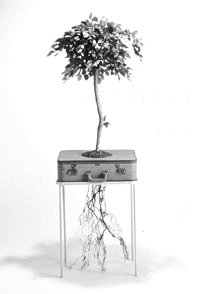 Transplant, by Irene Perez-Omer |
folklore, and religious icons. The paintings are bright and colored (all but
one), large and small (I particularly liked the two retablos), and awash in the
Latina past and present. But I want the artist to tell me something new,
something I don’t know about orange, red, or blue, about cultural icons and
Texas iconography, about herself. I’d have settled for words, preferred
pictures, will continue looking at the work.
Kathy Vargas, director of Visual Arts for the Guadalupe Arts Center in San
Antonio, presents her signature hand-colored photographs with mixed media. They
tell stories with objects that don’t quite hold still for the camera and with
words. I like the images so much that I’ve never before followed the loopy
script up one side and down the other, but I did at AMOA. In “Miracle Lives,
Diana,” an artist’s husband tells her,”You need to sell this shit or stop
making it.” The story continues, “Then miracle of miracles, he went away.”
Another is more predictable — “Where have all the flowers gone?” for
“Desaparecidos #1.” The words neither add nor detract.
Austin’s Connie Arismendi does not write on her work. She doesn’t actually
paint, either, or draw (with one exception in this show), or chisel, or carve.
Arismendi combines objects, fabrics, colors, and textures into an emotional
whole. I don’t know how else to describe the psychic weight of her simple
assemblages. Using crushed red velvet or red oil in a glass lamp, translucent
netting draped over another object or as support for a simple drawing, this
artist manages to do a great deal with less. Hers is an eloquent silence.
The same could be said for Irene P�rez-Omer, who presents an
installation called Between the Waves, which is dedicated to her
grandmother. Rather than a piece of art that might enter our home, the artist
has created art that we may enter. We can sit on the pews, handle the prayer
books, read the artist’s script on the wall, on the gold background of a
painting of a strong and beautiful woman wearing an old-fashioned blue dress.
Words spiral around candles on a table top and are written all over the back
wall. It’s like walking into someone’s memory box, filled with old letters and
photographs, dried flowers, half-burned candles, and a brooch. The artist
provides a printed booklet about the installation for those who really like to
read. For me, the experience of being there was enough.
“I Dream a World: Portraits of Black Women Who Changed America”; “De Mujer a
Mujer: Celebration of Latinas by Latina Artists”; and “Selma Burke Sculpture:
Selected Works from National and Local Collections” run through Jan 5 at AMOA
Downtown.
“Two Cents: Works on Paper by Jean-Michel Basquiat and Poetry
by Kevin Young” runs through Jan 5 at AMOA, Laguna Gloria.
Rebecca S. Cohen is an arts writer and recovering art dealer.
This article appears in November 29 • 1996 and November 29 • 1996 (Cover).