

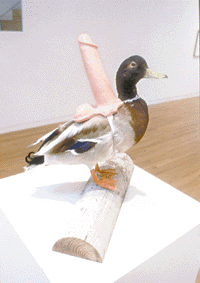
 Fuck a Duck, by the Art Guys |
is set to open at the Austin Museum of Art at Laguna Gloria. The Art Guys —
Houston artists Michael Galbreth and Jack Massing, who use that name for their
creative collaborations — are halfway through hanging the show when Acting
Senior Curator Kathryn Davidson informs them that three of their pieces,
specifically those containing sex toys replicating male genitalia, must be
removed from the show.
For the Art Guys, the request comes out of left field. They had faxed the
museum a list of works and their descriptions ahead of time. “It’s not like our
work is a big surprise to them,” says Galbreth. “We had even talked about the
more violent and sexually oriented pieces and agreed to put them on the second
floor so that the museum could have a sign advising parents of the mature
content.” But a sign cautioning parental discretion was unacceptable to AMOA
Acting Co-Director Judith Sims. “The children would be disappointed not to see
a whole exhibit,” says Sims.
That no one will see the whole exhibit is a point which eludes the museum
staff. Sims and Davidson view their request as simply a matter of curating the
show to make it more family oriented. “Our obligation is to present the best,
most appropriate art for the entire community,” says Davidson. “We love the Art
Guys’ work and this is a great show just as it is.”
But the Art Guys see it as having their work censored. “This is very, very
serious,” says Galbreth. “Serious enough for us to consider taking the entire
show down. This is like giving up your seat on the bus. That’s what censorship
does. It asks you to keep your mouth shut and give up your seat.”
In a quandary, Massing and Galbreth discuss it between themselves and with
colleagues around the state. They decide that pulling the show would be
negative all the way around and would probably turn into a media circus with
the work, both seen and unseen, becoming completely lost in the shuffle. But
that didn’t mean keeping their mouth shut with the museum. They told Davidson
and Sims that the museum’s decision was wrong and wrongly handled and, in their
mind, the museum’s reputation was jeopardized.
Whether or not it will be damaged in the art world at large remains to be
seen. But if actions like this one are a harbinger of things to come at the
AMOA, then the future of cutting edge art in Austin doesn’t bode well. “Not
being able to show those three pieces isn’t the end of the world,” says
Massing. “But it is a signpost about the way things are going.”
There is much at stake for the museum right now as they search for a director,
expand into a downtown space and begin building what is being proclaimed by
museum boosters as Austin’s first world class museum. One has to wonder if
these looming economic hurdles aren’t causing some conservatism on the part of
the museum’s artistic team. Or perhaps the whole institution is awash in
confusion as it drifts directorless between two spaces while trying to
spearhead a multi-million dollar fundraising campaign.
“Censorship is a very delicate issue,” says Sandra Gregor, Executive Director
of the Texas Fine Arts Association. “In a museum setting, it’s important that
one chooses artists with integrity and then stands behind them while taking
steps to prepare the public to engage the work.”
Austin neon artist, light sculptor, and National Endowment for the Arts fellow
Ben Livingston says manipulating the Art Guys’ exhibit makes the museum look
like weaklings. “As a public art space, it is the museum’s responsibility to
present culture,” says Livingston, “And if they choose a particular artist to
do that, then they have to be willing to get behind that artist 100% and not
censor them. This is exactly what will not make them a world class museum.”
“When museums or organizations like the NEA say, `We’re not going to show this
piece or we’re not going to fund the work,’ they aren’t infringing on your
First Amendment rights,” says Massing. “I can still make any piece of art I
want. But they are wielding the power and influence as the arbiter of what the
public can see.”
Austin artist Jimmy Jalapeeno finds the museum’s actions very unusual. “The
Austin Museum of Art is a real success story in my mind,” says Jalapeeno. “It’s
grown from an arts club to a museum with really good shows. Admittedly, they
are in somewhat of a PR maelstrom with all the fundraising they’re doing
because they barely have enough staff to cover their expansion. But I hate to
think they’re going to turn pale when risky art comes to town.”
Sims and Davidson and museum CEO Sid Mallory deny that there was any
controversy. Actually, the museumspeak regarding the decision echoes the
rhetoric from the most recent presidential campaigns, which heralded family,
community, and education as the qualities which would save us from the ravages
of bad ethics and immorality.
“The museum’s mission is one of inclusion, to get closer to the heart of the
community,” says Mallory. “To do that, we try to present programming consistent
with our community.” While Davidson stresses that AMOA is a public, educational
institution sensitive to the whole family, Sims seems most concerned with the
children coming to the museum. “This is a community museum, and part of that
community is children,” says Sims, noting between 6,000 and 8,000 children
visit AMOA each year. “Because of the sexually explicit content of those
pieces, we didn’t think they were appropriate for the show and we already had
tours of children booked in to see the exhibit.”
These are not the kind of sound bites which will put AMOA in the forefront of
the art world.
So why were the Art Guys invited to exhibit their work in the first place?
Because Sims and Davidson loved their work. Sims knew the Art Guys from pieces
which had been a part of previous AMOA group shows and Davidson, formerly a
curator at the Menil Museum in Houston, had seen several of their shows. Both
women thought their work was fun and funny, and would be perfect for AMOA.
Also, the museum had a two-week exhibition hole in January that needed
filling. So Davidson approached them to make a proposal for a show. The Art
Guys and Davidson went back and forth over a couple of ideas and finally
settled on bringing several objects from “The Great Outdoors,” a show which had
its origins at the Lynn Goode Gallery in Houston last year.
But the Art Guys don’t do repeat shows. There’s always something new to add.
“That’s why we do pieces like 101 of the World’s Greatest Ideas for Li’l
Duckies (and Goosies),” says Galbreth. “It’s easy to come up with three
ideas. But can you think of six? Can you think of 101? It really pushes you to
think, to explore, to discover. Our job as artists is to push the envelope.”
And with 101 ideas, the Art Guys create a lot of directions to push.
Which is why eliminating work is particularly offensive to the Art Guys. In
their world, everything is fair game. That idea is key to their work. Every
material, every subject, every human condition can be looked at, turned upside
down, made fun of, yanked out of its normal context, and slammed into another
one. Everything. Including sex toys. So they take a sex toy and strap it onto a
duck’s back and call it Fuck a Duck. Or insert fish hooks into a sex toy
and call it A Lure. Or take a stuffed turkey and replace its head with a
sex toy and call it Gobble, Gobble. To limit the possibilities for fair
game seals the envelope.
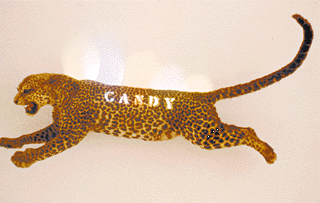 Candy (The Leopard), by the Art Guys |
Frances Colpitt, Associate Professor of Art History and Criticism at UT San
Antonio. “And it really shows in a very simple way how the Art Guys work —
taking one symbol like a mallard and another like a dildo to comment on
something much bigger. It’s horrible and very funny.”
But Sims didn’t think it was funny.
Galbreth was in the upstairs room hanging the edgier work when he noticed Sims
come in and begin looking at the work. He didn’t pay much attention until he
heard her gasp and say, “Oh my god.” “Then I noticed she was standing in front
of Fuck a Duck and A Lure and Gobble Gobble,” he says.
“The next thing that happened was Kathryn came in and told us to remove those
pieces.”
There was to be no discussion or middle ground. Sims could not defend those
pieces on any level. “It was so weird,” says Galbreth. “Up to that very minute
everything was cool. Nothing on the lists were questioned. The museum didn’t
request the right to omit works. In all of our discussions with Kathryn, she
had trusted us to curate the show. She suggested using the upstairs space for
edgier work. Even when we were hanging the show that day, we had some question
about whether 101 Ideas… should go upstairs because of the drawings of
sex toys. And I told Jack to put it up there just in case. We thought we were
being very sensitive to their concerns.”
But 101 Ideas… wasn’t considered objectionable. Neither were the
violent hunting images like E I E I O, which features the bloody remains
of a duck or Holy Cow!, which suggests a duck blown away with just its
wings remaining. Even the fish-like version of a vaginal sex toy, Large
Mouth Bass, the insides of which are reconstructed with a French tickler
and the mouth of which is replaced with a women’s mouth, was fine with the
museum. Are these more family-oriented? Should these pieces have been in a room
which didn’t advise parental discretion?
“Wildlife” closed January 26. When asked how the show was received, Davidson
says it was overwhelmingly positive. As for the children who came to see the
show, Davidson says the piece that got the most reaction from the children was
Large Mouth Bass. “And that was mainly because the description beside it
said `human sex toy,'” says Davidson. “That caused lots of giggles.”
But only the pieces with male sex toys were censored. Such is the hypocrisy of
censorship. Sims defends her decision by saying that the museum docents were
trained to deal with the energy of the pieces left in the show rather the
sexually explicit material. Galbreth thinks it’s ridiculous. “If there is
nothing wrong with the violent images, there should be nothing wrong with the
sexual images. None of the work is gratuitous.”
Annette Carlozzi, curator of American and Contemporary Art at UT’s Huntington
Art Gallery, doesn’t quibble with AMOA’s — or any institution’s — right to
decide what is in a show. “Obviously the most graceful way to curate a show is
in the artist’s studio with the artist, not at the 11th hour,” says Carlozzi.
“When you extend an invitation to artists to bring their work and trust them to
curate their own show, there’s risk involved. Either they bring work which
isn’t right for the space and you have to be willing to show it, or you pull it
and deal with the fallout from that. What you have to be concerned about in the
latter case is policy. Is it going to be a policy of that particular
institution to pull work at the last minute?”
This gaffe on the part of the museum may simply have been a case of
carelessness and miscommunication and not censorship. Sims says that the museum
sent the Art Guys three different letters which state the museum’s right to
pull work. The Art Guys may have assumed that they were being trusted to curate
their own show. Sims and Davidson may not have read the lists faxed to them. Or
they may have expected the Art Guys to bring a show full of work appropriate to
children. Or perhaps Davidson offered the “adults only” room as a solution
without Sims’ agreement. It’s hard to say. Without the museum’s acknowledgement
that there was a controversy with the Art Guys, all this remains conjecture.
But if yanking artwork at the last minute in the name of community becomes a
policy of the Austin Museum of Art, then Austin is in for a suprise if it
expects to see its new museum attract artists of any renown.
Lindsey Lane is a freelance writer living in Austin.
This article appears in January 31 • 1997 and January 31 • 1997 (Cover).