

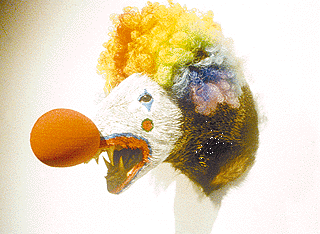
 Clown (Ha Ha Ha), by the Art Guys |
many ducks does
it take to make an Art Guys exhibition? “Wildlife,” the recent exhibition at
the Austin Museum of Art at Laguna Gloria, contained the work of Michael
Galbreth and Jack Massing, the fearless duo from Houston who call themselves
the Art Guys. The subjects/objects in the exhibition are animals — ducks,
fish, deer, a goat, a javelina — trophies procured by the artists and
embellished, converted, distorted, transformed into art.
There were duck jokes and duck puns a-plenty. The galleries are filled with
animal images and recycled body parts. E I E I O, in the upstairs
gallery, had tiny feathers, beautifully drawn, splattered with (mixed media)
blood. Don’t worry, it was probably paint. Two duck trophies wrapped in duct
tape, one in black and the other silver, hung upside down on the wall. Three of
the mixed media fowls that the Guys brought to Austin were rejected by the
museum’s co-curators as too foul to be included in the show (see companion
story). A largemouth bass wriggled out from the wall, situated about 30 inches
off the floor. Its red plastic mouth gaped open. The accompanying label
identified the medium as “bass trophy and human sex toy.”
“Holy cow!” said a woman across the gallery from me. She was laughing. I
couldn’t tell if she was reading the title of a drawing — a diptych with a
left wing on the left panel and a right wing on the right — or commenting on
the work, Holy Cow! The wings were beautifully rendered, the right
somewhat more bloodied than the left. The Art Guys draw very well. They also
have an astonishingly sharp graphic sense, obvious in every work on paper in
the museum. They are also smart. And they are clever — perhaps too clever,
like the lovable, oh-so-smart neighbor boy who is kind to his mother but keeps
getting kicked out of school for being a prankster. The Art Guys have a talent
for making others laugh at the goofy, the sinful, the ugly, the nasty. They
make light of weighty issues and take a serious look at the mundane. That’s
what art is supposed to do, isn’t it?
The Guys made N-I-C-E with yellow, blue, red, and green blinking lights
and wood bark. The letters spelled out the last word I’d have used to describe
their exhibition. But back to the ducks. Dead Duck #3 had nose-dived
into a block of concrete. Dry Duck, with a wing on one side and a doll
arm affixed to the other, was applying Right Guard anti-perspirant under its
wing. “How sinful,” giggled the woman as she stared at the duck.
“Oh boy, look at this, Judy,” said her partner, pointing up at Lamp
Duck, displayed high on a wall with a lightbulb for a head. “Oh, geez.”
I couldn’t wait until they began to read the drawings: Duck walks into a
drug store and buys a chapstick. The clerk sez, “Will that be cash or charge?”
The duck sez, “Just put it on my bill!” — A Duck Joke.
The drawing
was entitled, 101 of the Greatest Ideas for Li’l Duckies (and Goosies).
There were drawings upstairs and down — drawings for sculpture or drawings
made to work out the details as sculptures were being realized. What difference
did it make which came first, the duck or the egg? Oh, those guys! They drew
duck “bills” (altered paper money and duckie mouths), substitute wings
(airplane wings, paddles, golf clubs), and a marble (as in “cat’s eye”) duck.
The drawings offered insight into their process, described the dialog that
these collaborators share. Is this really how they create together, two grown
men trained in art history and anatomy and life? Galbreth and Massing met while
students at the University of Houston and have produced collaborative projects
since 1983. Is this really how they invent their silly/serious sculptures? The
drawings managed to both reel visitors in and keep them at a distance through a
strange combination of cerebral and silly images and words. Viewers past a
certain age were reaching for their reading glasses to apprehend every last
inch of meaning.
Downstairs, the middle gallery was more than a little off-putting for the kind
of person who imagines that wall-mounted trophies follow you around a room with
glassy-eyed stares. I always feel that way, which made it hard to laugh with
the laughing javelina, Clown (Ha Ha Ha), wearing a wig and red nose. A
motion sensor set off an eerie chuckle if you made the right moves in front of
the piece. A second trophy with motion sensor and sound had been tampered with,
apparently. While it spoke to me at the Lynn Goode Gallery in Houston, I Was
Tampered With made no sound at all in the AMOA gallery when I was there.
Both sides of the narrow gallery where Tampered was located were lined
with trophy heads adorned with wigs, goofy glasses with nose, and even a
concrete block. At the far end of the gallery, standing like the king among his
courtiers, was Robert Jr., a bobcat wearing a young boy’s preppy
costume, blue blazer with pocket crest, khaki slacks, and loafers. The
relationship of the head to the clothes was eerie. Party Animal, an
antelope trophy, looked like I feel the morning after an unpleasant night
before. The antelope appeared to need more than an aspirin to cure what ailed
him; the signs of wear and tear (on his fur) were irreversible. Looking at his
condition, I felt more than a little uneasy. Perhaps that was the point.
In the far gallery, Dust Bunnies refreshed the mood. The Art Guys had
formed little polystyrene rabbits and coated them with dust — genuine Art Guy
Dust, I’m told by the docent. A broom and dustpan stood nearby. The Guys used
chicken wire and fish hooks as the basis for drawings in this room, and
described The Emergence of Modernism using a hen trophy with a square
head. “What if…,” you heard them asking each other as you strolled through
the room. What if dust really gathered itself into bunny shapes, what if you
used an exploding fishing lure, what if you poked fun at people who need
trophies to prove their worth? What if you told a joke that wasn’t really funny
and everyone laughed?
Dead animals resurrected as art made me uneasy. I wanted to laugh out loud at
these dirty little schoolyard jokes — in fact, I did laugh the first time I
saw them in Houston — but my respect for life (and death) muffled the sound
this time around. Is the Art Guys’ work disrespectful or is turning animals
into trophies the obscene act? The Guys didn’t do that. Someone else did that.
They just made me look at those trophies with new eyes.
“It’s creepy. Isn’t it creepy?” asked the man in front of Roger.
“Kind of disturbing,” the woman said.
The Museum’s main gallery was dominated by a series of drawings on paper,
15 Works From 101 of the World’s Greatest Sculpture Proposals. A string
of familiar phrases ran across the top of the drawings, often jumping
mid-phrase from frame to frame. Fish or cut bait, stubborn as a mule, go whole
hog, white elephant, horse of a different color, paper tiger, pig latin,
kangaroo court. One way or another, it seems, we integrate animals into our
lives, our patois, our behavior.
My blonde cat, who stares down at me from the computer monitor as I write,
would have loved this show, especially the mannequin parts that dangled from
the ceiling — colorfully painted and sparkly legs, arms, hands, torso, and
head. They were fitted with fishing lures, sharp hooks affixed everywhere.
Ouch. That was us dangling up there, above the art, above the animals. Human
lures. Fishing for compliments? Fishing for understanding? Fishing for insight
into this exhibition! Duchamp, the early 20th-century artist who gave us the
“ready-made” and gave artists permission to be Art Guys, would have loved the
show, too. He once said, “Art is produced by a succession of individuals
expressing themselves; it is not a question of progress.” So, perhaps there’s
no pressure to pronounce the show “good” or “bad” or to rank the artists
against their peers. But it was good for me and for a lot of other folks.
A lot of people came to hear Galbreth and Massey talk about the work in this
exhibit during closing festivities last Sunday. (The opening reception had been
canceled because of the ice storm.) I suppose they wanted information about the
Art Guys’ work straight from the horses’ mouths. Afterward, the Austin Museum
of Art locked the doors long after the horses had gone.
Rebecca S. Cohen is an arts writer and recovering art dealer.
This article appears in January 31 • 1997 and January 31 • 1997 (Cover).