

 illustrations by Robert Faires |
Communications Group National Conference at Princeton University, I was hooked.
In his speech, “The Ground on Which I Stand,” the playwright articulates all
that he believes is wrong with the relationships between African-Americans and
the national theatrical framework: Black theatre is not funded. Black history
is being assaulted. Critics are woefully ignorant of black theatrical forms.
Pretty heady stuff for a magazine that usually reads like a gossip column.
The article was difficult to finish. I kept having to stop, equally angered by
Wilson’s accusations that a white theatre establishment was consciously keeping
black theatre off America’s stages and repelled by my own ignorance of black
theatrical forms. I thought this was a battle in its mopping-up phase instead
of an ongoing fight over cultural identity. Wilson’s words threw me into a rage
and a fit of embarrassment.
It made me open my eyes and look, not at the national scene, which somehow
seems to have little impact on theatre in Texas, but at Austin, a city with a
thriving arts community that, with dozens of performing arts groups, seems to
welcome a wide range of voices. Or, perhaps, that is simply the way the surface
looks to a white heterosexual female from the Northeast.
To get a more informed view, I sat down with three of our city’s prominent
black theatre artists: Boyd Vance, an actor and director for 20 years in
Austin, now artistic director of the Progressive Arts Collective; Dr. Joni L.
Jones, UT Speech Communication Assistant Professor, performance artist, and
dramaturg for First Stage Productions’ Shakin’ the Mess Outta Misery;
and Daniel Alexander Jones, Frontera@Hyde Park Theatre company member, director
of Shakin’ the Mess Outta Misery, and author of Blood:Shock:Boogie
and the upcoming FronteraFest effort Ambient Love, in which Dr.
Jones performs. Our starting point was Wilson’s speech and the rebuttal by
Robert Brustein, artistic director of American Repertory Theatre and New
Republic theatre critic, published in a subsequent issue of American
Theatre, but our real purpose was to talk about where black theatre is in
this town and where it could be going. After two hours, we emerged from the
Victory Grill into a bright November day and I had to figure out how to
condense a massive amount of material into a relatively small space without
skewing the thought behind the words, words that may not truly resonate with me
because of the color of my culture. “I’m praying that we’ve been real careful
in what we’ve said,” remarked Vance at the end of the discussion. “Hopefully,
it will cause thought and spiritual growth.” Hopefully, we will all start to
figure out all of the conflicting ideas we may have swimming around in our own
suddenly full minds.
Austin Chronicle: Personally, why do you do
theatre?
Joni Jones: I think it is part of my contribution to changing things. I think I
have a certain set of tools and skills that I can share with other people and
help them expand themselves. As cliché and trite as it is, I do theatre
to make this a healthier place to live.
Daniel Jones: Every incarnate spirit has a purpose, and I decided that this is
what I do. I couldn’t do anything but this. And I agree wholeheartedly with
what Joni said, that there must be work that impacts the world and we impact
the world by impacting communities, by impacting one another on an individual
level. Theatre, I think, is the perfect medium for doing that because it’s a
human medium. It does not have to involve technology, and it has the potential
to create massive and powerful change within the individual, who then can
affect the broader community.
AC: So how do you feel African-American theatre is being developed in Austin?
Is it?
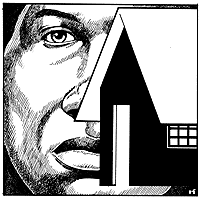
Boyd Vance: The thing that is interesting about August Wilson’s speech is, in
many ways, some of the denial that he talks about – how whites accepted the
civil rights movement but ignored the black power movement, how there is work
that we present for white people that is what white people want to see and then
there is work that we do within our own houses – is really critical if you
want to begin to discuss Austin theatre. The other part of it is, when you talk
about the stuff that we do for ourselves, for our own houses, for us to play
ourselves as black people, then really the civil rights movement and the black
power movement, as it affects Austin, has made us confused about our own house.
JJ: I love it. We don’t know what house we’re in.
BV: Consequently, the problem is — number one: If we want to pretend that
everyone is equal here, on some level, and that everybody is the same, then to
assert our self identities becomes very culturally negative for the general
population.
Two, as African-American artists, because we are so busy trying to reach
status quo and to be accepted by the general population, we have not learned
how to communicate with each other as African-Americans. In order to achieve in
the big world, we try to get there first and be the only one; we try to remain
exotic because we figure if there aren’t more of us around, then they are going
to need me and need me only. But then, when it comes time to create our art
together, we make high judgments on what we say to each other, how we say it,
who we think we are when we say it, who does he think he is, in ways that we
never would have called upon a white person. Being white gives you a certain
amount of credentials that we will follow what you say. But being a black
person, no matter what your age is or what your credentials are, we judge each
other. Therefore, we cannot work together as a people because we have
programmed ourselves not to be able to do that.
And that’s problematic in talking about community and creating together
because, somehow or another, I think black people need to acknowledge that
Daniel Alexander Jones being a wonderful artist does not invalidate Boyd Vance
as an artist. When we come to terms and say that, as black people, we are going
to move forward. Somehow we’ve gotten confused, so that if I say Joni Jones is
outstanding then that means that something is diminished in my reality.
DJ: Again, I am a relative outsider to the Austin community. I first came here
in ’94, in the summertime, and was a summertime person. I moved here this May.
And also being from the Northeast, I come from a completely different
background. So not only did I enter a city that I did not know, I also entered
a Southern culture that I knew only by virtue of having Southern roots in my
family. I didn’t grow up in the South and there is a whole other thing to
actually living in that environment. It’s been a trip on a number of different
levels for me as a person.
The thing about Austin spiritually for me has been that I have been blessed to
come into contact with so many black artists. It’s been a phenomenon to me. As
my homey-ace Shay Youngblood says, “There’s a rung on the ladder for each of
us.” I’ve never had the concept that one and one and one should fight because
there’s no reason for it. And there’s really room for all of us to do our work.
I came here and got to work with Zell [Miller], Cynthia Taylor-Edwards, and
then I met Sharon Bridgforth and root wy’mn and began to see Sonja Parks’ work
and got to meet Dr. Jones, having heard about her before. Having a sense that
there was a real strong tradition, if not necessarily of a broad-based black
theatre based here, certainly a tradition of artists who had a commitment to a
community, a commitment to developing art.
I was like, “Wow. This is a move.” Having lived here longer, I see that, like
every community, there are difficulties in communication and difficulties
because there are only so many people who are going to put down a dollar and
buy a ticket to see a show. You need them to come see your show because you
have to support your show, but then if they go to your show and they don’t go
to his show [pointing to Vance], then it’s “Who does he think he is?” and “Who
does she think she is?” That type of thing is in the soil, the soil of our
oppression, and we are made to chase after crumbs. When we really all deserve
our own cake. As artists in general in America, artists right now are made to
do that, too, so when you add [being black] – we’re sort of living under a
double construct here, of having to deal with being black artists and artists
in the larger American context, both of whom are marginalized. So we’re double
marginalized and trying to make a meal. That isn’t going to happen too
easily.
But I think the positive thing that I’ve noticed is that there is an effort on
the part of many people to take the risk to put their hand back out again, to
extend a hand to try to form community and to try to form the basis for work.
Certainly, I think that some of the work that’s happening here is of an
extremely high quality. I look at root wy’mn, and root wy’mn is certainly on
the vanguard of a type of theatre happening in this nation, and that’s just one
example. I’m sure that in all of the work we are doing, I know you are a
national artist, Boyd, and I’m sure that your work has impacted across the
country. And I know, Joni, that your work as a scholar and an artist – there
are not people doing what you’re doing. This is a type of thing that is
important about Austin. There are people here who are doing something unique in
the larger framework. At the same time, also in the framework of black theatre.
There is something to be cherished here in Austin.
The problem is, as with everywhere else, when it comes to dealing with
mainstream black theatres, and then dealing with the critical discourse, you
run into the sort of trendy multicultural thing, where it does become about “Do
you cast a black actor or do you do one black show or do you invite black
artists into a dialog with your institution that is going to change the nature
of what your institution is at its core?” And, of any solutions, that is very
rare.
The critical discourse, too, I’ve found to be very frustrating because of the
cultural imperialist and ignorant assessment of work here on the part of all
black artists that I’ve read in these newspapers. It infuriates me. That people
are so reductive in terms of what their views of what black culture is and so
completely unschooled in the form and aesthetic journey that black art has
taken in the last 25-30 years. Unless you fall down on the ground and call to
Jesus, you’re not doing a black play.
There are certainly avant-garde forms that are parallel to the form in music,
in art, in politics even, that are present in the development of our theatre.
It bothers me only because we as artists who see mainstream white theatre, who
are supposed to comment upon mainstream white theatre on panels, on boards, on
granting panels, are supposed to know the latest and most current development
in avant-garde work and performance art. And you can’t visit my house and tell
me what it means. Do your own homework.
I’m tired of being a teacher or instructor as well as an artist with
intelligent, well-versed artists and/or theatres. Do your own work. And if
you’re going to invite me in the house, or Boyd or Joni in the house, you
better be prepared for us to be in the house. We are going to move the
furniture. Definitely. In addition to the fact that we are going to do our own
work.
BV: It’s very important – we need black directors, black designers, and black
technical people, that work has to be created, and what is happening right now
is that unless we create the work ourselves, we’re not getting the work.
Frontera may be doing that, but the real deal is that in the house in which
some of this stuff is being produced, all black people are the artists that are
being hired. There’s been a nomadic tradition in Austin, where we go from one
theatre to another. How can we begin to develop community? Because that’s the
way we’re going to access the community in other ways.
DJ: On some level, until “white America” – it is a generalization and I don’t
like to make them – until America as a whole deals with the experience of
slavery and what it did in this country and how it is still as present with us
today as air, we are never going to move forward in our dialog. Never. It has
been tried and tried and tried again to bring that to the forefront. Brustein
liked Martin Luther King because Martin Luther King said it nice. He tried to
bring it to the forefront. And there were other people who didn’t say it nice,
who said it with as much vigor and truth as they could muster, who brought this
discussion to the table. It’s there. And it’s got to be dealt with. I think
that until that discussion happens, in all aspects of our work, we are never
going to move forward. That’s why you have to have your own, because as long as
you stay in that relationship of being in one way or another subject to the
whims of someone who is producing, your work is not going to have a certain
degree of efficacy. You’re not going to have the impact that you need to have
within your own community. Hopefully, there can be new models. I think there
are. There are people doing their own work, who are more or less institutions.
With younger generations who are sick of the same old system trying to find new
language, to build a new machine and throw the old one out. But nonetheless,
those discussions have to happen. Certainly within my relationship with
Frontera – we talk real. It’s not pretty all of the time. There are times when
racism rears its head and has to be called out. Those things have to happen.
But if we continue to play in this kind of model, as Abby Lincoln said, they
keep us around because they need us to bring the jazz, then there’s always
that, for lack of a better word and I mean this in the scientific sense,
parasitic relationship between the dominant and the quote-unquote subcultures
of this country. Once you suck a thing dry, you have to go on to the next
thing. Period.
JJ: Throw that chicken bone away.
BV: And then what happens is we have to watch where they throw the bone because
we have to put the meat back on the bone.
DJ: Indeed.
BV: And rebuild the community. That’s what some of this is about. Austin is a
very different place. And I would say, again, it’s a cultural hotbed and many
things can happen here. But, I imagine, 20 years from now it’s going to be
really different. Somehow we, as black people, have to rebuild and get people
to come out and really know the power of theatre, the power of African-American
theatre. And how to do that without financial resources and our mentality right
now.
JJ: One of the things I need to say, and I’m not even sure who sparked the
comment – I know that this analogy is not perfect, but I return to it a lot
because I think, for me, there are some things I need to explore in it.
Feminism has managed to get institutional support. It has managed to be in our
academies. It’s a word that people use and have some sense of what they mean
when they use it. And perhaps behind closed doors, men may be saying, “I wish
those women would shut up.” But men are not writing that. They’re not bodacious
enough to go out there and say, “Will women please stop complaining, you got
the right to vote, will you shut up and have some babies?” I think there is
something huge about the fact that this white man [Brustein] can say, “Black
people, can you please just get over it? The slave quarters have been razed.
Can you get over it?”
The hook-up I’m trying to make between feminism, and I don’t know what hook
to put on it, and blackness, is that I think that because of heterosexuality
men and women have been forced into a dialog. Their needs are going to propel
them. They’ve got to have some kind of conversation around gender and sex. I
think it’s really very healthy. But since black people and white people do not
have a vested interest in one another, we don’t have to do anything together.
We don’t have to. White folks aren’t forced, then, to examine themselves as
white people. Men have been forced to examine themselves as men, and what it
means to be male. White people are not pushed to that. They’ve been pushed, but
they won’t do it. They won’t hold up the mirror.
BV: Another part of this is that the way we have culturally progressed as black
people, we may not be forced to look at ourselves culturally either. As long as
we can run to the white person, as long as we can find a sort of cultural
security in dependence, unless we feel culturally compelled, if we have a sense
of community and really want to know.
You asked us why we do this. When we have a sense of why we do this, then we
will come together. But as black people in general, we don’t necessarily have a
need. Artists don’t have to pay attention to my work. But in the old days, we
were a community because of the way the lines were drawn by the powers that be.
Since those lines have dropped, it’s become a very muddy issue. We don’t know
what house we’re in.
DJ: And who took our sugar out of our house and is serving it with coffee over
there. That’s one of those cultural forms and ideas, like Brustein is saying;
the idea that is signified, I think, by his text is that there is some sort of
smorgasbord or beautiful laid-out table culturally that you can just pick and
choose from. Everybody can just take some and share. But you’ve got to know
when you eat that you have to eat it with this bread because that’s the way
this has been done for 1,500 years. Unless you eat these things together, you
don’t get the full protein. There are traditions. There are lines. There are
contexts. There are rituals. There are motifs that belong to the cultural
aspect you are taking. And unless you have a honest and earnest dialogue with
the culture or the cultures inside the culture, you’re transgressing something
huge. And that transgression is the thing that rubs me the wrong way as an
artist. When I go to a play and see an altar in a play that doesn’t have a
concept linking it to the reality that the altar comes out of, and I just see
the altar, I’m like, “Wait a minute. Do you all know what you’re doing?” Not
that you can’t use the altar, but if you’re going to use the altar, know what
the altar is there for. Do your homework.
Shakin’ the Mess Outta Misery runs through Feb 8 at The Public Domain.
Ambient Love Rites will be performed in Frontera Fest Feb 4 & 5 at Hyde
Park Theatre. The ProArts Collective photo exhibit BlackStage:
African-Americans in Central Texas Theatre 1975-1995, opens at the Austin
History Center Jan 31.
This article appears in January 17 • 1997 and January 17 • 1997 (Cover).