

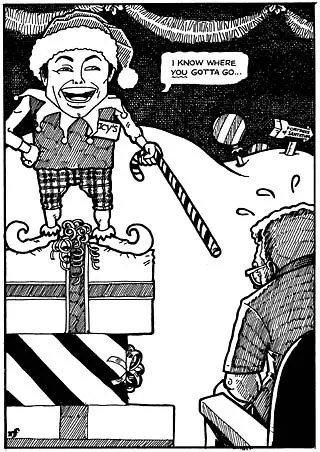
I wish everybody could sit down and talk for an hour or two with Martin Burke. This accomplished actor is as funny one-on-one as he is onstage — and as serious, honest, and surprisingly humble. We have been friends since 1990, when I played Tiresias and he played my “boy” in a production of Antigone. He didn’t have a single line in that show, but now he gets plenty of lines in every show, including the one he’s currently performing, David Sedaris’ The Santaland Diaries. As he is in the midst of his fifth sell-out run as Sedaris’ Little Elf, we talked about that show’s success and his acting career.
Austin Chronicle: How did you get into theatre?
Martin Burke: I guess through choir. In high school I sang and did musicals. I competed, and I did really well and got little medals and stuff — I still have them — from those days.
AC: So what was your first play?
MB: I did some stuff in junior high, a musical called Where’s the Mayor? Or, Swingin’ High! When I was little, I was one of the three kings in a Christmas pageant at church, and I sang one of the verses of that song. But I don’t really think of those as my first play. Finian’s Rainbow would be my first. I played the leprechaun.
AC: How did you end up playing the leprechaun?
MB: I’ve always been short. I’ve always been little. But I could sing the role, and I was the best one at the auditions, I guess. I was a little boy in The Miracle Worker — that was the first nonmusical play I was in. I was one of the children in The Sound of Music, the oldest boy. My line was, “I’m Friedrich, and I’m a boy.”
AC: This is like a pattern, Martin.
MB: What do you mean?
AC: You played the leprechaun, and you played a child in Sound of Music —
MB: I’ve always been small, and I’ve always looked very young. But where I started was not where I ended.
AC: Why did you decide to go to school for theatre rather than music?
MB: Because it was the thing that I enjoyed doing. I had fun doing it, and I felt I was good at it. I got a lot out of the University of Texas. I was given a lot of opportunities. I did a lot of children’s theatre, but the longer I stayed, the more different things I did. I got cast twice in one semester as the lead in Hair and as the lead in David Cohen’s play Baby Grand, and those were both adult roles. So it was like this culmination.
AC: After you got out of UT, did you try to work in the profession?
MB: I moved to Seattle, thinking in my head, I’m going to move there because it’s supposed to be a great theatre city, blah blah blah. I waited tables at like three different jobs all at once. I was there a year and three months, and then I came back here in early 1994. I was waiting tables again in the East Side Cafe, and David Cohen came in and told me they were auditioning Jeffrey down at Capitol City Playhouse. From that I got two independent movies. And then I decide I’m going to go to New York City, and I was there for six weeks and came back because I was miserable. It’s a very difficult place to live. After I came back, I did Richard III: Two Actors. I had to replace someone who had a medical emergency; I learned it in five days, and I’ve been working ever since.
AC: The bulk of your work has been at Zach Scott.
MB: David Cohen was going to be the dramaturge on Angels in America — that was the Christmas that he died — and I had played a Jewish person in Baby Grand, and he told [Artistic Director] Dave Steakley, “He’s played a Jew for me before, I guess he can play a Jew again.” That was the first show I did at Zach. I’ve been given a lot of opportunity there, too, to play things I never would have played. And have been asked, “What would you like to do?” It’s nice.
AC: Tell me about Santaland.
MB: It was sold out all weekend.
AC: How do you account for its popularity? It’s certainly not traditional holiday fare.
MB: I think it’s David Sedaris’ writing. More so than ever, I’m following the script rather than ad-libbing, but I’ve changed a lot personally. The humor can be so caustic, and I used to feel like coming down on people; that was my humor when I started performing it. Like, we’d be rehearsing, and somebody would do something, and I would say, “Can you try not to suck so hard next time?” People would laugh and laugh. But I’ve changed to where I catch myself before I do things that could be hurtful. The show is set up where I’m telling stories, and people get up to leave, and I say things like, “It’s an hour fifteen. Can’t you hold your pee? You’re a grownup.” On opening weekend, I think I really embarrassed this woman; I’m talking like Santa’s supposed to be at the door, and she walks in from the toilet, and I go, “So where have you been? Can’t you hold your pee?” And she pursed her lips and shook her head no, and I blew her a kiss and smiled at her. But she was upset. People get upset about lots of things, like their pee and the burned-children thing.
AC: What’s the burned-children thing?
MB: Macy’s does this great thing for children who are deformed by giving them all these wonderful gifts. And Macy’s posts the elves so they can see what the child looks like and then go and warn Santa, so Santa doesn’t get too freaked out when he sees them. I have to do this reaction to a child who’s burned, a child who has no nose, and the punch at the end is, “Santa has to be careful not to ask this child, ‘What do you want for Christmas?'” I went through that whole setup and that whole joke, and two people got up to leave, and it’s just my habit to say, “Where are you going?” And right as “where” came out of my mouth, I thought, “They’re leaving ’cause they’re pissed.” And the woman turned around and said, “I think it’s really rude what you said about the disabled people.” It really threw me, it threw me bad. Someone I know works with the disabled, and he doesn’t have a problem with it. He says there has to be some sort of levity there, because it’s very, very difficult. There’s also a joke about retarded kids, but the joke is that everybody looks retarded. He’s waving to these profoundly retarded people and says, “And I couldn’t even begin to guess where the retarded people ended and the New Yorkers began. Everybody looks retarded if you put your mind to it.”
AC: This is the fifth year. Why do you keep doing it?
MB: It’s a hard show to do. I feel like I’ve been beaten up every year, but then I do it again. So all my friends are like, “What are you doing it for?” I think there’s a fear of somebody else doing it and doing it better than me.
AC: That’s really honest.
MB: Hey, Zach could just go to New York and get somebody. So there’s that fear. There’s my loyalty to Zach. My loyalty to Dave [Steakley]. And it’s what’s given me my name in Austin. It’s made people want to go and see my other work. It’s sort of mine. So many people see me and say, “I know you. You’re the elf.” And I think I’m afraid of being alone on the holidays. I don’t want to think about why I do it. I just want people to keep yelling at me and saying, “Why are you doing it when you told me in January you’re not going to do it again?” There’s also the fear of Zachary Scott being mad at me.
AC: What really amazes me is that none of these reasons have to do with the play.
MB: Well, my god, it’s a job. It didn’t start that way, and there are things I still love about it. Like the last moment of the play. What I try to do is get the tempo going really fast and get it really manic and crazy and loud at the end so that when he sees that little girl, it’s dead silence. You can hear a pin drop in there. It is that silence that moves me so much, I think. Because if you’re talking like that and you get people laughing, and then they’re watching to see what you’re going to do, and then there’s nothing, you don’t do anything, it evokes its own response. It’s amazing to me, it’s beautiful. I did it the first couple of years because I loved it, and I still love that moment, but it’s such a job at this point. Please, go and talk to the people who are in Cats and say, “Don’t you just love performing it?” No, I love my check every week.
AC: But aren’t you giving in to the cynicism that Sedaris attacks in the play by saying that? All your reasons for doing it now are political and involved in the system; they have nothing to do with theatre.
MB: Right! Exactly! Exactly. And that this play goes on beyond Christmas is the same sort of cynicism, it’s the greedy sort of, “You’ve got one more day! One more day!” That’s what this show has become. It’s become that for me. Not wholly, but that’s exactly right.
AC: But everything you’ve been telling me puts the lie to that. You’ve been telling me the thing that you enjoy the most about being involved in the show is the way that it moves you on a consistent basis.
MB: I don’t remember saying that.
AC: That’s the way that I heard it. You said that you get this silence —
MB: But that’s like a theatrical thing. When you have absolute silence in the theatre and you know you have people, they’re not moving and they’re not making a single sound —
AC: But that’s the story that you tell. That’s what’s doing it. And it’s this particular story.
MB: Right.
AC: And it’s not like you get that with every play.
MB: Right.
AC: All the reasons you gave me were selfish and political.
MB: You said the first one was honest.
AC: Oh, they were all honest. I’m extremely impressed with your honesty.
MB: I’m so good.
AC: But you have to admit those were selfish reasons.
MB: I guess so. It seems like theatre is pretty selfish.
AC: It can be.
MB: It can be. I love to get people laughing, but when they’re not laughing, I get irritated. And that leads to less laughing because all I’m thinking about is them not laughing at me when I feel so funny.
AC: Do you think people keep coming back because it’s a funny, cynical show or because there’s truth there?
MB: I think people may not be aware of the truth in it. People come back because it’s funny. People laugh, they laugh hard, to like they’re crying they’re laughing so hard. That’s the writing. Like one of the elves is an actual dwarf, and I love saying, “Everybody wants their picture taken with a goddamn dwarf. It’s all Santa! Santa! Santa! The children don’t have respect for the elves, unless it’s the dwarf, and then, woooo!, they go wild. For sure she looks the part, but she’s just coasting on her looks.” She’s a dwarf! She’s coasting on her looks! I mean, c’mon!
AC: That’s rough humor, but it’s funny because it’s true.
MB: Yes. The day I graduated from UT, I was very moved by the ceremony. The dean said something that I’ll never forget, that I’ve sort of taken as a personal inspiration: that we as artists teach people what it is to be human.
AC: That is absolutely true.
MB: So it’s always amazing when people, like that lady who got up and left and told me I was being rude. I wanted to cry. I felt badly. We’re human. This is part of us. This is part of you. This is why you’re getting up and leaving, because you don’t want to be confronted with your own ugliness, your own problems with it all. That’s what I love about — when I think about doing theatre, that’s what I hope to do: to teach people what it is to be human. 
The Santaland Diaries runs through Jan. 5 at the Zachary Scott Theatre, 1510 Toomey. Call 476-0541 for information.
This article appears in December 27 • 2002.