

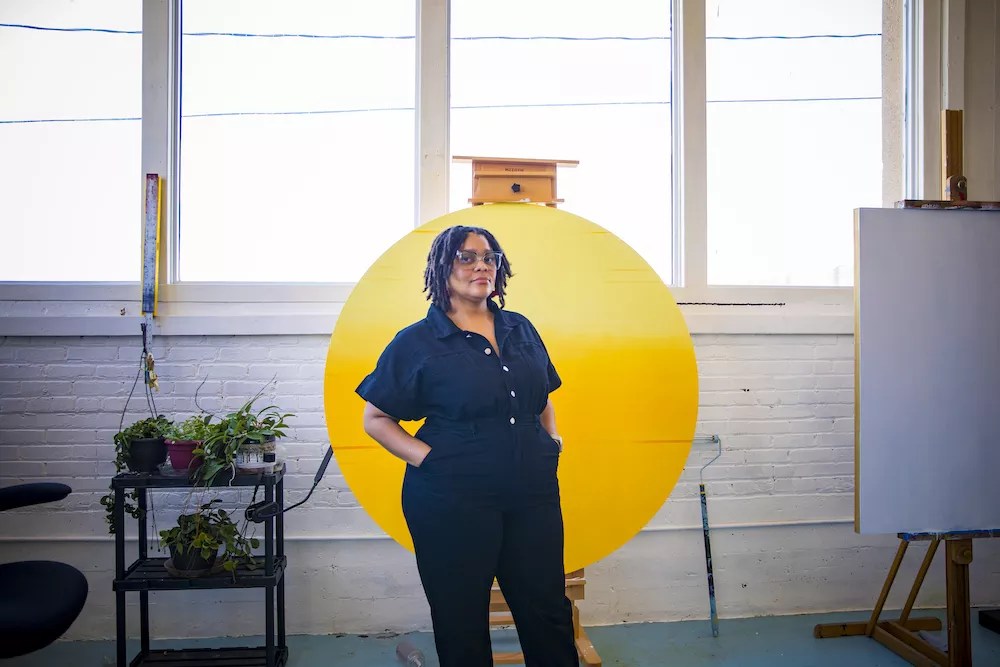
Motherhood as presented in art tends to depict a sacrificial and devoted figure, usually completely submitted to their title as a creator and caretaker. Notably, this heavenly framing of the mother figure rarely seems to come from those who have created life themselves. In Aimée M. Everett’s current exhibition, “Two Births and the Afterlife” at George Washington Carver Museum, the artist adds to the discussion with an honest and unapologetic mother’s perspective.
Everett communicates through symbols to create sensations. With an experimental manipulation of colors, shapes, patterns, textures, sounds, and objects, her abstract work exhibits a deeper interest in conveying feelings than providing literal explanations. Though employing a non-figurative style, the emotions expressed in Everett’s pieces are frank and pellucid. In fact, the entire exhibition is evocative of a children’s book with its surprising intensity despite a more quaint and infantile packaging.

In the show’s notes, Everett references her birthplace of New Orleans as a source of inspiration. In the city’s culture, death is celebrated for bringing on new beginnings. Everett carries this philosophy into her show, which simultaneously elicits feelings of grief and optimism.
Uncovering the sorrows of motherhood just as much as its joys, Everett’s installation is split into two rooms to address both sentiments. Underscored with celestial themes, the theme manifests in an exploration of both lightness and darkness. If the two separate parts of this exhibit reflect day and night, we can understand days as busy and open to possibility, while nights induce fears and isolation.
Uncovering the sorrows of motherhood just as much as its joys, Everett’s installation is split into two rooms, underscored with celestial themes, to address both sentiments.
The first room captures an atmosphere reminiscent of the frightening vastness of space. The walls are painted black and accented by the moody blue and gray tones of the different pieces. An artistic materialization of Everett’s struggle with postpartum depression, the space induces feelings of isolation, rumination, and helplessness. Little room is left for interpretation with on-the-nose titles like Sitting with Anxiety, I, which displays an ominous black rocking chair, or Calls Unanswered, which presents an arrangement of calls for help on the wall. Its obviousness is, one suspects, part of the point, as Everett unapologetically emphasizes the feelings of despair and grief that new mothers are seldom encouraged to share.
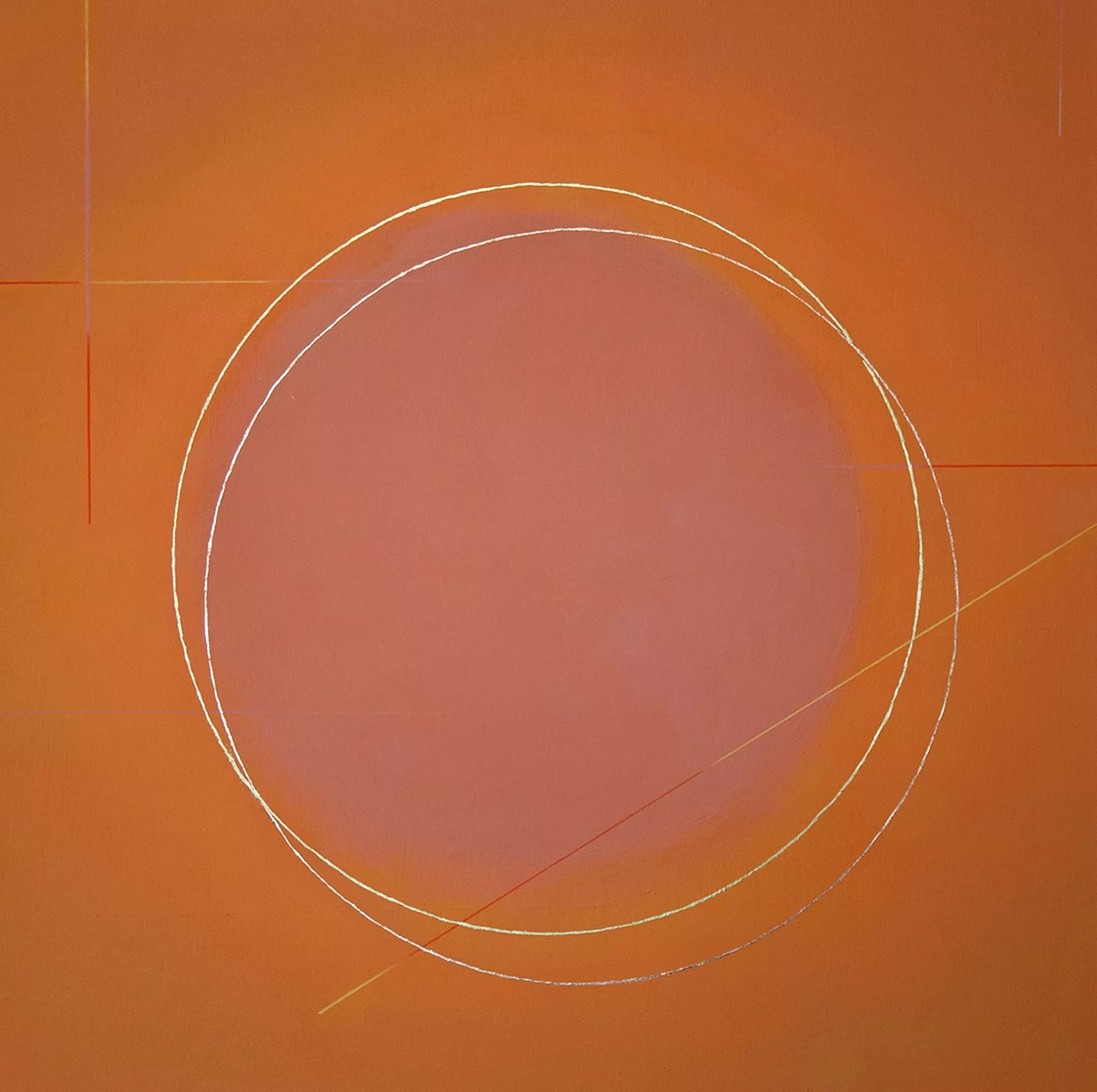
Waiting for you in the second room is a much-needed respite. Painted a darling baby pink and accented with bright orange, pink, and goldish hues, the space resembles a nursery. Like opposite sides of a mirror, each piece in the second room presents a delighted “glass half full” response to each of the pieces in the first room.
A highlight of the show is Burgeoning, a painting that captures a softly glowing full moon. Its coloring and mood make it reminiscent of Van Gogh’s Starry Night. In contrast to the corresponding wall in the first room that features Under These Stars, I Lay to Rest, a piece that feels like a moment of surrender to a bleak universe, Burgeoning is a comforting look at new worlds.
Everett’s clear-eyed take on the topic of motherhood is a refreshing switch from the all-too-familiar narrative that motherhood is the gift that keeps on giving. While this exhibit may resonate most with mothers, the rest of us can acknowledge the duality of good and bad that lies in all of our experiences and note the necessity – and beauty – of their coexistence. Through a cosmic interpretation of change, Everett celebrates the passing of an old life marked by independence and full nights of sleep, as it evolves into a happier and more fulfilling reality with a new companion.
Two Births and the Afterlife
Carver Museum
Through April 20
This article appears in March 1 • 2024.