

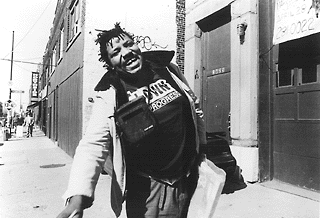
 Poet Rocker/Wacko: Wesley Willis |
ultra-tough Chicago crime writer whose body was found dangling from the window
of his office with a rope around his neck just before Christmas. He was wearing
a bullet-proof vest and had $400 and some brass knuckles in his pocket. Izzi
lived close to the edge and knew some rough people, but he had a new book
coming out and a wife and kids, so his friends doubt he killed himself. Izzi
doesn’t appear on my Top Ten because I didn’t read any of his books this year,
but I respected him, and I like books that are, like his, tough and close to
the bone. It also seems appropriate that my list should include not only crime
novels but a memoir and a biography or two as well.
* Moody Gets the Blues by Steve Oliver. In his first mystery novel,
Oliver has delivered a stunning debut that stars a taxi driver on Thorazine
moonlighting as a private investigator in Spokane. This book is a classic of
the genre, sure to be a big collectible.
* The Poet by Michael Connelly. The author of the best L.A. cop series
(The Black Echo, The Last Coyote) going leaves town (and his franchise)
and strikes gold again. Connelly, who debuted in 1992 with The Black
Echo, is already highly collectible.
* My Dark Places by James Ellroy. In this true crime memoir, the
toughest of the tough guys takes on his most gruesome case yet: his search for
the man who murdered his mother.
* Hellman and Hammet by Joan Mellen. This dual biography of Dashiell
Hammett and Lillian Hellman dishes some good dirt on their notorious and
legendary affair. Wow! What a couple of characters. I love ’em more than
ever.
* A Little Yellow Dog by Walter Mosely. Mosely’s bluesy tone takes us on
a drive down Chandler’s mean streets, but with a black man behind the wheel in
a time and place ruled by racist L.A. cops — adding an atmosphere of
credibility and paranoia that most other P.I novels only pretend to achieve.
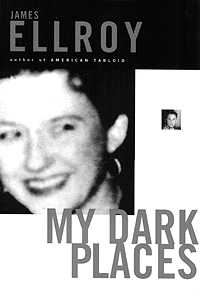 James Ellroy’s latest |
West was really as wild as we used to think it was depends on whether or not
you were around people like John Wesley Hardin, killer of fortysomething men.
Metz’s writing is like good whiskey taken straight: It’s just smooth enough
that you admire the way it burns on the way down.
* Cadillac Jukebox by James Lee Burke. Along with Walter Mosely, Burke
is one of the most poetic and soulful writers working today, and he proves it
every time out.
* Savage Art by Robert Polito. Those of you who are familiar with the
work of Jim Thompson, author of books such as The Killer Inside Me and
The Grifters, won’t be surprised to hear that this biography is, like
much of Thompson’s work, tragic, funny, brutal, and vital. Polito, a poet, did
a good job here.
* Bordersnakes by James Crumley. Another wild ride from the big guy.
* The Illustrated Life and Times of Billy the Kid by Bob Boze Bell.
Brilliant, brave, and irreverent, Bell is one of my favorite new discoveries of
the year. Books like this make you wonder why you’d read fiction for
entertainment.
Jesse Sublett has written several mysteries including The Rock
Critic Murders, and also works as a screenwriter as well as being a Western
aficianado.
Best Books
I Read in 1996
by Robin Bradford 1. Moby Dick by Herman Melville (originally published 1851) I spent the
first six months of the year reading Moby Dick; friends got sick of me
saying how I loved it so much I didn’t want it to end. Not only do I think it’s
the first modernist masterpiece, predating Joyce’s Ulysses by some 70
years, but I also believe there should be a copy in every motel room in this
country. I did my part when I left my first copy in a Virginia motel eight
years ago. Don’t wait that long to read it!
2. Killing Mr. Watson by Peter Matthiessen. A portrait of an outlaw,
husband, enterpreneur, and settler of the Everglades at the turn of the
century, this history of man’s battle against nature is narrated by half a
dozen voices, which sometimes makes for hard going. Ah, but what voices:
“Grandma House declared how meet and fit that Mister Watson should vanish in a
great storm, like the demon she herself had always said he was.”
3. The Collected Stories of Isaac Bashevis Singer. Singer is an
international writer up there with Marquez, Borges, Kawabata, Tatiana Tolstaia,
Bombal, and Kundera, transcending time, place, and language to the common world
we all occupy: “A bed is to sleep in or make love in, but when you can’t sleep
and have no one to love, a bed becomes a prison.”
4. Hoopie-Shoopie Donna by Susanne Strempek Shea. This is the only
hardcover book of fiction published in 1996 that I enjoyed reading. It could
have had something to do with the fact that I was plowing through the last
revisions of my own novel and hated fiction on principle. Or maybe I was too
busy reading pregnancy books (I recommend The Pregnancy Comfort Book by
Jennifer Louden and Anne Lamott’s Operating Instructions). If you love
polka or don’t know if you love polka, you’ll love this novel that begins:
“Winkie Papuga started the whole thing.”
5. The Matisse Stories by A.S. Byatt. Half of this slim collection was
published in The New Yorker, but I’m glad I read the other half if just
for this observation: “A woman’s relation with her hairdresser is anatomically
odd. Her face meets his belt, his haunches skim her breathing, his face is far
away, high and behind.”
Robin Bradford, an O.Henry award-winning fiction writer, is
expecting her first child and her first novel in 1997.
Top Five Spoken Word
Releases of 1996
by Phil West Maybe by next year, more than five will stand out. Mouth Almighty, a
new spoken-word division of Mercury Records, plans a barrage of 20 poetry CDs
over the next 2 1/2 years. Their first two made this year’s
Chronicle list, including Fat-Headed Stranger, the debut from
Austin poetry’s favorite son/whipping boy Wammo, and there are some intriguing,
promising items on their “to do” list. Audio poetry isn’t the largest genre,
admittedly, but a groundswell of popularity for Mouth Almighty might make life
easier for performance poets and poetry radio deejays such as myself. When a
poet knows his or her work inside out, like these winners do, the power of the
piece grows exponentially.
1. In Their Own Voices: A Century of Recorded Poetry compilation. It’s
hard to fail with a cast like this — nearly every important name in 20th
century poetry, from Whitman to Olds, Ginsberg to Frost, Stevens to Sexton,
Merwin to Angelou, and the list does go on — are featured here. A fine
collection of poetry and, in some cases, rare audio documents.
2. The United States of Poetry compilation. A bristling compilation from
the afore-praised Mouth Almighty, featuring an edgy, energetic collection of
pieces from the known (Lou Reed, Maggie Estep, Leonard Cohen, Amiri Baraka) and
the should-be-known (Lois-Ann Yamanaka, Quincy Troupe, Ai). Also contains the
occasional “found poem,” which scores extra points for me.
3. Wesley Willis, Fabian Road Warrior (American) Technically a “rock
album,” but when the same Casio keyboard loop (with variations in tempo and
key) play out over 71 minutes, it’s hard to not focus on the
hypnotic-yet-unsettling free-association that is a Wesley Willis lyric. Paeans
to mediocre rock stars, shameless product placement, and his recurrent “Use
evil profanity on me” make this the joke that hasn’t gotten old yet.
4. Wammo, Fat-Headed Stranger (Mouth Almighty) Those of you who hate
Wammo will feel your hatred swell with each track, meaning he’s done his job:
Putting together a CD that integrates his multiple instrument-playing,
ebullient rants, and cadre of talented friends into a disc that still manages
to be 100% Wammo. Just like him, you’ll love it or hate it.
5. 5Giants in the Dirt compilation. This compilation from this New York
indie label, which champions artists who are bending spoken word into curiously
shaped packages, is particularly notable for the tracks by Hal Sirowitz, a New
York comic poet who brilliantly obsesses about his mother. Imagine a more
neurotic nightclub-era Woody Allen.
Phil West is a member of the nationally placed Austin Poetry Slam
team and a regular contributor to these pages.
Random Notes on Books in 1996
by Margaret Moser Best Reissue: Country by Nick Tosches. This wicked, wicked examination
of the dark side of country music first saw the light in 1974, was resissued in
1984, and updated in 1996. I alternated between dropping my jaw and hooting
with laughter. Don’t take it as the gospel — just enjoy its rambling ways.
Best Literary Self-Evisceration: My Dark Places by James Ellroy. I used
to devour true crime until I read Tim Cahill’s book on John Wayne Gacy, which
scared the bejesus out of me. Ellroy’s story of the search for his mother’s
killer is fascinating, sad, and a little eerie.
Best Fairy Tale for Adults: Lorien Lost by Michael King. This
gentle story of a painting come to life is magical and enchanting, a gentle
breeze of a book that is absorbing and tender.
Best Book for Cocktail Party Chatter: The Rules Just because this book
is hugely popular doesn’t mean it can’t be made fun of. No matter how many
“owl books” (you know, those ones with “who” in the title), The Cosmo Girl
ethos is alive and well.
The Truth about The Rules: They work.
Top Five Books I Started
And Couldn’t Seem To Finish…
by Andy Langer 1. The Run of His Life by Jeffrey Toobin (Random House) Perhaps this
should have been a sequestered read because by the time I was halfway through,
the press had ruined most of Toobin’s best revelations.
2. It’s Alive, Steven Cuozzo (Times Books) 15 chapters and not one puny
chapter title — a sin for a book on the history of the New York Post.
3. Ashes to Ashes by Richard Kluger (Knopf). Since I was averaging about
a pack a chapter on this intense account of the cigarette wars, I stopped for
my health. (Reading, not smoking.)
4. Fool’s Names, Fool’s Faces by Andrew Ferguson — Funny, but merely a
pre-travel P.J. O’Rourke.
5. A Prime Time Life by Aaron Spelling. A yawn of an autobiography,
made worse by the stale publicity photos of Tori, Tiff, and Heather.
Andy Langer reports for the Chronicle in music and politics, hosts
radio programs on 101X and KUT, and still smokes too much.
The Lists
by Barbara StricklandFiction
1. Saudade by Katherine Vaz
2. The Gods Are Thirsty by Tanith Lee
3. Indian Killer by Sherman Alexie
4. The Autobiography of My Mother by Jamaica Kincaid
5. Playing the Bones by Louise Redd
6. The River Beyond the World by Janet Peery
7. The Death of Frank Sinatra by Michael Ventura
8. False Allegations by Andrew Vachss
9. Ten Indians by Madison Smartt Bell
10. A Regular Guy by Mona Simpson
Non-Fiction
1. Zen and the Art of Motorcycle Maintenance: An Inquiry into Values by
Robert M. Pirsig (Over 20 years old and still up to date as far as I’m
concerned — a true classic)
2. Marijuana Law by Richard Glen Boire
3. The Coming Race War by Carl T. Rowan
4. Lovejoy: A Year in the Life of an Abortion Clinic by Peter Korn
5. The Size of Thoughts by Nicholson Baker
6. Rush Limbaugh Is a Big, Fat Idiot and Other Observations by Al
Franken
7. Thinking in Pictures and Other Reports From My Life With Autism by
Temple Grandin
8. Henry James: The Young Master by Sheldon Novick
9. Guillotine: Its Legend and Lore by Daniel Gerould
10. The Devil Knows How to Ride: The True Story of William Quantrill and
his Confederate Raiders by Edward E. Leslie
Collections
1. Weird Business, edited by Joe R. Lansdale and Richard Klaw
2. The Country Ahead of Us, The Country Behind by David Guterson
3. Granta #54: Best of Young American Novelists/Granta #55:
Children: Blind Bitter Happiness
4. Home: American Writers Remember Rooms of Their Own edited by Sharon
Sloan Fiffer and Steve Fiffer
5. Give the Pig a Chance by David Rice
6. Sudden Fiction (Continued) edited by Robert Shapard and James
Thomas
7. The October Country, by Ray Bradbury (reprint)
8. Dark Destiny: Children of Dracula
9. Women on the Case, edited by Sara Paretsky
10. The Quantity Theory of Insanity, by Will Self
Publications
1. The Sun “A Magazine of Ideas.” Poetry, essays, fiction, and
interviews of the highest caliber for the thinking magazine reader. Well worth
the $32 for a year’s subscription.
2. The Idler “Literature for Loafers.” Celebrates the joys of
slackerdom with inimitable style. Issue #12 features an interview with Bruce
Robinson, essays on guilt and late night grub runs, and recipes using what’s
been in the back of your refrigerator for the last two months.
3. The Anomalist
4. The Utne Reader, truly “the best of the alternative press.”
5. Bust irregular quality but hip and witty takes on feminism,
sexuality, and every riot grrl’s inalienable right to wear spike heels.
Barbara Strickland is a regular book reviewer for The Austin
Chronicle, profiling such writers as Mary Willis Walker and David
Rice.
The Best Paperbacks of 1996
by Stuart Wade 1. Independence Day by Richard Ford. If you aren’t already familiar with
the prequel, The Sportswriter, run out and buy both books — now.
You’ll be glad you did.
2. Wonder Boys by Michael Chabon. Flat-out hilarious novel about a
writer with a monster case of writer’s block, and bad luck.
3. Bird by Bird by Anne Lamott. Witty, inspiring reading for anyone who
desires to write for a living.
4. The Giant’s House by Elizabeth McCracken. Highly inventive story of a
shy librarian and a boy with a spastic pituitary. (I am not making this up.)
Not yet available in paperback, but it’s worth the extra dough.
5. In the Lake of the Woods by Tim O’Brien. Chilling, cerebral tale
about the disappearance of the wife of a failed political candidate.
6. The Palace Thief by Ethan Canin. Wonderfully quirky foursome of
novellas. Bet the farm on Canin, a physician who happens to be a great fiction
writer in his spare time.
7. The Information by Martin Amis. Though not his best book, Amis still
has no peer at capturing the most powerful of human emotions: “We hate it when
our friends become successful.”
8. Rush Limbaugh Is a Big Fat Idiot (and Other Observations) by Al
Franken. Payback is hilarious, as demonstrated by the Left’s answer to P.J.
O’Rourke. To paraphrase Edward G. Robinson, Where’s your Gingrich now?
9. Sacred Hoops by Phil Jackson. By the Chicago Bulls’ Zen head coach,
and ego-handler nonpareil, this underrated chronicle of the team’s 1996 NBA
title run should be on Barry Switzer’s nightstand.
10. Trying to Save Piggy Sneed by John Irving. Equal parts memoir,
essay, and fiction, this is a sort of literary bootleg, a “Beatles Anthology,”
of a most Fab novelist.
Stuart Wade is the co-author of Drop Us a Line, Sucker! and
generally avoids “Golden Oldie” formats on the radio.
Memorable Books of 1996:
A Writer’s Year in Hell
by Marion Winik 1. Geography of the Heart by Fenton Johnson. This memoir of a lover’s
death from AIDS was reviewed together with my simultaneously-published First
Comes Love in the San Jose Mercury-News. After reading therein that
his book was transcendent and mine a piece of crap, I hardly expected to find
myself a few months later sitting on a stone wall in Alsace weeping as I wrote
Mr. Johnson an adoring fan letter. Well, it really is transcendent. What
can I say?
2. Never in a Hurry, Naomi Nye. This terrific collection of essays by my
dear friend in San Antonio was reviewed together with my book in the San
Antonio Express-News under the headline, “From the Profound to the
Profane.” Guess which I was? Nevertheless, everything I said about this book in
the blurb I gave for its back cover is true. Naomi really does render the
exotic familiar and the familiar exotic with magic tricks of perception and
language. Check it out.
3. Drinking: A Love Story, Caroline Knapp. This woman went to the same
college I did, writes personal essays for a paper like The Austin
Chronicle in Boston, and published a book about her travails with alcohol
addiction. For some merciful reason, our books weren’t reviewed together.
However, after she was on Oprah, Drinking was on the bestseller
list for several weeks — quite a contrast to the utter non-event of my own
Oprah appearance. If I hadn’t already read the book when this happened,
I’m sure I wouldn’t have (see #4), but as it is, I did read it and can report
that there is some excellent writing, especially in the first half. I thought
the story got a little tedious after a while, but apparently it fits the “I Was
Lost But Now Am Found” paradigm the American public looks for in its substance
abuse stories. Shortly afterwards, my editor at NPR asked if I knew how to get
in touch with Knapp. Wanted to use her on “All Things Considered.” How great.
4. The Deep End of the Ocean by Jacqueline Mitchard. I probably would
have been eager to read this first novel by a writer whose work I had long
enjoyed in Parenting magazine, where we both began publishing round
1990. We were contributing editors together, and even though we had never met,
I had a sisterly feeling. Then, mere days after my aforementioned
didn’t-sell-a-single-copy appearance on Oprah, the irrepressible Ms.
Winfrey announced her new book club — with Mitchard’s novel as the first pick.
Deep End hit the bestseller list the following week at #1 and her
publisher announced a second printing of 650,000. The next day, my editor at
NPR called to tell me how great the book is. I guess if she can’t get Knapp to
replace me, Mitchard will do. I will not be reading this book any time soon.
5. Tales of Burning Love by Louise Erdrich. I was on my book tour the
same time as Erdrich was, and found myself following her from city to city.
Often we would be on the same radio or television program, and I would be
interviewed in the three minutes left after her extended segment. Low
attendance at a reading? Erdrich was signing across the street. To make matters
worse, when I was finally introduced to her, she was perfectly lovely. As for
the book, it’s not her best, but die-hard fans will enjoy it.
6. A Civil Action by Jonathan Harr. This is a tautly written, true story
of a toxic waste lawsuit in Woburn, Massachusetts, and one of the first books
that has kept me up reading till 3am in a long time. Even though it has camped
out at #1 on the paperback nonfiction bestseller list, I have no sick feelings
of jealousy – and probably never will unless it’s still there when my own book
comes out in paper this May.
7. Dave Barry’s Complete Guide to Guys
8. Forever Erma by Erma Bombeck. These two books are much funnier than
anything I could write in my wildest dreams.
Non-’96 winners include:
9 Another Country by James Baldwin
10 U & I by Nicholson Baker
Since these volumes were not published during the period of competition, I
could read them with pure enjoyment and respect for the enormous talents of
their authors. These are some damn fine books. (Sigh.)
Marion Winik, author of First Comes Love and Telling,
is currently working on her new book.
This article appears in January 10 • 1997 and January 10 • 1997 (Cover).