


On a balmy November afternoon, I and hundreds of others opened our laptops or turned on our tablets or phones to attend the first day of adult programming for the 2020 Texas Book Festival. I didn’t have to walk further than my desk, pay for parking, or fight crowds to hear from this year’s guest authors. And the authors didn’t have to come to Austin either.
Welcome to the virtual edition of this annual literary event. From my home, I could watch authors Mychal Denzel Smith, author of the recent Kirkus Prize-winning Stakes Is High: Life After the American Dream, and Isaac J. Bailey, author of Why Didn’t We Riot: A Blackman in Trumpland, discuss their books – Smith from his couch in Brooklyn and Bailey in South Carolina.
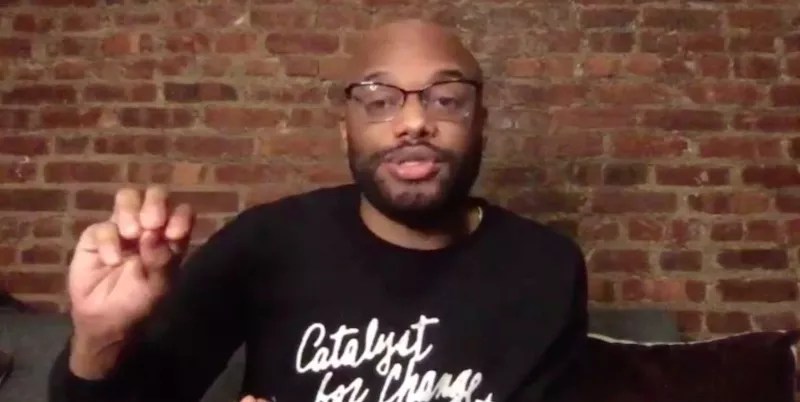
Moderator Jennifer M. Wilks, associate professor of English, African and African Diaspora Studies, and Comparative Literature at the University of Texas, opened this session, “Election Day: Mychal Denzel Smith and Isaac J. Bailey in Conversation,” with an intriguing premise. Both authors urge their readers to think about America, yes, as a place, but also an ideal, and addressing Smith, Wilks asked, “Is life after the American dream … is that life possible without thinking about life after America, which you discuss as a fable or a myth in your work?” Smith unpacks much of this unraveling of the American myth in his book, however it can’t be stressed enough the pertinence and importance of what he is talking about. We are told as Americans that some of us will come from nothing and have the opportunity to create something. It is this condition, that there should be people with nothing at the core of the American dream, it is this harmful philosophy that pervades the American ideal that Smith is asking us to attempt to undo.
“We have to break ourselves free of the idea that the American dream is worthy of our attention or worthy of our praise and then therefore we’re breaking down the myths at the heart of the country … I’m not interested in the survival of America; I’m not interested in the USA; red, white, and blue, all of that being the surviving thing. I’m interested in how we as a people constitute ourselves. How we decide to live together, how we decide to govern ourselves, and that has nothing to do with those things that have been loaded into America,” Smith said.
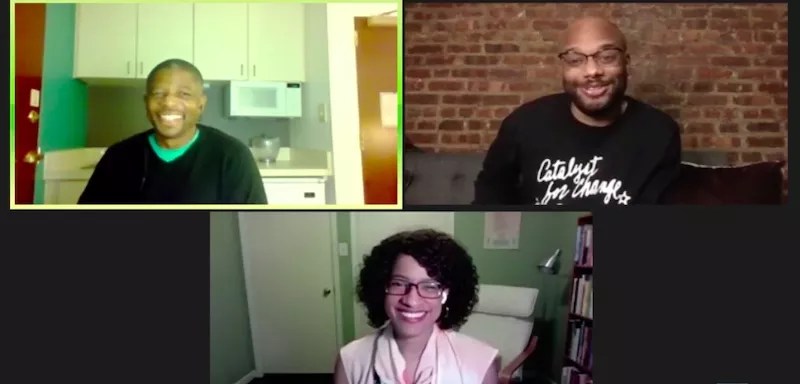
It is a revolutionary thought to attempt to extract the good qualities of America, equality and justice, and mobilize those in earnest. Smith warned that those fascinated by the symbolism of America and its myths pull us back into those stories, but in order to have true change we must untangle these myths permanently.
An attendee asked through the moderator, “What do you think about Trump’s efforts to woo Black men in particular?” Bailey, Smith, and Wilks all grinned wide through clenched teeth, slightly chuckling. Bailey had some pertinent insights.
“If you go back to the 1990s with Donald Trump in New York, even back then he was this sort of idol for many rappers, and even as he was doing all this racist stuff with the Central Park Five, there were still these rappers who actually wanted to be like Trump. He bragged a lot, he talked about money all the time, he talked about women all the time, how he can treat them a particular way, et cetera. For a small but significant portion of Black men, that is still appealing,” Bailey said. “And that is really a bad thing that actually needs to be rectified, really, really soon.”
This article appears in November 6 • 2020.