


100 Suns
by Michael LightKnopf, 208 pp., $45
If the radiance of a thousand suns were to burst forth at once in the sky, that would be like the splendor of the Mighty One. … I am become Death, the destroyer of worlds. — Bhagavad Gita
Turns out, the sixth sign of the apocalypse is when it becomes art — or in this case, an art book. One hundred explosive black-and-white and full-color photographs of America’s favorite megaton detonations (1946-1962) for your coffee table. So pour a cup and while away the holiday hours as mushrooming radiation clouds beget rumbling tides of soot so disturbingly beautiful that one transfixes not only on their majesty, but on the weight of their consequence. Inside the action, cameras take to the puzzled, unwittingly radiated military guinea pigs who witnessed human stupidity’s most glowing act from their dusty desert trenches. The Rapture notwithstanding, 100 Suns is a gorgeous art book of extraordinary design and composition, as brilliant reds, oranges, purples, and grays knock out the glossy black pages, bringing the apocalypse home, once and for all. — Taylor Holland
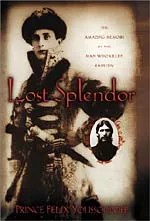
Lost Splendor: The Amazing Memoirs of the Man Who Killed Rasputin
by Prince Felix YoussoupoffHelen Marx Books, 300 pp., $21.95
Mass quantities of cyanide wine and pastries. No dice. Gunshot wound. Nothin’. A gentle dragging through bloodstained snow, a few more rounds, and, finally, an icy-river baptism. As the poison coursed, Rasputin asked his killer to serenade him with something “cheerful” on his guitar. Prince Felix Youssoupoff, instead, gave his prey a sad Russian ditty. “I looked at my victim with dread, as he stood before me, quiet and trusting. … Of what use was his faculty for reading the thoughts of others, if he was blind to the dreadful trap that was laid for him?” As his body succumbed to the absoluteness of death, Rasputin confounded even his murderer. We may never know the complete truth about the peculiar, prescient, bearded monk whose beguiling of Nicholas II and his wife, Alexandra, became the catalyst of imperial Russia’s ruin. Could he truly cure hemophilia? Was the miracle worker actually shtooping the czarina and her young daughters? How big was his penis, really? Some details, great and small, shall remain mysteries. However, the recent reprinting of Lost Splendor, by Youssoupoff, the Oedipal, dog-loving aristocrat who fired Rasputin’s first wounding blow, sheds poetic light on the 1916 killing and much more. Historically and literarily compelling, Youssoupoff offers ultimately an articulate and oftentimes witty insider’s account of the corruption and opulence that fueled the most revolutionary of firing squads. — Courtney Fitzgerald
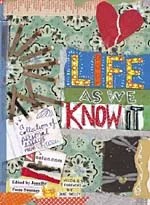
Life as We Know It: A Collection of Personal Essays From Salon.com
edited by Jennifer Foote SweeneyWashington Square Press, 336 pp., $14 (paper)
“D-I-V-O-R-C-E.” The dirty truth is perhaps too much for even country songs to confront openly. But “it’s beautiful and hard all at once” to Suzanne Finnamore, one of the 40 contributors to Life as We Know It, Salon.com’s collection of personal essays from its “Life” section. Finnamore’s words embrace the magnificent ugliness of reality and all the hard-to-do that breaking up brings. She and her fellow essayists pull the bile and bullshit from this complicated thing called contemporary life, serving it to us in frank elegance via essays like, “We Believe Children Aren’t the Future” and “Born to Pop Pills.” This is the personal essay at perhaps its most personal. Fledgling as well as acclaimed writers (Amy Bloom, Kathryn Harrison, Susan Straight, and Benjamin Cheever) perfect the discipline into more than masturbatory diary-entry fodder by articulating what is at once personal and universal with incisive wit, passion, and familiarity. Still births, car-crash-mangled expectant mothers, and other cold hard facts become strikingly beautiful through the urgency of these storytellers. Here, in these clusters of love and life lost and regained, the compulsion to write is bitterly and sweetly obvious. Skinned alive. Sharing out of necessity. The stuff of country songs, actually. Just what the holidays are all about, right? — C.F.
Travelatrocities and Map Quests
This week’s SARS is last week’s shoe bomber. Queasy greasy spoons and acrid cabin pressure. Tacky souvenirs and tipping. Packing and unpacking. Heat …
Distance, like time, is relative.
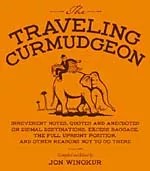
For some, escape is fully realized only by casting a vast gulf between self and what’s left behind. While others, inspired by the horrors of foreign and/or political climates (factoring in ethnocentrists and agoraphobes) remain content to revel in the limited confines of their own back yard. The Traveling Curmudgeon (Sasquatch, $16.95), a medley of miserable meanderings about travel and why one should not do it compiled and edited by Jon Winokur (The Portable Curmudgeon), wastes no time waxing whimsically about heading out for the great wide open, and instead spills it like it is — thick as a petrol slick on an Alaskan honeymoon: Travel can certainly suck. The quotes collected in this churlish little volume dispense wisdom and whatnot from world-weary, oddly juxtaposed notables like Truman Capote, Erma Bombeck, Henry Rollins, Calvin Trillin, and Miss Piggy. First, quotes are grouped by area (city, state, region, country, etc.) so readers can simply look up their intended landing strip and avoid it altogether. Then the thematics take over with clusters of “Travel Tips” offering convincing arguments to stay at home, like “Rumanian-Yiddish cooking has killed more Jews than Hitler” (Zero Mostel) or “There are only two reasons to sit in the back row of an airplane. Either you have diarrhea, or you’re anxious to meet people who do” (Henry Kissinger) or “I love New York. I’ve got a gun” (Charles Barkley). A fantastically enabling gift for the decidedly landlocked, Curmudgeon (an appropriate potty-side reader at 5 inches by 6 inches and 180 pp.) validates what some of us often feel when venturing forth but feel too foolish or provincial to say (so let’s let Gertrude Stein): “Once you get there, there isn’t any there there.”
For those for whom curmudgeonly mumblings are not enough to keep feet planted on terra firma, there are always maps. And the inviting series of Knopf MapGuides ($8.95, paper) encourages going places. These palm-sized info-packs offer pocket protection from the confusions of cities around the world. The series covers 23 destinations, including Amsterdam, Barcelona, Istanbul, Milan, Prague, and Stockholm. Each city is broken into six urban regions, for which colorful, foldout maps serve as useful wrapping for small but chewy guides to what the authors call “unmissable” features of each immediate area: hotels, restaurants, theatres, bars, parks, etc. Though efficient in design, artsy thumbnail photos and economical but hearty descriptions (25-30 words each) pepper the directories with enough flavor to begin an adventure. Despite the compact size, the smart area maps afford details like street names, so these lodestars aren’t mere souvenirs. In each booklet, there is an overview with general city information, a public transportation map, and an index to streets and attractions. The intention here is to get daytrips started and provide some substance once appetites are whetted. — Kate X Messer

Gift Gallery
John Vachon’s America: Photographs and Letters From the Depression to World War IIby John Vachon, edited by Miles Orvell
University of California, 344 pp., $49.95
Seemingly the last of the New Deal photographers to be individually spotlighted, Vachon’s work appears worthy of the company he kept in the Farm Security Administration’s photography effort: Dorothea Lange, Walker Evans, Arthur Rothstein, and Russell Lee. Editor Orvell adds Vachon’s words as a lasting tribute to the quiet man in America’s greatest group documentary effort.
Women and War
by Jenny Matthews
University of Michigan, 192 pp., $29.95 (paper)
Following Matthews’ appearance in Austin comes this stunner — the brilliant record of a committed war photographer who has no trouble finding street-fighting women and war victims in a political landscape that ranges from Baghdad to Bosnia to Rwanda. Not for the squeamish.
Horses
by Michael Eastman
Knopf, 152 pp., $45
In what may have been the year of the horse as favorite American domesticated animal, Michael Eastman provides the equivalent of equine cheesecake/beefcake. Two heavyweight writers add introductions: novelist/philosopher William Gass and novelist/horsewoman Jane Smiley.
Beyond: Visions of the Interplanetary Probes
by Michael Benson
Abrams, 319 pp., $55
Take a trip to the far parts of our solar system in this spectacular selection from NASA’s Planetary Image Resource Facility. Slovenian writer/photographer/filmmaker Benson chooses fire and ice and craters and mountains that stretch to the orbits of Uranus and Pluto. Foreword by Arthur C. Clarke, afterword by Lawrence Weschler.
Avedon at Work: In the American West
by Laura Wilson
University of Texas, 175 pp., $39.95
Not as Inside Baseball as it first sounds, Avedon at Work is the record of Dallas’ Laura Wilson assisting the great fashion photographer as he travels the West from the Bexar County jail in Texas to the wheat fields of the Dakotas. The result was one of the last century’s greatest art shows that opened in Fort Worth’s Amon Carter Museum in 1985. Avedon’s uncompromising portraits are brought back to life by the gifted Dallas photographer and writer Laura Wilson, who, in her spare time, raised movie stars. — Dick Holland
This article appears in December 12 • 2003.