


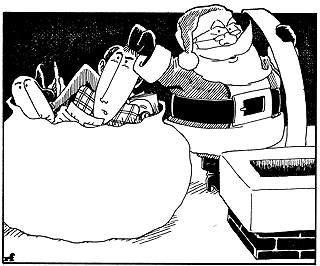
 illustration by Robert Faires |
theatre scene, gift-wise. What with getting a new theatre downtown (the John
Henry Faulk at Fourth & Brazos), new offices for the Austin Circle of
Theatres and the Box Office, our first bona fide cabaret at Bremond House, a
new lobby at Live Oak’s State Theatre (in which we now have our second
cabaret), a gallery downstairs at The Public Domain to go with their theatre
upstairs, a gaggle of new theatre companies with a lot of potential (e.g.,
Austin Musical Theatre, Austin Theatre for Youth, Colonial Shakespeare,
Critical Mass, Rude Mechanicals, Third Coast Repertory Company), a national
conference for improv troupes and one for independent theatre artists, an
international symposium on British theatre, and maybe more outstanding
productions in a single 12-month period than we’ve seen in a decade, by the
time it came to send you our wish list, our stage community had already
received most of the things we’d have put on it. (Well, there’s still this
business about getting the South Congress porno house for a legit theatre, but
first we have to figure out who’s willing to steam-clean the place….)
Then we thought about plays.
Now, you probably figure that with some 240 productions every year, Austin’s
loaded for bare where plays are concerned. Well, it is true that we already
have a lot of dramas here, but it’s a funny thing: We have a lot of some, not
so much of others. That is, certain plays or kinds of plays are produced here
in abundance, and others aren’t. For instance, over the last few years, we’ve
had a steady drizzle of work by A. R. Gurney — Love Letters, Later
Life, Love Letters again, and Sylvia — and this year we had
a sudden downpour of plays by Caryl Churchill — a staging of Top Girls and two of Mad Forest (!) in the spring and this fall a Vinegar
Tom. But where August Wilson is concerned — to pick the name of an
important modern playwright whose work has been produced here with some
regularity in the past — we’re in a bit of a drought; we haven’t seen a local
staging of one of his plays since Boyd Vance directed Joe Williams Has Come
and Gone at the Zachary Scott Theatre Center in 1992. Among classical
authors, Chekhov and Ibsen come round our stages with some frequency, but
neither Shaw nor Strindberg get to visit much nowadays. And poor Shakespeare
has local companies practically falling all over each other to stage certain of
his plays — there was that recent season of the three Macbeths and
we’re presently in the midst of one with twin Twelfth Nights — but
other works by the Bard — Coriolanus, Richard II, Henry
IV — go perpetually untouched here.
We know the reasons that certain plays get produced here vary. In a few cases,
you have plays which will always be staged over and over; they’re like the
weather. Productions of A Midsummer Night’s Dream are as inevitable as
heat in August. The play has an enduring appeal to audiences and appears to
offer an irresistible lure to theatre artists (in this category, place also
Three Sisters, A Streetcar Named Desire, and Rosencrantz and
Guildenstern Are Dead).
In other cases, you have plays which are hot, either culturally or
commercially. The play that has won a Tony or Pulitzer or some other notable
prize or that has inspired some critical buzz or that has been made into a
major motion picture may win a local staging based on the strength of that and
the likelihood that Austinites will want to see it. Then there is A
Christmas Carol, which speaks for itself (as do the rapidly multiplying
herd of other plays with Christmas in the title).
Still, probably the biggest factor in determining which plays are staged in
Austin is the interest of Austinites. Just like politics, all theatre is local;
it is driven and to a great extent succeeds on its connection to the community.
A playwright’s work strikes a chord in an Austin artist and that person is
drawn to produce it here. Or once produced here, that work strikes a chord with
audiences, who attend in large numbers for it and inspire local artists to
produce more of the playwright’s work. Sometimes it’s both. You have Dave
Steakley, who loves pop music, staging the pop revue Beehive. Austinites
turn out in droves for it, and we get not only annual revivals of
Beehive but the spin-off Rockin’ Christmas Party and similar
fodder, such as Forever Plaid. In the Eighties, this synergy made Austin
a prime place to see multiple works by Alan Ayckbourn, Christopher Durang,
David Mamet, Joe Orton, Sam Shepard, and Tennessee Williams.
As to why certain plays don’t get done locally, the reasons are fuzzier.
(People tend not to talk very much about why they didn’t do a show —
and considering how many shows people don’t do, they wouldn’t have the time to
talk about them all anyway.) Still, you can postulate a few likely factors,
some having their roots in practical considerations — companies not having the
funds to mount Angels in America or Peer Gynt (at least in the
way that they’d like); feeling that Timon of Athens or Ghosts aren’t big draws at the box office; being unable to reconcile conflicts in
scheduling with the artists needed to mount The Piano Lesson — and some
being grounded in creative concerns — maybe nobody in town really gives two
hoots for the work of that old windbag Shaw. Of course, you can’t rule out
unfamiliarity with a playwright’s work. Sometimes plays aren’t done simply
because companies haven’t read the plays.
With this last idea in mind, Santa, we’d like you to drop a few scripts our
way this holiday. They’re plays that we haven’t seen done in town, but we think
they fit in the mold of shows that our theatre community has proven that it
likes and can do well and that audiences have supported. They reflect our city
in certain ways — in dealing with music, with polarized factions within
communities, with the tension between staying as we are and changing — and
they reflect our tastes — in inventive language, in dark humor, in lyricism.
We can’t say for sure that folks here haven’t read them, but on the off-chance
that they haven’t, bring us some copies, would you? They might spark something
that our town hasn’t seen yet.
* Mojo, by Jez Butterworth
Our friend Elizabeth Richmond-Garza of the UT Department of English suggested
this one to us. She says that it’s “about the Soho rock music scene in 1958,
about the various people who are trying to get the shows on and about the
British learning to be American rock musicians. It’s very, very, very funny,
extremely satirical,” with an edginess of language and a bit of violence to it.
* After Easter, by Ann Devlin
Another recommendation from Richmond-Garza, this tale of three sisters, one of
whom is considered mad because she thinks she’s hearing voices telling her to
do things, melds political tension and imaginative power. “It has very bold
scenes, like Special Forces coming onstage with sub-machine guns, and dream
visions and surrealist touches,” says Richmond-Garza. “It also has the new way
of thinking about Ireland. It’s the only play I know by a Northern Irish
playwright that has a moment of sympathy for a British soldier, which is a big
deal. It’s a really remarkable play.”
* Just about anything by Horton Foote
This gentle and eloquent Texan has spent a half-century harvesting thoughtful,
compassionate drama from his native soil. Last year, he won a Pulitzer Prize
for Drama for his play The Young Man From Atlanta, yet the last time a
local company produced one of his plays was 1989. We have a deep reservoir of
talent that can convey the intimacies of Texan life, and local audiences are
clearly in love with Texas plays. It would be so lovely to share with them one
of the state’s best.
* Valley Song, by Athol Fugard
This South African dramatist has never been widely produced in Austin and
that’s a shame. His works, in which he wrestles with the deep divisions in his
homeland, brim with intelligence and power and humanity. Richmond-Garza prizes
this, his most recent play, which pits a young woman wanting to leave her rural
home to pursue a career in music in the city against the old man who wants her
to stay: “It’s about the new South Africa, about the younger generation that
doesn’t live under apartheid. It’s thinking about, `Do you really have
possibility or do you really not have possibility, and does embracing the
possibility involve giving up things?’ The characters are very sympathetic and
very rich.”
* Cinders, by Janosz Glowacki
This work by an Eastern European is set in a girl’s detention center, where a
filmmaker has come to make a movie of the inmates’ production of Cinderella.
And he is willing to use any means neccessary to get what he wants. The piece
speaks to issues of repression, manipulation, sexism, power, illusion, and art,
among other things. It is one of those theatrical Chinese boxes — a play
within a play within a play — that can be so compelling. It has terrific roles
for women, and its potential for ensemble work is great.
* The Secret Rapture, by David Hare
The recent production of Racing Demon was the first time this brilliant
British social dramatist has been staged locally. It proved that he has much to
say to Austin, and our friend Richmond-Garza notes that this play “is about
over-fast property development and expansion. There’s a whole series of plays
from the late Eighties, like Michael Frayn’s Benefactors and Hare’s
Secret Rapture that were either aimed at Reagan or were aimed at
Thatcher that would probably be very funny and very relevant, as they say, in
the context of this uncontrolled expansion of the city of Austin.”
* The Wall of Water, by Sherry Kramer
Sherry Kramer knows how tangled the desires of end-of-the-millennium Americans
are, and in her plays she details the snarled mess of anxieties and yearnings
that passes for romance these days. In this work, she plays that mess for
laughs, criss-crossing the encounters of a curious assortment of singles in a
New York apartment: biologists, mental patient, party gal, health worker, et
al. The show is full of sharp, funny observations on modern life and love,
and it builds into a mad farce, with a wildly fantastic, over-the-top climax.
* Zoot Suit, by Luis Valdez
“Valdez is somebody who should be performed here,” says Richmond-Garza. “He’s
the only broadly successful Hispanic playwright in the country in a lot of
ways. He’s the only one who’s had a Broadway hit, for instance.” His work
speaks to the Hispanic experience in Anglo America, but it crosses the divide
of theatre for a monocultural audience, and Austin needs that, Richmond-Garza
says. “You have theatre done in Spanish, but it’s for a Hispanic community, and
you have theatre done in English for the English community, but the thing about
Valdez’s work is that it’s an attempt to desegregate those audiences by having
a play that’s literally bi-lingual.”
* Terminal Hip, by Mac Wellman
Wellman has a keen interest in language, which he takes to a fascinating
extreme in this one-act. The format is a lecture or speech to the audience; the
thing is, while all the words that the speaker uses are English, their meanings
are scrambled. At first, they sound like random stringing of nouns and verbs
and adjectives, a meaningless jumble. But sense can be made of them and as the
speaker continues, one begins to grasp meaning and hear in a new way. It’s
savvy, funny, and a thrilling challenge for a bold actor and director.
By the way, Santa, this is in no way a complete list. It doesn’t include
Edward Bond, John Guare, Mar�a Irene Fornes, Philip Kan Gotanda, David
Henry Hwang, Terrence McNally, John Osborne, Suzan-Lori Parks, Tom Stoppard, or
any of a number of late 20th-century playwrights who aren’t produced here very
often, if at all, and it doesn’t touch the classical writers at all. We didn’t
want to omit them; we just didn’t want to load you down. Feel free, though, to
bring by any other plays you think we could use.
Yours truly,
Robert & Adrienne
Special thanks to Elizabeth Richmond-Garza, UT Department of English,
for her insights and suggestions.
This article appears in December 20 • 1996 and December 20 • 1996 (Cover).