




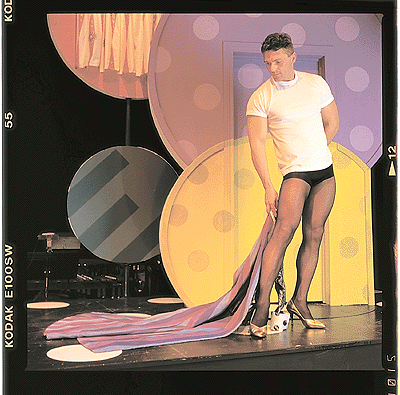
 Joe York on the set of Ruthless! |
upstairs at Caswell House is ready to burst. The second floor of this restored Victorian manse, one of
Austin’s favorite venues for weddings and soir�es, isn’t really roomy
enough to hold more than a few dozen people comfortably, and on this night in
late June, there are, what? 100? 120 people jamming themselves into it. It’s
impossible to get an accurate count because folks are squeezing into hallways,
nooks, corners, any cranny available. They don’t want to miss this evening’s
special event: a solo concert by one of the leading lights in the city’s
theatre community. And make no mistake, this is a special event. If you can’t
sense that just from the crush of bodies, each of which has shelled out $35 to
be there (the proceeds benefit Christopher House), you should be able to sense
it from the level of anticipation in the room. It’s like water on a boil:
animated, intense. These people know something’s coming.
You can count on one hand the number of theatre artists in Austin who can
inspire this kind of excitement. For better or worse, our town simply doesn’t
take its stage performers all that seriously, doesn’t grant them the respect,
the deference, the celebrity, that it does so many of its musicians, politicos,
and coaches. So when you see a hometown theatre artist generate that kind of
enthusiasm and energy, when you see one break through the crust of
Austin-tatious indifference to theatre and turn a crowd into so much hot,
bubbling water, you know you’re seeing someone remarkable, someone of
extraordinary talent and charm and charisma. The member of this elite crew of
local performers who’s causing all the commotion at Caswell is a gentleman —
and I use that word deliberately — named Joe York. He’s an artist who has made
his home in Austin for more than 20 years, during which time he has performed
in nearly 80 local productions on stages all over town, from tiny Hyde Park to
the grand Paramount. What he has… well, to explain that, it’s better to wait
until he takes the stage.
At last, when the room can’t accept another body and it’s so charged that it
feels about a spark away from combusting, York weaves his way through the crowd
to the stage. This incites a final fit of agitation among the assembled, and as
he faces his audience for the first time, all that anticipation peaks and locks
in place, boiling water abruptly frozen. It holds there while York makes his
brief opening remarks, and you can bet most of the crowd is using the
opportunity to drink in the actor’s form, for a not-insignificant part of his
appeal is right on the surface, plain as day, in his look. He’s tall, broad of
shoulder and muscular of build, his physique robust in that way that they used
to call strapping. And in fact, there’s something almost old-fashioned in
York’s appearance. He has the look of a matinee idol of days gone by: the dark
hair and eyes, the broad face with the lantern jaw, the smile that shows off a
dazzling array of big, white teeth. And in that smile and those limpid eyes is
the quality of York’s that’s the most old-fashioned of all: a sense of
wholesomeness. Golly, he just seems like the nicest fella, steadfast and true,
happy to pitch in to help anyone in need, a guy you can count on. You look at
York, and what’s not to like? He’s homemade vanilla ice cream on the Fourth of
July.
Then York’s accompanist for the evening, his musical theatre colleague and
friend Allen Robertson, strikes up the intro to a song and York begins to sing.
And as his warm baritone blankets the crowd in tones rounded and rich and
buttery, it melts, instantly translated from solid to liquid again. York’s
voice is his other great charm, an instrument which is deep enough to convey
command and full enough to broadcast power, yet which is capable of profound
tenderness. At its fullest — call it Robert Goulet mode — York’s voice has
the breadth and force of a river in floodtime; you feel from it a passion
almost operatic. At its most delicate, his baritone is like a down comforter,
warming, cozy; its smoothness soothes, it reassures. Always, the sound is
steeped in feeling and from York — remember, that nice, nice fella — it
always comes across as sincere, genuine, true.
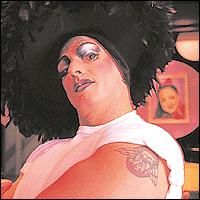 York in the guise of Agent from Hell Sylvia St. Croix |
most popular performers in Austin theatre and why, for 20 years, he’s been the
de rigeur choice for the romantic lead in any musical staged here. He
seems to be just what Lerner and Loewe had in mind when they created the
character of Lancelot in Camelot, the man Rodgers and Hammerstein were
thinking of when they wrote Billy Bigelow in Carousel, the very picture
of the roguish Starbuck that Schmidt and Jones envisioned for 110 in the
Shade. What you may not be able to glean from this experience of York,
however, is that he is also one of Austin’s most important theatre artists. To
get a handle on that and why, it’s instructive to take a look at York’s current
project, Ruthless! The Musical, which opened last week at the Zachary
Scott Theatre Center.
Ruthless!, a deliriously campy musical send-up of backstage melodramas,
opens with York onstage, but the figure we see is miles away from the romantic
stalwart and boy-next-door sweetheart at the Caswell concert. Here’s a
character swathed in black velvet, whose face — peering out from under a great
ebony saucer festooned with jet-black feathers — is a comically sinister mask:
over the eyes vault inky arches underlaid with thick coats of silver eye
shadow; the lashes look like twin tarantulas; the cheeks are slashed with
industrial-strength rouge; the lips, tinted the shade of dried blood, seem to
open upon a gateway to Hell. And those eyes — the pupils sunk low so that the
whites above and around them are all visible — they stare the stare of sheer
dementia. This is a grande dame of grotesquerie to give Cruella DeVil the cold
sweats, a demon diva. And she’s played by Joe York.
Now, what’s a huggable hunk like York doing camping it up as the
jaw-droppingly over-the-top theatrical agent Sylvia St. Croix? Well, from the
looks of it, having the time of his life. He throws his head back to deliver
one of Sylvia’s trademark laughs — a maniacal cascade of ha-has — with
undisguised glee. Her withering put-downs positively zing out of his mouth. He
vamps for the audience, tossing winks (not to mention the occasional salacious
glance at some male) into their laps like bonbons. Each wiggle of her padded
hips, each overwrought thrust of an arm, each bark, is served up with the giddy
delight of a six-year-old chowing down on a fudgy birthday cake.
However, to answer the question from a more — sniff, sniff — critical
perspective, that is, in the context of York’s creative career, what York is
doing is pushing himself as an actor: working against type, challenging himself
with a role for which he might not seem suited physically or artistically. That
happens to be something that York likes to do and works at. Look at his work
over the last several seasons and you’ll see that Sylvia is simply the latest
in a long line of character parts that York has tackled: Sweeney in Sweeney
Todd; Teddy in The Homecoming; Smudge in Forever Plaid;
Marvin in Falsettos; Jud in Oklahoma! The majority of York’s work
is still in the musical theatre, but even within that one form, he’s managed to
embody figures as diverse as a maddened barber consumed by black dreams of
revenge; an affable but seriously dim-witted member of a Fifties pop quartet; a
neurotic New Yorker awakening to his homosexuality after years of heterosexual
marriage; and a troubled loner on the Western frontier. No bravado, no
gallantry, no sweep-the-crowd-off-its-feet allure. These roles have made York
stretch and sweat, and the fact that he is willing to sacrifice his
considerable natural appeal to investigate a broader range of characters is
enough to put him in a select rank of Austin actors.
 |
decade, he has added stage direction and design to his fields of interest, and
several times a season now York takes on projects in those realms. If he isn’t
onstage, likely as not he’s offstage in the thick of some upcoming production.
Last summer, he contributed the scene design for Subterranean Theatre Company’s
production of Sin. When Live Oak Theatre mounted Sweeney Todd at
the State, York was busy not only with the demands of the title role, but with
the design of the set in collaboration with Don Toner and the choreography in
collaboration with Cathie Sheridan. He spent the time between the close of
Sweeney and the start of Ruthless! designing props for the Zach
Scott production of A Christmas Carol.
The results speak for themselves: In the past four seasons alone, York has
been honored with a B. Iden Payne Award and a Critics Table Award for his
performance in Falsettos; Critics Table Awards and Payne Award
nominations for his direction of Quilters and Cabaret and for his
performances in Nine and Oklahoma!; a Payne Award and a Critics
Table nomination for his performance in Forever Plaid; a Payne Award for
his props design for Little Shop of Horrors; and Payne and Critics Table
Award nominations for his performances in Lend Me a Tenor and The
Homecoming, and his direction of Little Shop of Horrors and Come
Back to the 5 & Dime, Jimmy Dean, Jimmy Dean. It isn’t only that York
pushes himself; it’s that the work which comes out of this effort is
consistently engaging and inspiring.
Appeal. Versatility. Drive. History. Acclaim. Respect. You can connect one or
two of these qualities to any number of Austin’s theatre artists, three or four
to a few dozen, more than to only a handful. Put them all together and you can
connect them to only one man of the local stage. In a word, this star of
Ruthless! is peerless.
It wasn’t always this way. When York arrived on the scene in the mid-Seventies, he says he had a hell of a
time landing a part. He was a student in the theatre department at St. Edward’s
University — his classmates included local stage fixtures David Jones
(Sin), Bill McMillin (Critical Mass Productions), and Michael Stuart
(Cyrano) — and to hear him tell it, almost no one at St. Ed’s would
cast him. Bil Pfuderer was one director who recognized his talent and put him
in The Fantasticks, but aside from that production and a couple other
shows, York says he kept getting passed over for the campus plays.
In reaction, York simply stepped outside the boundaries of academia. “I just
wasn’t getting any shows at St. Ed’s,” he recalls, “so I just came out into the
community. I figured if they weren’t going to use me and I wanted to be
onstage….” To the actor’s delight, it didn’t take long for the community to
see what the university had missed. Ken Johnson snapped York up for a
production of Camelot at Center Stage. Ken Webster nabbed him for an
early production of Bleacher Bums. York landed in productions of How
the Other Half Loves and A Little Night Music at Zachary Scott. And
eventually, he made his way to the Hillside and that great tradition of Austin
theatre, the Zilker Summer Musical.
The Hillside. It fills an important place in the Joe York story, not so much
for the musicals it allowed him to be a part of — though that’s not to sniff
at such show biz mainstays as How to Succeed in Business Without Really
Trying, The Unsinkable Molly Brown, Camelot, Carnival,
or Annie — but for the people it brought him close to. York remembers
an intimacy among the Zilker company that pervaded one’s life. “It used to be
such a family,” he says, “and your whole year revolved around it. From the
close of the show, what you were thinking was, `What’s next summer’s show?’
Because it was our social life. And outside of your nine-to-five grind, that’s
what you did.” It was where he continued to develop his professional and
personal friendship with Bil Pfuderer, who directed so many of the Hillside
productions. Most significantly, though, it was where he met, as he says,
“the most important part” of his life, his partner of 10 years, Scotty
Roberts. York and Roberts, a talented actor in his own right, were both cast in
Molly Brown and hit it off. And you can say York’s life has never been
the same since. In more ways than one.
York embarked upon his career as a director not long after he and Roberts met.
A year later, in 1988, York staged an independent production of Is There
Life After High School? at Hyde Park Theatre. Working with a modest script
in a form he found comfortable, with the support of many of his close friends
from the Hillside (including Roberts, natch), York was able to test his mettle
at staging a show. He found he was up to the task and crafted one of the most
smartest and most charming productions of that season. Although York’s focus
continued to be acting for the next few years, the minute he was handed the
opportunity to direct at Live Oak, he seized it and used it as a springboard
into a full-blown directorial career. In the half-dozen years since, York has
staged nine productions.
For York, directing comes down to one basic thing: trust.”One of the things I
respect about directors is trust, knowing that a director trusts me. Bil
Pfuderer trusts me implicitly. And that’s not to say, `Let me just do my own
thing,’ because I’ll make bigger mistakes than anybody. But he lets me make
them. And he has always created an environment — and Dave Steakley does this,
too — where he allows his actors to make absolute fools of themselves. I think
as a director you have to do that. The actor has to feel so comfortable that he
can trust himself to make a fool of himself, to say, `I am going to embarrass
myself, fuck up royally, and discover things that way. And nobody’s going to
pass judgment on me.’ There are too few directors who will allow people to do
that, and far too few actors who give themselves the liberty and the luxury to
make huge mistakes. Bil creates that atmosphere. Dave has created that very
warm, trusting atmosphere here.
“When I first started out directing, I was very heavy-handed, meaning that I
would want to say, `Texture that line this way and at the end of it, move your
right hand like this.’ It isn’t that I didn’t trust people, but I wanted to see
them do it the way I had pictured it. But it was very, very quickly pointed out
to me — not in any direct way but in the response I was getting from the
actors — that what needed to happen was I had to create that other sort of
environment. To flat out tell people, `Make a fool of yourself. It’s all right.
We’ll stumble through this together. Admit when you’re wrong. Brag about
something you think you did right. And I’ll do the same thing. As a director,
I’m not going to lie to you. If I haven’t a clue, I’m not going to pretend to
be the know-it-all, I’m going to say, `I don’t know what’s happening here, I
can’t give you advice because I have none. Your instincts are much better than
mine.’ It’s all about trusting.”
 |
out parts which were departures from the norm of the suave hero. “I figured,
why not?” he says. “In my 20s and early 30s, I did a lot of young romantic
leads, and I don’t say I didn’t enjoy doing that or don’t enjoy doing
that, but I didn’t want to be stereotyped, and I knew I could do all this
stuff, and the character work is the work I most enjoy. So, in a town like
this, where I’ve been fortunate enough to have a reputation and I’m fortunate
enough to be able to talk to producers and directors and suggest projects that
are a step apart from what I’d been doing, I’d be a fool not to take advantage
of that situation.”
Sylvia St. Croix represents that situation being taken advantage of to an
unprecedented degree. It is a milestone in York’s performance career, unlike
any role he’s ever had and about as diametrically opposed to his “image” as he
is liable to get. “This is by far the grandest role I’ve ever taken,” York
says. “But I’ve always wanted to do a drag role, and I think a lot of men have.
With all the glitz and feathers and beads and bangles and spangles…. I don’t
mean that I wanted to play a woman so much, because if someone said I want you
to do… what? The Belle of Amherst, I wouldn’t find that the least bit
appealing. (Beat) ‘Cause she doesn’t wear furs. (Laughs) That’s what appealed
to me about this. It’s the glitz and the padding and the tits and the ass. It’s
a tits-and-ass role, and that’s what I wanted to do. Not so much the gender
switch, as to be able to put it on, you know, put on the dog.”
Heaven knows, York puts on the dog here. The big dog. The heavy-duty dog, not
unlike the English bulldog tattooed on his arm or the two that he and Roberts
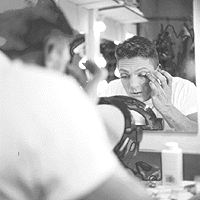
keep at their home (Tony and Begonia). To make himself over into Sylvia, York
shaves his face, legs, and the backs of his hands. He spends the better part of
an hour creating the gloriously overdone makeup. He straps himself into a
corset, over which he appends padding for his backside and falsies for his
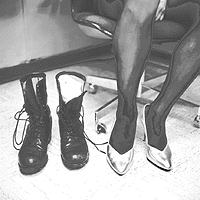
front. Then, of course, there are the shoes. He has two pairs, one black and
the other gold. Months in advance of the first rehearsal, York began scouting
catalogs to find heels that would fit his feet. He finally settled on a pair of
size 13 double-wides (from “Lady Sasquatch,” he insists). And they make all the
difference in the world. “I’m not a proppy kind of actor,” he swears, “but with
any role I’ve done, I’ve always thought, `I just know I’m gonna feel right when
I get this, when I get this hat or that glove or a cape or these boots.’ I
didn’t think it would be as good to be in heels as it does. It hurts, but
psychologically, what it does for being able to pull this off, is uncanny. And
I’m proud of my legs in those pumps!”
Despite the elaborateness of York’s physical preparation, the actor is most
intent on making the character work on her own than as a drag role. The day we
speak, he is bolstered by the reaction of the show’s first preview audience.
“One thing I feel is going to work is that it’s not going to be just the joke
of a man in a dress; the audience is going to be relating to the character as
this grande dame diva,” he says. He smiles. “I got the feeling last night that
they were treating me the way Sylvia St. Croix would want to be treated. That
was a lot of fun.”
For York, the risks are worth taking because they are almost invariably
followed by fun. That’s the way it was with the Caswell House concert.
Originally, York had no interest in performing alone, without the cover of a
character to shield him from the audience. It was only when his friend Steve
Franden, who had won a night at the Caswell House in a silent auction
fundraiser, approached York about entertaining there, that York took the idea
of a solo cabaret act seriously. And though he agreed to do it — stipulating
that the event be a fundraiser for Christopher House — York was terrified. He
sweated bullets through the weeks preceding the concert, agonizing over song
selections and snappy patter to fill in the spaces between numbers. What that
packed house couldn’t see while it was building to its fever pitch was a
horribly nervous York batting away flocks of butterflies. It was an enormous
risk.
But when he got out there,… well, you can guess.
“You know, that’s one of the favorite things I’ve ever done,” he says now.
“Since I started doing cabaret-type performing, that has been some of the most
gratifying experiences I’ve had onstage. You know, it’s great when you’re
connecting off an audience, when you’re feeding off of them, but to get that
same connection, to get that same food from them when you’re not under the
guise of some costume, when you’re no one else but who you are, that’s been
such a rush. That’s purely an ego thing, but I wish everyone could experience
that.”
It’s an ego thing, but he manages to turn it into a wish for the rest of
humanity. Always thinking about others. What’d I say? Isn’t he the nicest
fella?
Ruthless! The Musical runs through February 23 at the Zachary Scott
Theatre Center. Call 476-0541 for info.
This article appears in January 24 • 1997 and January 24 • 1997 (Cover).