

|
|
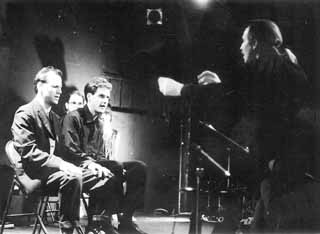
As another year’s successful FronteraFest draws to a close, you’d think our friends at the Hyde Park Theatre would want to close up for a month and get some well deserved sleep. That’s not going to happen. Directly on the heels of the fringe theatre festival, they’ve scheduled another intriguing week of unusual art: “Sound & Vision,” six nights of new music, dance, and theatre starting Tuesday, February 16 (see sidebar). Festival director Jason Phelps says the mission of this festival is “to present multidisciplinary collaborations of nationally known, professional artists from Austin and beyond.” One group that best represents this concept is the Walter Thompson Orchestra, which returns to Austin after its widely acclaimed Sound Painting performance at last year’s FronteraFest.
“Sound Painting” refers to an elaborate language of signs and gestures that composer/ conductor Thompson uses to communicate with his orchestra during performance. Originally designed simply so Thompson wouldn’t lose his voice from shouting above the music, this tool of communication blossomed exponentially into an interdisciplinary art form that allows a conductor to create a totally improvised, completely unique work using musicians, singers, dancers, actors, and visual artists.
If words like “interdisciplinary” and “improvised” conjure images of incomprehensible coffeehouse performance art, put your fears to rest. I confess that last year, when I was invited by a jazz-genius friend to Thompson’s show, I expected an evening of spaced-out horn battles between musicians jamming to melodies that made sense only in their own heads. I went anyway. Pleasantly surprised doesn’t describe my experience; I was blown away by a show more entertaining, intriguing, and exciting than anything I’d seen in a long time.
Seated on the Hyde Park Theatre stage, several horn players, a drummer, a violinist, two singers, a dancer, and two actors eagerly awaited signals from Thompson, a sharp-looking chap with long hair slicked back into a ponytail, a neat goatee, and bright, twinkling eyes. After giving a brief introduction, Thompson launched into a series of gyrations and gestures that made him look like a speed freak playing charades. His motions unleashed a whirlwind of activity on the stage. The band began to improvise, themes emerged, the singers produced beautiful, unearthly tones, the two actors embarked on a madcap, nonsensical dialogue that somehow began to make sense, and around it all danced a woman in black tights and a leotard whose frenetic motions seemed to pull the piece together.
It quickly became apparent, however, that Thompson was the real glue holding the scene together. As he heard and observed what was taking place before him, he responded to and shaped it using his system of gestures. The Sound Painting vocabulary now includes over 600 gestures, divided into seven categories: sections, indicating certain individuals or groups on stage; rhythms, giving tempos and time signatures; genres, bringing out the “feel” of the music; tonal indications, signaling certain key centers or specific chords; functions, instructions used in conjunction with other signals; sculpting, bringing out concepts and textures; and palettes, calls for short sections of notated music and/or rehearsed music, text, or choreography. As complicated as all this sounds, it is amazingly easy to grasp on an intuitive level; after watching Thompson’s interaction with the performers, one quickly understands what is happening and becomes absorbed in the spontaneous creation occurring before one’s eyes.
“Sound Painting uses the entire group as the instrument,” Thompson says. “I’m the traffic cop who keeps all the parts moving. If I step away from the podium, then all kinds of crashes will happen.”
Thompson directs this traffic without a formal script or score. “It’s a real give-and-take situation when I’m conducting,” he says. “I have a number of gestures I use called ‘search gestures.’ I throw one out and if the response sparks a shape I want to develop, then I take it and work with it. I’m not always sure what I’m going to get when I’m searching; that’s the exciting part. I have to be ready to respond quickly. But I never come to a performance with a pre-planned overall sketch. I know the system inside out and so do the performers; it’s composition from improvisation. If you over-plan, you kill it!”
Obviously musical improvisation is nothing new, but a work encompassing music, singing, acting, and dancing, all directed by one person, is still novel. What in the world led Thompson to this new artistic ground? “I’ve always mixed up concepts and ideas in as many ways as I could think of,” he replies. “I arrived at my work now somewhat by necessity and somewhat by accident. The addition of dancers and actors to the orchestra was a natural progression. I have been working as a composer in theatre and dance for the past 20 years. When I was commissioned a few years ago by Lincoln Center to write a piece that would include the audience, I decided to base the piece on the concept of a ‘town hall meeting.’ I brought actors into my orchestra for this piece and it just opened up a whole new world of possibilities in Sound Painting.”
Speaking of audience participation, when you attend a Sound Painting performance, you become part of the work. Thompson gives the audience a set of simple instructions complete with its own gestures. When he signals the audience to join in, the theatre becomes a huge, hilarious buzzing hive of sounds and aural textures; everyone in the house is performing! “It’s important for me to break down the barrier between performer and audience,” Thompson states. “I don’t mind showing the magic of how things work. I also love the textures and sounds that come from an audience. You can’t get those sounds from a trained chorus.”
The complexity, diversity, and pace of a Sound Painting performance often reflects life in this age of multimedia information overload. In fact, Thompson’s work has been compared to a 500-channel satellite dish. That reflection is part of a conscious effort by Thompson — but only part. “I try to work into my compositions what I deal with in everyday life,” he says. “Sound Painting by its very nature is a monster that eats everything! In other words, I take my material from wherever or whatever sparks my interest.”
That may come from almost anywhere, the composer says. “Everything from the television and movie media to the sort of comical political forms — like what’s happening with the president — to seeing and hearing all kinds of musical and visual stimulation. It’s not so much what’s going on in the art world, but more of what’s going on in general. That’s where I draw my material from.”
Thompson’s mention of “comical political forms” reminds me how funny last year’s performance was. Humor came through loud and clear, and it was amazing to see a non-verbal “joke,” if you will, crack up an entire audience.
Thompson allows that numerous comedic influences go into the work.”Cartoon music, Spike Jones, horror film scores — I love this stuff! I have a number of gestures that elicit humor from the performers. [Since] the direction the Sound Painting takes is always in my hands as the conductor/composer, if the work starts to become humorous it’s because I’ve felt this is the natural direction the piece should take. There are times when something happens, like an audience member dropping a bottle or something like that, and I direct the whole orchestra to ‘heckle’ that person. I wouldn’t do this unless it happened in a part of the composition that would lend itself to a humorous direction.”
Thompson even has a series of gestures that he uses to “steer the composition toward humor.” They include heckle, vamp, murderous intent, jock mode, imitate, and over the top. Many of the musical jokes remind me of Peter Schickele’s P. D.Q. Bach material, in which Schickele satirizes classical music through the guise of a fictitious brother of Johann Sebastian. The humor in Thompson’s work ranges from parodies of standard musical themes to flatulent sounds from a tuba. The addition of singers and actors on the stage also lends itself to humor; silly sounds from a classically trained voice, for instance, or actors interpreting apparently meaningless texts with exaggerated intention or emotion.
If one can judge from the comments of Jason Phelps and Joshua Taylor, the two actors in last year’s FronteraFest performance, the experience of working on Sound Painting is as fun as listening to it. “Sound Painting is amazing for me,” says Phelps, “because I don’t consider myself a traditional actor. I also dance, write, and do sound design, so I think of acting and performing as musical, rhythmic, and physical languages for me to use and abuse and sculpt much like a band does.”
The chemistry between Phelps and Taylor was a key component in the overall strength of last year’s Sound Painting performance. Both actors seemed quite comfortable in the precarious position of having to improvise on the spot.
“Jason and I have worked together several times and have known each other for years,” says Taylor, “so we have a good idea where the other might be going, although not so much that we can’t be surprised
“All the stuff Josh and I did last year was totally improvised,” says Phelps. “We chose some random text to bring in, then Walter would gesture for ‘text palette 1’ and we would have already assigned that palette before the performance; then we would just riff off each other.”
“We used a Subaru car manual from Jason’s car and a few different self-help books as sources,” Taylor adds, “but that’s about it.”
“A lot of it really depends on chemistry and listening to each other,” Phelps continues. “This work does not fly with ego-driven performers. You must be able to make yourself vulnerable and trust Walter and your other players to compose as a whole.”
This year’s performances will be based around a common theme, “transformation,” and each night’s performance will build on the previous one. Taylor won’t say too much about how this will work. “I can tell you how we think it’s going to work,” he offers. “The thing about Sound Painting is that it always comes out a bit different than you expect. We stumbled on the idea of ‘transformation’ as an idea big enough to contain whatever possible mutations the reality of a fixed theme might hand us. [Working] with a fixed text … yielded some interesting results, but ultimately it was too confining and left little room for true on-the-spot composition. So now we are just trying to go into the performances with a few pieces of text and a general notion that we are trying to compose with and we’ll see what happens.”
Another new link in the evolutionary chain of Sound Painting is the addition of visual artists, such as painters, video artists, and filmmakers. In Austin, artist Lisa Miller will add her video projections to the Sound Painting mix. Visual artists learn the Sound Painting language, then they “have to respond in their medium the same way a dancer responds using the body,” Thompson explained. “A painter might have several locations on the stage that she can work with, but only when gestured. A gesture such as ‘long tone’ means one thing to a musician and something else to a dancer and something else to an actor and something else to a visual artist, but all the disciplines respond to the same gestures. I sculpt the look of the room as the composition develops.”
This evolutionary growth of Sound Painting shows no signs of slowing in the future. Thompson has copyrighted and trademarked Sound Painting, and he plans to train other composers in using his system. He is writing a book explaining the process, and hopes to release the system in the next few years. He has received several grants to teach Sound Painting to youngsters in schools, and last summer a Sound Painting “think tank” drew nearly 100 musicians, dancers, actors and artists to Woodstock for a month-long brainstorming session in which over 150 gestures were added to the vocabulary. The success of his new artform has surprised and delighted Thompson, who quipped that he now “almost makes a living at Sound Painting.”
Thompson said that he is excited about returning to Austin. “Last year was just incredible. I talk about it all the time. The crowds got better and more excited each night, and we got a standing ovation every night. Incredible!”
Walter Thompson’s Sound Painting runs February 16-20, Tue-Sat, at Hyde Park Theatre, 511 W. 43rd. Call 454-TIXS.
This article appears in February 12 • 1999 and February 12 • 1999 (Cover).