

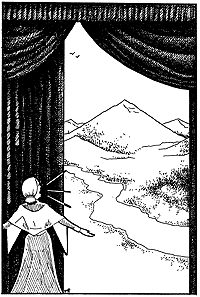
 illustration by Robert Faires |
in America America loves a frontier. Chalk it up to all those years in which our forebears
had a mighty expanse of largely unsettled land sprawling beyond the horizon to
the west. The feverish desire to push into it, to explore it, to test
themselves against it, seeped into our blood. As a culture, America came to
savor the challenge of new territory. We kept pushing west through one frontier
after another until we hit ocean. Then, when all the land had been cataloged or
claimed, we turned our eyes upward, rushing to reach that airless, ashen
frontier on the moon. Even now, when space exploration is almost financially
prohibitive, the prospect of life on Mars can still generate a thrill in us,
can set us chattering excitedly about payloads and multiple-year missions and
what-all it might take us to get there. Venturing onto new ground is something
that is part of who we are.
The same might be said for Austin Lyric Opera (ALO). In the 10 years that this
company has been enlivening our arts scene, ALO has made it clear that
venturing onto new ground is part of who it is. Simply by trying to create a
professional opera company in a city with no such animal, a city where most
opera was confined to the academic arena, ALO was crossing a frontier. It had
nothing on which to base its belief that Austin would support opera at all,
much less professional opera on the scale of the Bass Concert Hall, the
3,000-seat venue that ALO had decided would be its home. But it plunged ahead
anyway. Fortunately for ALO, this was one instance in which someone built it,
and they did come. ALO’s early productions boasted sold-out houses for several
performances and 90% attendance for most of the rest. Of course, it didn’t hurt
that the company was producing some of the most popular works in opera: The
Magic Flute, Die Fledermaus, La Traviata, Carmen, Madame Butterfly… But
programming “name” operas in generally traditional stagings was a necessary
strategy given the financial stakes. What’s worth noting is that, once it paid
off, ALO could easily have kept securely to the middle of the road,
repetoire-wise, and it didn’t. As soon as it had established itself, ALO began
moving further afield of that center line, trying new things: a updated version
of The Abduction From the Seraglio; a production of Beethoven’s opera Fidelio;
an abstract staging of Lucia di Lammermoor. The Romantic mainstays were still
there, but squeezed in among them at every opportunity was a step onto new
ground.
This time a year ago, ALO was making perhaps its boldest venture yet into new
territory: staging its first Wagnerian opera. Getting to the point where it
could produce such an enormous enterprise as an opera by Wagner — with its
epic score; heroic singing roles; grand, demanding orchestral and choral parts;
and overall sweep and scope of vision involved — was a major undertaking, and
ALO began to lay the groundwork years before the actual production. It was a
major risk for the company, not least because it would be such a departure from
the kind of opera that ALO had produced to date. This was not the sassy stamp
of Bizet or the flutter of Puccini wings; this was thunder, deep, primal, and
rolling on for hours. Would the audience that had crowded in to see these other
works come for thunder? ALO could only guess, but it gambled on the idea that
nine years of steadily raising the stakes, taking its patrons on progressively
more ambitious operatic adventures, would be sufficient preparation. It was.
They came, and what they saw in ALO’s Tannhauser was a bold march into
the thicket of Wagner’s Black Forest. It may not have been without stumbles,
but there was no hesitation; ALO gave the production its all.
This January finds ALO again heading into a new frontier: American opera.
The Ballad of Baby Doe, opening January 10, is the company’s first work
by an American composer.
American opera is often unjustly neglected and disparaged, the red-headed
stepchild of the form. So many European composers had created operatic
masterworks by the time this country was old enough to compose for itself that
its work was bound to suffer by comparison. Yet when taken on its own terms,
American opera is capable of considerable lyrical and dramatic power. The
Ballad of Baby Doe comes out of what is arguably the most fertile, if not
necessarily the greatest, decade for American operas, the 1950s. It was during
this decade that Aaron Copland composed The Tender Land; Samuel Barber
wrote Vanessa; Carlisle Floyd produced Susannah; Gian Carlo
Menotti wrote The Consul, The Saint of Bleecker Street, and that
Christmas favorite, Amahl and the Night Visitors; and Leonard Bernstein
composed the opera Trouble in Tahiti, and a pair of musicals that court
opera, Candide and West Side Story. Not bad for a red-headed
stepchild.
Like many of his contemporaries, Moore was interested in American settings and
musical idioms. He drew on folk tunes and other indigenous musical styles —
ragtime, jazz — for his melodies. He found his stories on native soil. Prior
to The Ballad of Baby Doe, he had composed an opera based on The Devil
and Daniel Webster. Baby Doe was taken from a newspaper story describing the
death of an old woman near a mine in Colorado. She was the widow of a man who
had made a fortune from silver mining but had lost it all when gold dislodged
silver as the monetary standard of choice. Before he died, she pledged to keep
his mine and lived by it, alone and penniless, for decades. Doing further
research, Moore and his librettist, John Latouche, found an even more
compelling history to the woman: She had fallen in love with her husband,
Horace Tabor, when he was already married, and their romance caused a scandal.
Tabor had been not only rich, but politically connected; he was a Senator
briefly, appointed to finish out someone else’s term, and when Tabor and Baby
Doe were at last married, President Chester A. Arthur attended their wedding
reception. Tabor gambled everything on his belief in silver, and when that fell
through, he lost everything but his wife’s love and support. Moore and Latouche
were able to condense this couple’s history into a highly dramatic and touching
tale, one in which the strains of waltzes and folk melodies and even hymns not
only make the work eminently accessible to American audiences but personal for
them. It is so accessible, in fact, that it might almost be musical theatre.
Now, an American work, especially one that leans in the direction of musical
theatre, may not seem so much like it’s challenging new territory following
Wagner or even as intricate a standard as the season opener, Mozart’s The
Magic Flute; it sounds rather like pushing past the Rocky Mountains in
winter to tackle the California coast in springtime; how rough. But musical
rigors and epic narratives don’t always tell the tale. With some operas, an
artist may be able to get away with standing still and singing, that is,
letting the music and voice convey all the emotion within a character or scene.
Not so with The Ballad of Baby Doe. Precisely because it is so close to
theatre, this opera demands careful attention to acting. The cast must bring
their characters to life through their faces, their movements, what they do as
much as what they sing. In the end, that still may not compare to the demands
of a Wagner, but that doesn’t make it a pi�a colada by the poolside.
And Baby Doe faces the same issue as Tannhauser in terms of
audience: Will American opera play among fans who have been nurtured along on
the European masters? Have Austinites absorbed the disturbing condescension
toward American works that comes from some corners of the opera world? Or will
they just be indifferent, possessing nothing on which to peg this opera besides
the fact that it’s American? After all, it isn’t as if Douglas Moore — or most
of this country’s composers of opera — have the bankable name of a Verdi or
Mozart. These are very real risks where the producing company is concerned, and
they have long-term implications. If an accessible 20th-century American opera
fails to sell, will ALO feel that it can gamble on other American works? Or
even other 20th-century works?
So there are chances to be taken in crossing the terrain into American opera.
And it seems apt that ALO is risking them with a work that takes the frontier
of a century past as its setting. In the late 1800s, the West was well on its
way to being settled, but there were still great swaths of it that lay
untouched. These might be regions of astonishing beauty, breathtaking in their
opportunity, however, they could still crush the life out of someone who
gambled against them and lost. Just because Austin Lyric Opera has been around
for 10 years doesn’t mean that it doesn’t face very real dangers every time it
mounts a production. It does — the same danger of ruin that miners faced in
the Colorado of old. But it continues to gamble, to risk ruin in order to share
the majestic beauty within these operas. That’s part of who Austin Lyric Opera
is, and for that we can be grateful.
The Ballad of Baby Doe runs January 10-13 at Bass Concert Hall, UT
campus.
This article appears in January 3 • 1997 and January 3 • 1997 (Cover).