

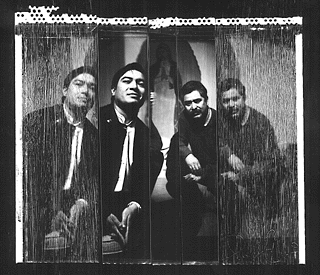
 photograph by Minh Carrico |
Ruperto Reyes, Jr.,
Petra’s Pecado brings him full circle. After more than 20 years, Reyes is again
involved in the heart of Latino theatre in Austin.
Reyes, a dark-skinned, forty-something man who sports a bushy Mexican
mustache, was raised on a farm near Manor. It was there that he first developed
an interest in theatre. That interest grew so strong that in the 1970s, Reyes
helped found a Chicano theatre group that performed in East Austin.
After graduating from the University of Texas in 1976, Reyes moved to Houston
where he taught theatre for a time before heading out to California in 1978 and
a regular gig with El Teatro de la Esperanza — one of the country’s premier
Latino theatre companies. It appealed to Reyes that the California troupe
specialized in taking theatre to people who didn’t go to theatre: recent
immigrants, migrant workers, minority children, and the inner-city poor. For
close to a decade, he helped bring theatre to people who had never been inside
a theatre.
But in 1983, Reyes quit acting altogether and moved back to Central Texas to
take a job teaching. That began a long hiatus from theatre.
The stage, however, wasn’t through with Reyes. In 1994, an old friend called
up and convinced Reyes to come out of retirement. Buddy Villa, a colleague of
Reyes from Teatro de la Esperanza, wanted Reyes to try his hand at writing.
Reyes had been long intrigued by the idea of how La Virgen de Guadalupe, Latin
America’s patron saint, would be received if she appeared today. He chose to
use that as the basis of his play and began to write. After a couple of failed
attempts at writing the play as a drama, Reyes struck upon the idea of
incorporating into his story two comedic characters from a short sketch written
by Rodrigo Duarte-Clark, another company member of Teatro de la Esperanza. It
worked. Reyes ended up with Petra’s Pecado.
The play is set in the small town of Las Flores. Petra’s Pecado (Petra’s
Sin) is a simple tale of good versus evil. Petra — she’s good — owns a
small tortilla factory in Las Flores, Texas. Business has been slow, the taxes
haven’t been paid, and now the Internal Revenue Service is threatening to shut
her down. In a final act of kindness to her loyal employees, Petra has cable
television installed in the factory’s break room. As it turns out, the cable
company is offering “premium” channels for free that month. Coaxed by the
cable guy to surf around a bit, Petra is flipping channels when she comes upon
what she believes at first to be a man wielding a cane. But wait! That’s no
cane. And this isn’t the Disney Channel.
Ashamed of what she has just witnessed, Petra makes a beeline for church to
confess the sin to the parish priest. Yet before she has a chance to cast off
her guilt, Father Johnson — he’s new in town and looking to boost church
involvement — decides to take advantage of Petra’s quandary by instructing
her to direct the church’s biggest fundraiser of the year, a play about La
Virgen de Guadalupe. This is to be her penance.
Enter Tina Tamayo — she’s evil — whose tortilla and food products company
employs half the town. Greedy, arrogant, and overbearing, Tamayo is the kind of
woman who’d use stray cats as taco meat if she thought she could make a buck.
She hates Petra and has been trying to put her out of business. Now, she’s out
to sabotage Petra’s directorial debut as well.
Hokey? Sure. At times Reyes even crosses into the realm of the schmaltzy.
Still, Petra and her husband ain’t The Cosbys. Reyes admits to having worried
at one point that the play might be viewed as sacrilege. It has some profanity,
but mostly it’s just packed with jokes. And most of them are pretty damned
funny.
It’s not War and Peace, but that’s the thing about Reyes’ play that
appealed to Rodney Garza, artistic director of Teatro Humanidad Cansada, the
company producing the play’s Austin premiere. “Petra’s Pecado talks
about the struggles of average people,” Garza says. “For the most part, they
are people who are content with living anonymous lives. Each character knows
about pain and frustration, as well as life’s simple pleasures.
Garza adds that Petra’s is about understanding that life is full of
miracles, few of which have anything to do with divine intervention. “I like
[Petra’s Pecado] because it’s a simple tale of love and friendship, two
things that I happen to strongly believe in. Sometimes we’ll hear on the news
about the appearance of the image of the Virgen or Christ, and the news plays
that up as a genuine article, as if that’s the only kind of miracles there are.
Just realizing the value and power of a real friendship can be a miracle. To
keep a friendship for 20 years or 60 years is really not the easiest thing to
do.”
Garza is not alone in responding to the play’s sense of miracles. In 1994,
the
play was submitted for consideration as part of Teatro de La Esperanza’s
Festival Latino of New Play Readings and it was presented as a work in
progress. Then, in 1995, San Antonio’s Guadalupe Cultural Arts Center premiered
the two-act play, in a production directed by Garza. According to Jorge Pina,
who runs the theatre program at Guadalupe, the show was so popular that the
center gave it a second run in 1996. Most of the time, the show played to
near-packed houses, says Pina, and 30 times the performances sold out. “I think
there’s a connection the play makes to us and who we are [as Latinos],” Pina
offers. “There are connections to our senior citizens, our abuelitas and
abuelitos [grandmothers and grandfathers], tios and tias [uncles and aunts], to
La Nuestra Senora de Guadalupe [Our Lady of Guadalupe], and to the way we still
can believe in miracles.”
Now, Reyes and Garza want to see if those connections extend to audiences in
Austin. They’ve mounted a production in the Santa Cruz Center for Culture, a
120-seat performance space on Seventh Street in the heart of Hispanic East
Austin. The space is owned and operated by Roen Salinas, director of Academia
Aztlan, a Latino arts umbrella. Garza’s company Teatro Humanidad Cansada is one
of Academia Aztlan’s sponsored organizations.
The team is aware that Austin has a typically lackluster interest in Latino
theatre. Teatro Humanidad Cansada is one of only a handful of Austin theatre
troupes currently emphasizing Latino plays, and only a few of the Chicano or
Latino theater groups formed over the past three decades has lasted more than a
few years. “When I decided to put this group together,” says Garza, “I started
doing research and was saddened to read that Chicano theatre had existed here
in the 1970s. I thought to myself, `That happened right here in Austin? What
happened?’ At that point, I took it as a challenge.”
Garza committed himself to getting people to overcome their stereotypes about
East Austin, to see it not for the occasional drive-by shooting or minority of
crackheads but as the neighborhood of mostly hardworking families simply trying
to make ends meet. He feels the Santa Cruz Center is instrumental in getting
that message out. “The thing I like about Santa Cruz is that it provides a
forum for all kinds of people who promote the Chicano view of things and tries
to get people (outside of East Austin) to realize what’s here.”
Santa Cruz is part of a growing effort to build up the community, an effort
which has had some recent success, thanks to the kind of community activism in
which Garza and Santa Cruz director Roen Salinas are involved. These are people
who march to protest and speak during the citizens communication part of the
Austin City Council meetings.
Still, not all the prejudice Garza and his company face come from outside the
East Austin community. “One of the tiffs (that the neighborhood bar owners)
have with us is that a lot of them believe that all dancers and actors are
homosexuals. So they have this attitude,” says Garza. “But I’ll follow that up
by saying those barriers are being broken down. So not only is it important for
us to get people to come into the neighborhood and accept us, but we’re getting
the people here to accept us, too.”
After three years, the signs of acceptance are clear. Garza says that his
theatre company has grown, that people are getting involved. “The best thing,”
he says, “is that I’m not having to do everything on my own anymore. I have
help now. And I’m happy with the crowds. I’ve seen full houses, half-full
houses, houses that are 80 percent white. It varies. I know our name is out
there. People know about us.”
One person who clearly knows about Garza and his band of thespians is Martin
Segovia. He owns La Bola de Oro, a cantina just around the block on East Sixth
Street. His bar is easy to spot. It’s the one with the larger-than-life mural
of Little Joe y la Familia. “Martin’s put the word out at his little bar that
we’re okay,” Garza reports. “Now every time we go in there, he’s going to be
sure to talk us up. He’ll say, ‘Hey, these guys have a theatre over here. Go
see the show!’ It’s great. His bar may not be the biggest place in Austin, but
we’ve got our posters up there and it makes us feel like we’ve spread a little
bit of culture.”
That bodes well for Reyes’ return to theatre in this community, as did the
opening of the Austin production this past weekend. Irene Gonzales, an Austin
Circle of Theatres Award-winning actor who appeared in both San Antonio
productions of the play, turns in another superb performance as Petra
Dominguez. She is matched by Maria Elena Garza Salcedo of San Antonio, another
holdover from the Guadalupe Arts Center shows. Tina Tamayo is played
respectably by Vangi Munoz-Garza. San Juanita Alcala is a strong Tacha — every
Chicano has an aunt just like her. And Reyes himself turns in a solid
performance as Petra’s benevolent but macho husband Rafael.
The surprise performer in this production of Petra’s Pecado is Raul
Salinas. In his first acting role, the internationally renowned Chicano poet
has become Chano, a foul-mouthed, sharp-witted, elderly man embittered by the
loss of his son to the Vietnam War. Salinas comedic and dramatic timing is
almost impeccable. Even poetic.
Complementing the strength of the production itself was the response of the
audience: The opening performances were near sell-outs. All told, they make
this project something of a miracle for the playwright who has returned to his
roots. “A lot of things came together at once to really inspire me to do this,”
says Reyes. “Some of those things were good, and some were bad. But it’s been
an amazing process for me.”
Petra’s Pecado runs through February 23, at the Santa Cruz Center for
Culture, 1805 E. Seventh. 478-9717.
James E. Garcia is a freelance writer living in Austin.
This article appears in February 14 • 1997 and February 14 • 1997 (Cover).