

Italy is out of the World Cup.
Oh, I know; the sun rose again today, and I still have the U.S. and Brazil to root for, and anyway, in the grand scheme of things, I suppose there are more important issues I should be concerned about. But still …
It’s the World Cup. And Italy is out.

Yes, there will be other Cups. But not for this team. Four years is a long time in a soccer player’s life, and most of this veteran squad won’t pass this way again: Delvecchio and DiBiagio, who never got onto the field this year, Maldini, the captain for a decade, Del Piero, Vieri, Inzaghi, DiLivio, and others. Yesterday, they were heroes; today, they’re history – and a bitter history, at that.
And it’s not just the players who’ll be different, four long years from now. My son Zeke was 9 years old when this cup started; by the time the next one rolls around, he’ll be on his way into high school, a child no more. He’s taking it pretty well, all in all — after he closed himself in the attic for a couple of hours, he came down and was no worse than melancholy for the rest of the day. But later in life, when he looks back at the World Cup of his childhood, this is what he’ll have to remember: five goals disallowed, a clearly unjust red card, a couple of glorious goals, cowardly (and doomed) bunkering to protect one-goal leads, and one win in four games. A child deserves better.
Perhaps you don’t understand. Perhaps you think this is just a soccer game, a sporting event like the Super Bowl or “World” Series. Perhaps you think I’m being melodramatic. From the depths of my despair, I pity your shallowness of feeling. Here are a few recent books that might help you understand this divine obsession.
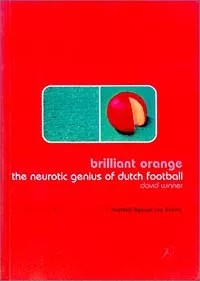
Brilliant Orange: The Neurotic Genius of Dutch Soccer, by David Winner (Overlook Press, $26.95): In the mid-1960s, Amsterdam transformed itself from “one of the most frumpy and tedious capitals in Europe” to a “cosmopolitan world city, luxuriant with sensuality and sin, beauty and sophistication.” At the same time, the city’s main football team, Ajax Amsterdam, transformed itself from a staid, defense-minded, parochial club team, to the single most innovative squad in the history of the sport, dragged the national squad to international greatness, and changed the tactical thinking of the whole soccer world.
Winner writes about soccer tactics, radical politics, architecture, colonialism, modern dance, and Nazi collaborators; and he manages to explain how they all fit together, while arguing persuasively that they’re all unrelated facets of a schizophrenic national psyche. It’s a brilliantly entertaining read, skipping lightly around its terrain in a conscious homage to the fluidly shifting style of Dutch “total football.” By the end, you’ll have learned quite a bit about the tactics and strategy of the game, but even more about Dutch culture in all its peculiar contradictions: Rembrandt and Bosch, Calvinism and the red light district, racism and tolerance, progressive colonialism, and self-effacing arrogance. In short, in the words of the final chapter title: “the calvinist carnival.”
Soccer in Sun and Shadow, by Eduardo Galeano (Verso, $15 [paper]) is an even more overtly political book than Brilliant Orange, though it’s also more specifically about soccer. In a series of one- to three-page vignettes in a poetic style, Galeano starts with the basics — “soccer,” “the player,” “the ball,” “the fan,” “the goal” — and then progresses through an episodic history of the sport, from Chinese prehistory through the 1998 World Cup, juxtaposing each WC with its geopolitical and cultural context. (1966: “The U.S. Air Force was bombing Hanoi with renewed vigor … In London, with Harold Wilson chewing his pipestem and celebrating victory at the polls, young women sporting miniskirts, Carnaby Street as fashion capital and the entire world humming Beatles tunes, the eighth World Cup got underway.”)
It’s a radical leftist text, both in politics and in its view of soccer. Galeano calls the history of soccer, “a sad voyage from beauty to duty,” and sharply criticizes the commercialization of the sport, and the modern emphasis on winning as opposed to entertaining play. But he also celebrates the joyous beauty of the game where he finds it, from the sandlots to the largest stadia: “And when good soccer happens, I give thanks for the miracle, and don’t give a damn which team or country performs it.”
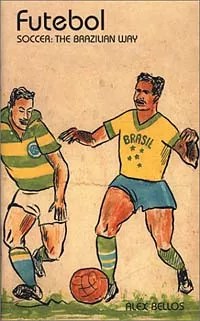
Futebol: Soccer, the Brazilian Way, by Alex Bellos (Bloomsbury, $25.95), is a charming, if relatively straightforward, series of vignettes describing Brazilian soccer, past and present — lots of interviews with major figures in the sport’s history, and with current players and fans. Bellos is an overseas correspondent for the English papers the Guardian and Observer.
The Miracle of Castel Di Sangro, by Joe McGinniss (Little, Brown, $14.95 [paper]): Upon reading about the surprising success of a small-town club in rural Italy which has risen from semi-pro status to the high minor leagues, this American author decided more or less on a whim to spend a year in the town, learning about the sport and the culture. It’s a fun and instructive read, less about soccer than about the culture of mistrust and corruption, and about the Italian society in general.
Fever Pitch, by Nick Hornby (Riverhead Books, $12.95 [paper]), is probably the best introduction to the obsession of fandom. Hornby, the author of High Fidelity and About a Boy, is also a rabid fan of London club Arsenal in the English Premiere League. And this, his first book, is the autobiographical account of his obsessive fandom — a life measured out, game by game, from 1968 to 1992, defined by the “Gunners,” in all their successes and (mostly) failures. It’s the most important relationship in Hornby’s life, and he accepts that. If at a few junctures he questions the seemingly one-sided nature of the relationship, he finds solace at other times in its constancy. And in the end, he says, there’s simply no other thrill like it. People compare goal-scoring to an orgasm, he notes, but: “Even though there is no question that sex is a nicer activity than watching football (no nil-nil draws, no offside trap, no cup upsets, and you’re warm), in the normal run of things, the feelings it engenders are simply not as intense as those brought about by a once-in-a-lifetime last-minute Championship winner.”
This article appears in June 21 • 2002.