

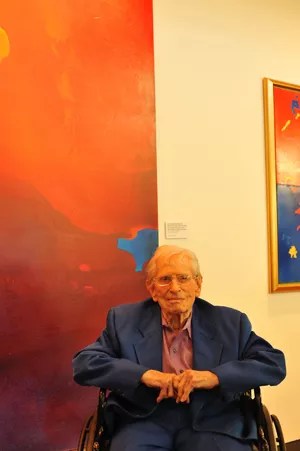
“It’s the house with the blue door,” Kelly Fearing reminds me over the phone. Bright blue, a color found in many tones in Fearing’s natural world – the world in his paintings, now on view in “Kelly Fearing: Selections From a Life in Art” in the University of Texas’ Bass Concert Hall.
Fearing sits at a table in his spacious studio with a new copy of Artforum in front of him and a catalog of his 60-year retrospective to one side. We pore over paintings – in the book, in the studio, in other rooms in the house. The afternoon’s conversation travels through place, time, and subject, always connecting to the touchstone of art. As naturally as things grow in his paintings, talk branches out to other interests and life events, related minor chords in his symphonic paintings: music, world mythologies, aquariums, collecting fish, the lives of saints, the natural world, experimenting with materials and techniques, bodybuilding, yoga, studying at Columbia, living in the Chelsea Hotel, how he came to art. Everything connects to art, nodes extending out from the core like the star points of a snowflake, each its own exquisite pattern.
A much beloved figure in Austin, Fearing is a living treasure and living history – an Old Master of the Fort Worth Circle. The group of like-minded artists and friends formed in the 1940s was the focus of an exhibition at the Amon Carter Museum in 2008. The Circle, so named 60 years after the fact, was instrumental in bringing the influence of avant-garde European art to a Texas that knew only bluebonnets and Western art. Fearing came to Austin in 1947 and taught at UT for 40 years, retiring in 1987.
At 91, Fearing still keeps a full schedule. He continues making and showing art, exploring new materials and methods and partnering with chance to see what happens, a hallmark of his lifelong art practice.
Looking at Fearing’s art, both at the exhibition and in his studio, made me ruminate about how art changes when you factor in time and its sidekick, ever-changing context. How we look at a lifetime of art is different from how we look at new art, right out of the crucible. Much like reality, art is what it is from its inception. Yet our responses to art change as we change. Art ages as we age, and then we are gone, and another generation looks with ever-changing eyes. But in essence, the art remains the same, despite our changing visions of it.
One thing that has remained steady for me in Fearing’s paintings is a sense of spirituality that transcends religion, whether or not the subject relates to saints or gurus, twin subjects that appear again and again. I ask Fearing about the spirituality in his subject matter or, rather, the connection to spirit as an animating force.
“I am not a religious painter,” Fearing says. “I use the saints because they were in impossible situations.” The saints, he continues, provided a form of surrealism in the postwar world. Fearing is drawn to saints who are mystics rather than martyrs, and who, by my account, have resonant spirits with the painter himself. Fearing is equally influenced by stories of Buddha, Zen, Daoism, and the lives of the saints. Much like his time with the Fort Worth Circle, Fearing is bridging boundaries that separate one from the other.
Fearing’s paintings not only hold up over time, they draw me in deeper. His work is deeply personal and enigmatic. The art exudes a special spirit, much like the artist himself, whether one finds it in the rock formations, the birds and animals, the saints or the gurus, or simply the art itself.
“Kelly Fearing: Selections From a Life in Art” is on display on the fifth floor of Bass Concert Hall, East 23rd Street & Robert Dedman Drive, through Jan. 14, from 11am to 2pm Monday-Friday and during performances.
This article appears in November 27 • 2009.