

For the 1,700 Texas students who took top prize at their schools’ science fairs, the journey to understand wind resistance and derby cars, optimal air pressure in soccer balls, and the absorption power of name-brand diapers vs. generic didn’t just end with a blue ribbon. These students were also invited to show at the 64th Annual Austin Energy Regional Science Festival. Held Feb. 19-22 at the Palmer Events Center, the regional fest is one of the largest city-sponsored fairs in the country and is one of the few regional fairs that includes elementary school students.
The title sponsor of the festival is Austin Energy, in partnership with the Austin Science Education Foundation and Dell Technologies. Ingrid Weigand, executive director of the Austin Science Education Foundation, said the foundation was established as a nonprofit to fundraise for the fair.
“As the fair was growing – and it has pretty much doubled in size since Austin Energy took over – it became very apparent that this is really a full-time job,” Weigand said.
The fair included students from 23 school districts.
“We feel it is incredibly important to reach students as young as possible to get them interested in math, science, and engineering,” Weigand said. “Too many students are intimidated by STEM fields, especially when we get to girls or students from the minority population.”
Weigand said each student in the elementary division was given a participation ribbon.
Addison Delacruz and Jayden Smith, fourth graders at Alma Brewer Strawn Elementary School, displayed a project called “Cow Farts and Global Warming.”
“I was in the car with my dad and I said, ‘I still gotta figure out what I’m going to do for the science fair,’ and he said, ‘Why don’t you look up cow farts and global warming,’ so I did,” Delacruz explained. “There’s something in their farts called methane, and it’s 23 times more destructive than carbon dioxide.”
Noah Huber, a third grader at Round Rock Christian Academy, showed off a project on the Kratky Method, a way of growing food without soil. Huber grew lettuce out of a mason jar using only fertilizer and water. In three months, Huber was able to get three harvests of lettuce for his salads.
“We cut it and then [watered] it until it grew more,” Huber said. “It’s called hydroponics.”
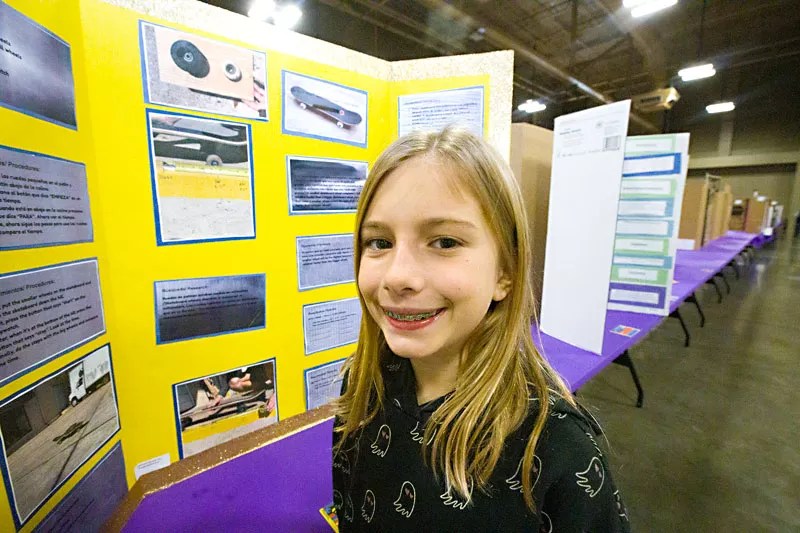
Minnie Fucik, a fourth grader at Becker Elementary and an amateur skateboarder with her dad, focused her project on how the size of wheels on a skateboard affects the distance covered in a certain period of time.
“The bigger wheel on the skateboard was faster than the small one,” Fucik said. “I thought it was going to be the small wheel.”
This article appears in February 28 • 2020.