

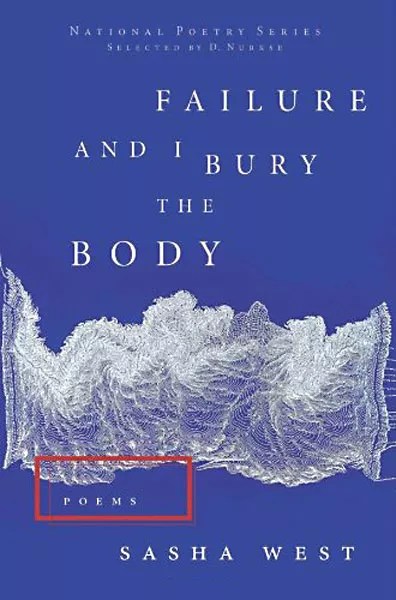
Failure and I Bury the Body
by Sasha WestHarper Perennial, 128pp., $15.99 (paper)
In our success-obsessed culture – Learn from your mistakes! Teach students to succeed! Try, try again! – indulging failure is seen as weakness, wallowing, time ill-spent. But what if we could rest with failure awhile, follow its detours, shoot the shit? What knowledge does failure safe-keep for us?
The debut collection of Austin poet Sasha West, published last year as one of five winners of the 2012 National Poetry Series (West’s book was chosen by D. Nurkse), renders Failure a he, a kind-eyed, morphing character with whom the narrator takes a meandering Southwestern road trip. At first, it’s just the two of them, faded by the desert as are the freight trains, tumbleweeds, and desert motels. But at the end of “We Visit Every Nursing Home From Amarillo to Yuma,” the narrator’s former lover – “the dead idea of him” – appears in the flesh as an extra limb. It starts to stink, so Failure tries to help, sawing off the limb repeatedly before it grows back.
The dead idea blooms into a full-bodied Corpse, a third wheel; burden, comfort, and prop. They stay on the move, the narrator escaping the desert to periodic preoccupation with melting Antarctica, that supreme global failure of neglect. The narrator and Failure are each other’s sidekicks – neither is leading – and the Corpse, in “Nocturne,” is their reluctantly adopted stray:
Failure would crook his knees into mine
and with my knees I’d push the Corpse’s legs
into a bent position – Failure would encircle my waist
and I would throw my arm
around the waist of the Corpse
When they finally abandon the Corpse, it is a solemn, monumental affair. Failure and the narrator are meticulous makers: He carves miniatures out of motel soap and takes an X-Acto knife to their road atlas, and she envisions memorials to the Corpse with fire, snowglobes, the sacrifice of small animals. Entrails and taxidermies, both human and animal, are complicated and opulent. (Failure’s the type who’d be into Victorian hair-wreaths, post-mortem portraits, death masks.)
Throughout the work, birds and rabbits, fragile and wild harbingers of change, pepper the lines with their small, unpredictable bodies. As with the poems, there’s thrill and terror in their volatility. From “Forge With the Stars of Distant Fire”:
At night, we hold a handful of flares out the window, headlights off, to see
the rabbits run alongside us, to watch the sage pass.
This article appears in September 19 • 2014.
