

THREE CHEESY WOMEN: ACTING UP AT THE CABARET
March 8, Later at Live Oak cabaret
All singers act to some degree. It comes with the territory. Most songs are
written from the standpoint of a character, and to communicate the fullness of
the song to an audience, the singer must assume the character’s identity and
act out his or her story. Sometimes you forget how much acting can add to a
song until you see a singer who’s gifted as an actor.
I saw three last week, three singers whose skills in expressing character, in
conveying feeling, in mining joy or sorrow or crazed hysteria from a lyric
reminded me with delight what acting brings to the performance of a song. They
were three of our theatre scene’s leading ladies — Laura Powell, Jacki Roach,
and Cathie Sheridan — who joined forces to create a new forum for their
considerable talents: Three Cheesy Women, a trio performing pop hits and
musical theatre numbers as part of Live Oak Theatre at the State’s flourishing
— and addictive — cabaret, Later at Live Oak.
The trio’s repertoire rarely strayed far from the familiar, with a few numbers
— “Boogie Woogie Bugle Boy,” “Mister Sandman” — feeling almost obligatory for
the female harmonies they contained. But the Cheesy Women never gave any number
anything less than a rousing energy, and often they added a humorous tweak to
the proceedings, as in their rendition of the McGuire Sisters’ hit “Sincerely,”
which they sang in full twang, or the “Marriage Medley,” that began with the
romantic optimism of “Matchmaker, Matchmaker” but segued into more
down-to-earth accounts of the institution, such as a few sardonic numbers from
Sondheim’s Company. What allowed these women to pull off such musical
jollity was their acting; they sold the jokes in telling gestures, in comical
faces, in punched-up words, in pauses, in winks.
None of this is intended to take away from the vocalizing that was done. Each
of these women has a lovely voice, and, individually and collectively, they
inspired thrills purely on the basis of their vocal prowess. But the particular
pleasure they offered that one doesn’t always encounter in a cabaret was the
experience of rich acting pushing a song to higher ground, another level of
joy. Near the end of the show, they spun stories around the miseries of
auditions and sang songs by characters they could’ve played. The medley was a
tart rebuke of myopic directors as well as a hilarious tribute to and send-up
of actors, who, of course, always know what they can play. As far as I’m
concerned, gals, you got the parts. All of `em. — Robert Faires
IT TAKES TWO: NATURE UNSPOILED
Tarrytown Gallery, through March 20
 “Country Road with Distant Lights” by Gamble Whitehead (pastel on paper) |
beauty of nature as the primary component of their pastels. Working together on
each piece, the partners use an expressionistic approach in their depictions of
rivers and rocks, hills, and roads. Light plays a pivotal role in the works, as
in the way patches of sunlight filter through dense foliage onto a shaded,
narrow road, and the play of light bounces off running water.
If you’ve been in the Austin area for long, you’ve seen their subjects:
limestone ledges lining a stream, a shimmery Barton Creek babbling over large,
jagged boulders. The paintings are like windows that look out onto tranquil
rural settings, except not all the works are totally rural. Country Roads,
Distant Lights presents a familiar, bittersweet scene: a country road at
night, bordered with shrubs and trees, a round, rolling hill nestled in the
distance. It would be a pristine environment but for the city lights that
speckle the hill and the glow over the hillside that insinuates more city
lights on the other side. The work is the only one to suggest human presence,
and it does so with the disturbing notion that people are slowly spreading
throughout a primitive area of land.
As a whole, the works are almost eerie in their lack of human occupation.
They convey a quiet stillness that makes you feel like you’re all alone —
except for a few critters eyeing you from the bushes.
— Cari Marshall
VANDALS?: BEYOND SPRAY CANS, BEYOND CRIME
Holy 8 Ball Studios, through March (by appointment)
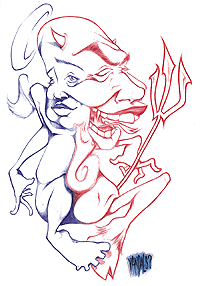 by Saint (pen & ink) |
on their pieces. The canvases (and boards, and metal, and….) had to be
installed in the gallery earlier today, so here the artists are, on ladders to
reach the tops of their massive works, spray-paint cans in hand. They are young
men, most in their teens and early 20s, many of whom are showing in a gallery
for the first time. One artist approaches me. “Are we going to be in the paper
again?” Yes. “Are you from the Austin American-Statesman, too?” No. The
Chronicle. “Oh. Cool.” He nonchalantly returns to his ladder to work,
but his smile tells me he’s enjoying all the attention.
Few galleries in Austin could (or would) show the art featured in
“Vandals?” for a variety of reasons, not the least of which is the sheer size
of the works. Most are done in several floor-to-ceiling panels; in order to be
hung and viewed properly, they require an almost barn-like exhibition space.
Holy 8 Ball fits the bill in that respect. At around 1,800 square feet of open
space, the venue virtually cries out for shows like this one. Gallery owner
Bruce Dye says, “One artist who was supposed to show later this year took a
look at the space and realized it would take a whole year’s worth of his work
to fill the space. He wants me to take out insurance because one big disaster
would wipe out a year’s worth of his life.”
Other local galleries might also shy away from the aura of illegality that
surrounds a show of young graffiti artists. This day before opening, there was
some consternation among the artists in the show about whether one of them
would be able to make it to the opening because he had been arrested the
previous day for vandalism. Curator Jane Madrigal says, “Every single one of my
artists has been arrested for graffiti.” Madrigal has worked with Mexic-Arte as
a visual/performance artist for the past five years. She met some of the
artists while teaching art in South Texas. “When I went down to the Valley, I
was teaching at an alternative school, and the young artists, that’s all they
know how to do is graffiti. And it was just so fabulous, I couldn’t say it
wasn’t art.”
Madrigal is indignant at the thought of people trivializing the work of these
young men. “I do this because these artists — and that’s what they are,
artists — aren’t criminals. That’s just the label that’s been put on them. But
they’re going to jail. If it’s not the graffiti, it’s for other things. We’re
criminalizing our youth, and that’s really sad. They’re putting 100 new beds in
juvenile hall, and some of those boys that would be lying in those beds are my
boys here, and they’re not there because of the stuff I’m doing with them.
What’s up with that? We need to take a good look at ourselves, and what we’re
doing to our children… we should at least try to meet them halfway.”
The work featured on the splendid promotional postcard is not actually in the
show, but other work by the artist, Saint, is. His work is the most
accomplished in the show, and his are the only featured pieces to break out of
the spray paint medium (some of his work is done in airbrush).
The other stand-out is Creep, whose featured piece Toy Killers was
shown last year at Mexic-Arte. His work is the most message-driven in the show,
featuring scrawled messages like “fuk the past” and allusions to classic themes
of good vs. evil.
Perhaps the success of last year’s film Basquiat (as well as the late
artist’s legacy) will spur members of the art-loving public to venture into the
world of graffiti art. But don’t accuse the artists in the “Vandals?” show of
being derivative. Madrigal says, “I took my boys to see Basquiat’s exhibition,
and they weren’t impressed at all. Everybody talks about his stuff being
graffiti, and it is graffiti, but my boys are so evolved beyond that. Their
stuff is not scribbles.” — Leah Welborn
This article appears in March 14 • 1997 and March 14 • 1997 (Cover).