

MAMMALIA: ANIMAL MAGNETISM
Martin Brothers Cafe, through March
 “Storm’s a Coming” by Sarah Higdon �1996 |
influences, you can pretty much count on finding some playful animal
iconography in her work. But while Sarah Higdon does give animals human
qualities in her acrylic paintings, her settings tend to be a little more tense
than the Cat in the Hat sort.
Higdon’s animals are immersed in a wash of bright, vibrant colors, but their
expressions generally aren’t too playful. Some appear churlish, as in My
Life With the Big Top, which depicts two dogs in clown garb, drinking
cocktails with a rabbit wearing pasties. The three characters — with
expressions ranging from bored to angry — stand upright in a field of grass
under a cresent moon. The scenario makes one wonder: Is this what animals do
when humans aren’t around? You can almost hear them, as they drink their
martinis, grumble and complain about how their owners treat them.
Three Purses portrays three bespectacled grandma bunnies, clutching
their handbags and looking as though their grandchildren had just arrived for
lunch with three new body piercings. Peering over their eyeglasses, the chubby
rabbits look as ornery as any grandma with an ax to grind.
Higdon claims her work is “about the times one feels out of place, yet handled
with wit and satire as opposed to coming off melancholy and serious.” Though
wit and sarcasm are evident, the works convey an equal sense of brooding
melancholy, befitting work influenced by Alice In Wonderland.
Kudos to Martin Brothers for the excellent halogen lighting; it does the
paintings justice. — Cari Marshall
HUMOR IN TOULOUSE-LAUTREC: PORTRAIT OF THE ARTIST AS A
SELF-DEPRECATING WIT
February 28, Harry Ransom Center
The recent lecture on “Humor in Henri de Toulouse-Lautrec” drew the Frenchiest
crowd I’ve seen in town. The fourth-floor auditorium of the Harry Ransom
Humanities Research Center (HRHRC) overflowed with scarf-tied necks,
cheek-kissing greetings, and conversation that ranged from rapid-fire, native
French (I caught something about a discotheque, I think) to French-accented
English (discussing the use of gaslights in French art). While encountering
such a heavy concentration of French people in an auditorium in the heart of
Texas was a bit disorienting, it would be hard to imagine a crowd more
appropriate to the occasion.
The talk, co-sponsored by the Alliance Fran�aise and the UT Department
of French and Italian, was given by an American, Julia Frey. A connoisseur of
the colorful French artist, Frey has recently published a book titled
Toulouse-Lautrec, a Life, much of which she researched at UT. The HRHRC
houses about 1,000 pages of Lautrec family letters and serves as one of the top
three sources of information about the artist in the world.
Using slides of the artist’s work and photographs that he produced with
friends, Frey helped convey Lautrec’s humor. The first slide was a photo
designed by the artist and taken by Maurice Guibert — a trick photo depicting
Lautrec as an artist, sitting at a canvas, painting Lautrec as a model, posed
on a stool. The image is an excellent example of Lautrec’s tongue-in-cheek
attitude, one that appears time and again in his depictions of the sizzling
Moulin Rouge burlesque scene. Through the slides, Frey illuminated many of the
hidden jokes and, often, insults in Lautrec’s paintings, a number of which were
at the expense of the artist himself; Lautrec often pictured himself as either
a grotesque — greatly exaggerating his less-than-attractive features — or an
animal being subjected to apathy or cruelty.
Overall, Frey’s lecture was intriguing and witty, a refreshing consideration
of the lighter moments in the life of a terribly disturbed artist, one haunted
as much by his wealthy, domineering family as by his dwarfism.
The Lautrec family letters are available for viewing by the public in the
HRC’s manuscript collection, though, of course, you must be proficient at
reading faded, 19th-century French writing to get the gist of them. Or you
could pick up Frey’s 600-page book.
— Cari Marshall
SHERLOCK HOLMES: A HOOT… NO, REALLY
The Public Domain, through April 5
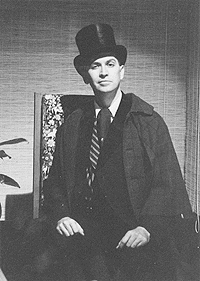 Robert Faires as Sherlock Holmes |
I find myself in the unenviable position of choosing to review a show
that you, my editor, are in, for a company that the Chronicle‘s other
theatre reviewer, Robi, is the artistic director of. Never one to balk in the
face of a situation that could get my heinie in a lot of hot water, I press on.
This somewhat recast Sherlock at The Public Domain really does
improve on the show’s first mounting by PD a few years ago. Bernadette Nason
fits the role of the devious con artist Madge Larabee much better than she did
the role of Alice Faulkner, the blushing damsel-in-distress, a part filled in
this production by Leigh N. Yeager, who delves for as much character
development as this underwritten part will allow. Michael Stuart returns as
Moriarty and is as delightfully eerie as ever. The rest of the cast is
well-rounded and includes stand-out performances by Michael Miller, Marco
Noyola, and David R. Jarrott.
This set at PD’s “new” space works much better than the one in the mounting of
this script at Synergy Studio. The scene design by Michael Arthur and Robi
Polgar and costume design by Sylvia Tate give us a much better sense that the
drama is just one of Holmes’ seven-percent dreams, a fantasy in which he gets
to fall in love, fight a worthy adversary, solve the crime, put the bad guys in
jail, and get some relief from the terrific boredom he faces by being so darn
smart. However, it did feel at times that the manipulations of the set which
the cast had to make hung up the pace of the show.
I guess my largest qualm with this production, though, is the motivation
behind it. Why bother remounting this show? Granted, this version far exceeds
the previous one, but why do the show again with essentially the same concept,
some of the same actors, and the same director? Is there some screaming void
which this show fills?
Regardless, it’s still a hoot.
P.S.: Re: the Holmes-man himself: All I can say is, I thought your performance
really worked. In this mounting, I think that you instill Holmes with a
deliberateness and humor that was missing in the first and really tap into the
idea that he is the true mastermind behind this mystery. Unfortunately, there
is no real good way to say this without having it look like I am sucking up to
the boss-man. C’est la vie.
— Adrienne Martini
Through Apr 5, Thu-Sat, 8pm, Mar 16, Sun, 2pm, at The Public Domain,
807 Congress. Tickets: $5 Thu; $12 Fri/Sat ($10 seniors, students, ACoT).
474-6202.
This article appears in March 7 • 1997 and March 7 • 1997 (Cover).