

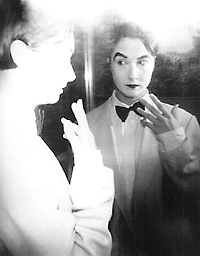
 Lisa D’Amour as Oscar Snowden photograph by Bret Brookshire |
must be a bar-
room of people in Austin — aged late 20s, sensibilities vaguely
artistes, with plenty of time to think — who have seen the sign and
felt the spark. It’s that big sign along Congress Avenue, the one for the
appliance store, Oscar Snowden’s Appliances, with the man in the baggy suit
leaning against a giant O. His O. You can imagine a whole world inside that O
— an oviparous universe where nothing is impossible. The difference between
the rest of us dreamers and Lisa D’Amour is that she didn’t just share the
fantasy over bong hits and Shiner Bock. She wrote a play about Oscar and his O,
and brought them both to life herself, in a one-woman show last fall at Hyde
Park Theatre.
Before each performance proper, D’Amour carried her dressing room onstage and
talked with the audience. Free-associating, making small talk, explaining for
the uninitiated who “the Big O” was in real life and how the Oscar
Snowden in her piece is a creature of her imagination, she refashioned her
slender good looks into a white-faced androgyne. Her eyebrows are thick black
arches with a tingling menace at their point. Her bowtie is one cock past
kilter. When “Oscar” speaks, the audience is pulled into the world of the O,
guided by a soliloquizing player who talks like his creator meant him to, like
“Dr. Seuss on acid.” Aaron Tucker, who helped D’Amour on another show and has
worked as a professional circus clown, found her performance especially
righteous. “She was using clown tools instead of trying to be a clown,” Tucker
says. “Some of the best moments were the silent points, where she found some
specific meaning in her gestures. You know what she’s saying even when she’s
not talking.”
Becoming “Oscar Snowden” jumpstarted the performer within D’Amour. She has
always done some acting, but for the last few years she has been
building a narrowly circulated though solid reputation as a dramatist, first
with The Shape of Air, produced by the UT Department of Theatre &
Dance, and then with My California, which D’Amour produced herself for
FronteraFest ’96. In My California, she used interlocking monologues to
traverse three generations in a family of troubled (and troublemaking)
women. The Shape of Air was more ambitious, with a cast approaching 20,
including dancers, oracles, disembodied voices and terrific visions. This
feminist bildungsroman came off like a good old-fashioned thriller,
complete with a duel for a young runaway’s soul. Besides using six or eight
subplots, D’Amour immersed herself in the Noh theatre of Japan, lifting the
main storyline and stylistics from
a traditional Noh drama, and engaging a
translator to help put parts of her own dialogue into Japanese. All these
elements together made for a frenzy when Tucker started making masks for the
play. “There was a sort of magical element in some characters that others
didn’t have…,” Tucker says. “Some characters needed to transform, to be
magical at one point and then be normal at another.”
It’s almost too much to take in, but that’s part of the point. Hers is not a
kitchen-sink type of drama, it’s a build the house around your ears type. And
instead of taking a break after Oscar Snowden, D’Amour took herself to New
Orleans for a collaborative retreat with other play-world people (including
Megan Monaghan from Austin), and to Seattle’s Annex Theatre, where she
performed Whore (d’oeuvres) Dilemma with theatre artist Wesley Middleton
(their third collaboration) and rendezvoused with Frontera company member
Daniel Alexander Jones, who was also appearing at the festival there. At least
one onlooker was smitten, dubbing D’Amour “the Lucille Ball of the
avant-garde.”
Now Ms. D’Amour is returning to Austin for Frontera@Hyde Park Theatre’s 1997
FronteraFest. “I’m trying to think,” she says, stalling when I ask about her
entry, “I don’t know how much I want to reveal.” She decides to give up two
things: 1) the title, Dream of a West Texas Marsupial Girl — “It’s in
the great tradition of Texas kangaroo plays,” she deadpans. “I wanted to
explore the genre in a new way.” — and 2) a list of the play’s high points:
“Thievery, beef jerky, and giant leaps of faith…. That’s all I want to say.”
Suspicious minds needn’t fret. This woman’s theatre waxes experimental without
becoming distant or overly fond of its specialness. Her ambitions are practical
even if they’re unabashedly grand: “Creating a world for a play in which
anything can happen… [to tell] a literal story, with a beginning and an end,
but a story that happens in different ways because of the world.” That’s why
her avant tendencies glide so smoothly through the performance. She’s
telling recognizable stories about love, and children, and following your
bliss; these themes fall out, however, amidst prophetic birds and Japanese
oracles, bouncing from a courtroom to a haunted wood, or lounging on the inner
landscape of a vowel. Communicating isn’t so much about what you say and how
you say it; where you say it can make all the difference.
Talking about the where of a play, D’Amour isn’t just splashing through the
abstractions of writer-talk. She means the setting, and whether it’s literal or
dreamed, she looks to know the interior and, by knowing, to call the shots.
Hers is a dazzling blend of pragmatics and imagination. She tells me over a cup
of coffee, with a perfectly straight face, how she was attracted to the Oscar
Snowden sign by “the shape’s giant bounds,” but she doesn’t care if the words
are obscured by the second installment of her two-muffin lunch. The setting for
her next play is not only realistic, it’s real: She’s collaborating on a
performance to be staged beneath a suspension bridge in Portland, Oregon. The
story concerns the St. Johns area in southern Portland, a thriving bedroom
community in the 1920s crowded with wool factories, shipyards, and warehouse
operations. The Great Depression would end St. Johns’ dream of boomtown fame,
but D’Amour sets her play just before the bust, at the opening of a magnificent
bridge in 1931. A young girl discovers a group of vaudeville street performers
whose seemingly harmless antics are intertwined with city politics and the fate
of thousands. Yes, it sounds as much like a David Copperfield show as theatre,
and if you know that’s a compliment, you’re in the club.
Vicky Boone, artistic director for Frontera@Hyde Park Theatre, who has worked on several shows with D’Amour, describes the playwright’s
style as “relaxed but risky… Lisa isn’t afraid to get an enormous crush on
something, some subject or idea. She manages a kind of total absorption into
what she’s doing.” D’Amour shares a concentration on emotion and event that
Boone sees happening across the nation. These people want to make “unique
theatrical works and put them in untraditional venues,” and believe that
“theatre can be cheap and brilliant, all at once.” For a good example, Oscar
Snowden and the Magic O debuted in D’Amour’s garage, with her roommates and
a circle of friends looking on, then appeared in the Late Night Jams at last
year’s FronteraFest, before its fulfillment during a week-long, after-hours run
at the theatre in November. The man with the O has now been seen at the Annex
in Seattle and may soon show up at a bar in New Orleans, or perhaps at Austin’s
First Tuesday Downtown celebrations when they pick up in the spring.
While all this is taking shape, the unflagging, unflappable D’Amour will be
busy dramaturging John Walch’s Craving Gravy, opening in March at the UT
Department of Theatre & Dance, and getting a new script of her own filed at
the University’s graduate playwriting program, where she’s in her third and
final year. She’ll also find time to worry about what she isn’t doing. “I
thought I’d be a natural to write a children’s play,” D’Amour says, “but
I tried it, and it didn’t work.” Last year, she sweated over a Twelfth-Night
drama called Carnival Queen, aimed at younger audiences, but found her
characters either sententiously pushing a message about race or veering off
into pure fantasy. She sighs, says she drew a blank, and wonders if her
“childlike lens” on the world is really meant for children.
Whatever the lens shows, it will, D’Amour figures, show up as a play. “Because
of this certain kind of `poetical’ quality to my shows, people tell me I should
write poetry. But oh, the idea of trying to write a poem with a capital
P is just daunting.” As for prose, “it scares me. I haven’t even tried
it; it’d probably be all dialog.”
Judging by her expatiations, D’Amour’s fears, like her ambitions, are bound
up with writing. She offers very little about her upper middle-class upbringing
outside New Orleans, but she describes with relish a happening at the
turn-of-the-century house her family owns in Covington, Louisiana. The house
was built by a former governor in 1904, but its oak floors and bay windows have
most recently served as the scene for an artists’ retreat. For three days, the
Boguefalaya River played host to theatre people talking about the possibilities
for doing small-budget, large-minded shows in New Orleans and the Gulf Coast
region. The weekend climaxed with an event rarely seen on the muddy banks of
Louisiana bayous: a Sunday morning yoga session on the lawn, with a group
member “hovering around whispering strange nothings in our ears.”
D’Amour wants to make plays which approach the ecstasy that sneaks up on
people, to create those strange nothings in her audience’s ears. For a model,
she recounts the New Year’s Eve she just spent in New Orleans. She was at the
Caf� Brazil on Esplanade Street, taking in the Cool Bone Brass Band and
a white-boy funk group called Galactic. Midnight came and went with the
appropriate toasts and hugs, but about 10 minutes after 12 the electricity went
out on the entire block. After a stunned recoil and mass shuffling in the dark,
Galactic’s brass section and drummer started playing again. Before long, a
trumpet cried out from the rear of the crowd. It was a member of Cool Bone, who
led his cohorts to join Galactic into several hours of acoustic jamming in the
dark. Lighters and candles provided sporadic mood lighting, and the place
erupted into a bacchanal. People ended up in various stages of undress.
Strangers shared drinks, sprayed champagne onto one another, and invented
dances that incorporated fanning actions and blowing air at each other to make
up for the defunct air conditioning system. “I’ve talked to a couple of people
since then,” D’Amour says, “about how I’d like to catch that, that abandonment,
that release that happens. There’s a kind of transport that can engulf you,
something that I don’t often get in the theatre…. But that’s it. That’s the
thing.” n
Dream of a West Texas Marsupial Girl will be performed Thursday,
February 13, as part of FronteraFest ’97 at Hyde Park Theatre. Lisa D’Amour
will also host several Late Night Jams, Saturdays, 11pm, during the
festival.
Brett Holloway-Reeves is a freelance writer living in Austin.
This article appears in February 7 • 1997 and February 7 • 1997 (Cover).