

I write to you about The Life with tear tracks on my cheeks. Not even old ones, because every time I look back at one of the pieces that make up Carrie Fountain’s third collection of poetry, the whole process starts anew: eyes welling up, looking toward the ceiling to attempt composure, reaching, defeated, for the Kleenex.
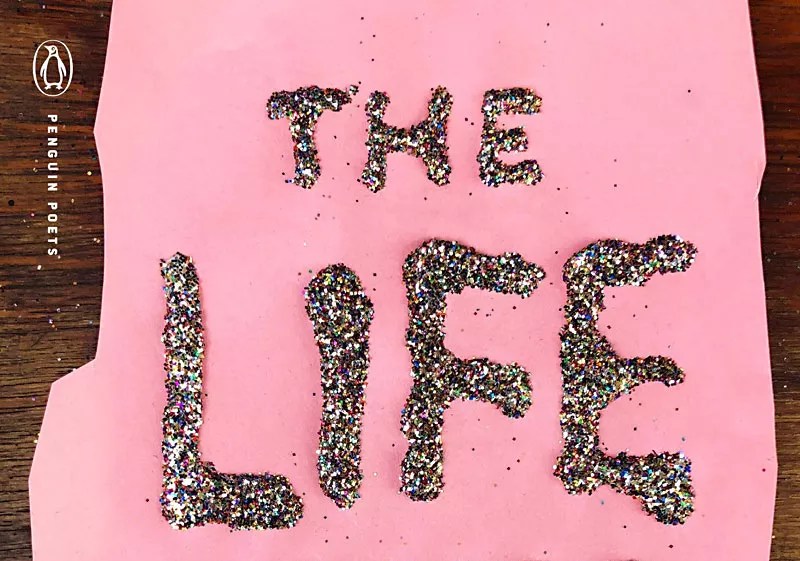
With a pink construction paper cover and the title and author name written in charmingly gloopy glitter (a heart-twisting nod to the foregone Valentine’s Day card glitter in one of the book’s many stunners, “Will You?”), The Life may not seem like an obvious weeper. But from the very first poem, “The End,” which chronicles both the hanging of ornaments on a miniature tree and the moment of Christ’s birth, Fountain is skillfully tying minute, personal experiences to our biggest quandaries about human nature to devastating effect. Of Mary and Jesus at the first Christmas, she writes, “They will meet for the first time. / She’ll have those breasts until the end / of her life. He’ll have that mouth until / the end of his.”
The profundity of what changes and what doesn’t runs deep in the collection. Transformations of oranges and backyard smells and the house next door creep up on you in “How Has Motherhood Changed the Way You Write?” and the way a child suddenly comes into being and then, on top of that, becomes their own person (!!) and the way a grandmother can slip away to somewhere else in death astounds in “The Parable of the Gifts.” How one’s life can change shape entirely (“Once, my life was neat. / It was a handkerchief, folded, / slipped into a back pocket. / No one had to know / it was even there. Now, / it’s opened.”) seems both simple and unfathomable in “The Answer.”
There is also a great and terrible longing snaking through so many poems: for goodness and the possibility of being remade in love in “Cold” (perhaps my favorite in the collection), for the ability to tell the truth about a dead pet fish to one’s son and daughter in “Summertime,” for “everything…/…a clean heart/…for the children to sleep and the drought to end” in “First,” and for an answer to the question “What is this life for, anyway?” in “The Question of Your Youth.” Our time on Earth is limited, and, as she plays with form and point of view, with fable and faith and autobiography, Fountain grapples again and again with how much in life seems tantalizingly possible and how much achingly out of reach.
It’s been a year with so many catastrophes and cruelties worthy of public mourning that I have felt foolish crying over the small things, the intricate yearnings and disappointments of day-to-day life. But I’m very grateful to Fountain for finally bursting the stormcloud hovering above me. It’s a long-awaited rain.
The Life
by Carrie FountainPenguin Books, 112 pp., $18
At Last, the Rain
A version of this article appeared in print on May 7, 2021 with the headline: At Last, the Rain
This article appears in May 7 • 2021.