

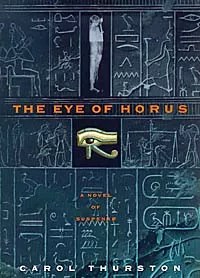
The Eye of Horus: A Novel of Suspense
by Carol ThurstonMorrow, 384 pp., $24
Arguably the most interesting facet of Carol Thurston’s The Eye of Horus is the history it’s based on. In 1975, the Egyptology powers that be X-rayed the mummy of Tashat, the wife of a Theban noble. Inside her sarcophagus, wedged between her legs, was a man’s skull. At first, scientists chalked it up to an embalmer’s mistake. Further investigation proved that the skull was put there intentionally, carefully wrapped with Tashat’s remains, which also indicated that she had suffered some sort of physical violence at or just before the time of her death. Oh, and the man’s skull had been bashed in.
Like I said, it’s a great piece of history. And it’s the fiction writer’s dream — a gripping, true-to-life tale set in a distant, exotic land that that still has plenty of plot boxes to color in. It’s time travel without having to build the dang machine. H.G. Wells must be kicking himself for not having thought of it first; of course, he was dead by the time Tashat and the body-less head were found.
Wells, though, might come back from the grave just to give Thurston a boot to the seat of the pants for treating her subjects with too much reverence and not enough critical thought. Thurston, in one of her plotlines, assembles a version of how Tashat and the skull met their respective ends, which involves political intrigue, Nefertiti and Tutankhamen, a doctor, and a brilliant little girl. That brilliant little girl would have benefited from a closer examination. Thurston treats her like a goddess, displaying only her wonderful qualities, turning her into an Egyptian Superwoman, able to save her society in one single bound.
The second plotline suffers from almost the same problem, except this superwoman — Kate, a medical illustrator charged with visually reconstructing Tashat’s mummy from X-rays and MRIs — isn’t aware just how super she is and requires the support of a male radiologist to realize her full potential. Thurston plays these two plotlines off of each other; as Kate discovers a bit of information about the mummy, we’re given a glimpse of why it may have happened. This discovery process is suspenseful — not nail-biting stuff but certainly interesting — but it’s a problem when the forensic process sustains more suspense than the lives of two main characters. It’s almost as if Thurston is viewing her creations through a sheet of glass, as if they were already on display rather than human, three-dimensional characters. All in all, Horus isn’t a bad book, but it assumes too much and never realizes the vibrancy of the people on which it is based.
Carol Thurston will be at Barnes & Noble Homestead (14101 N. Hwy. 183) on Wednesday, August 23, at 7:30pm.
This article appears in August 18 • 2000.